Prelims: Current events of national and international importance | International Relations
Why in News?
As India prepared to host the Foreign Ministers of the US, Japan, and Australia — the members of the Quad grouping — Pakistan and China simultaneously issued a joint statement of their own.
What is the China–Pakistan Economic Corridor (CPEC)?
- It is a flagship project under China’s Belt and Road Initiative (BRI), designed to enhance connectivity and economic integration between China and Pakistan.
- Launched in – 2015.
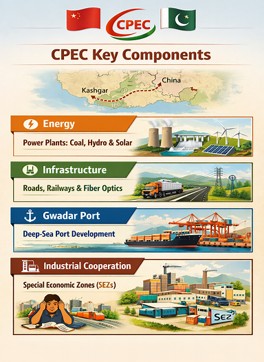
- Strategic Route - The corridor stretches from Kashgar in China’s Xinjiang province to Gwadar Port in Pakistan, forming a 3,000‑kilometer network of highways, railways, and pipelines.
- Investment Scale - Estimated at over $60 billion, covering energy, transport, and industrial zones.
- Core Objective - To boost trade and logistics efficiency, reduce transit time, and open western China to global markets.
- Key Components -
What are the recent talks between China and Pakistan on CPEC?
- Expansion of Strategic Infrastructure - The recent joint statement reaffirmed plans to upgrade the Gwadar Port and modernize the Karakoram Highway.
- These developments aim to strengthen regional trade connectivity, improve logistics efficiency, and enhance Pakistan’s role as a gateway for commerce between South Asia, Central Asia, and the Middle East.
- Strategic Maritime Diversification - One of China’s underlying strategic objectives is to reduce dependence on the Strait of Malacca, a critical maritime chokepoint in Southeast Asia.
- By leveraging the CPEC route, China can receive energy imports from West Asia through Gwadar, offering a shorter and more secure alternative to traditional sea routes.
- Contingency Against Maritime Disruptions - The corridor also provides a strategic fallback option in the event of a blockade or disruption in the Strait of Hormuz, ensuring continuity of energy supplies and trade flows.
- This diversification enhances China’s energy security and geoeconomic resilience.
- Opening to International Participation - For the first time, the joint statement invited third-party nations and investors to participate in CPEC’s development.
- This move signals a shift toward multilateral engagement, potentially attracting global investment and expanding the corridor’s economic footprint beyond bilateral cooperation.
Why CPEC matters to India?
- Sovereignty Concerns and India’s Opposition - India’s foremost objection to the China–Pakistan Economic Corridor (CPEC) lies in its passage through Pakistan-occupied Kashmir (PoK), which India considers an illegal occupation.
- From the outset, India has officially opposed CPEC on sovereignty grounds, emphasizing that projects such as the Karakoram Highway directly violate its territorial integrity.
- Diplomatic Pushback - The recent diplomatic exchanges between India, China, and Pakistan serve as a signal of India’s willingness to assert its position more strongly.
- India’s stance highlights its determination to counter Chinese and Pakistani narratives and prevent legitimization of Pakistan’s control over PoK.
- Risks of International Involvement - The inclusion of third-party investors or international entities in CPEC projects could strengthen Pakistan’s grip over PoK, further complicating the sovereignty dispute.
- India views this as a direct challenge to its territorial claims, raising the stakes in regional geopolitics.
- Gwadar Port and the String of Pearls - The revamp of Gwadar Port is seen as part of China’s broader “String of Pearls” strategy — a network of ports and military facilities across the Indian Ocean.
- This chain stretches from Djibouti on the Horn of Africa, through Gwadar (Pakistan), Hambantota and Colombo (Sri Lanka), Chittagong (Bangladesh), Sittwe (Myanmar), and up to the Ream Naval Base (Cambodia).
- The objective is to establish a dominant Chinese presence in the Indian Ocean and surrounding waters.
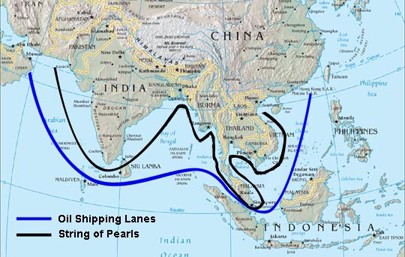
- Strategic and Naval Implications - Gwadar Port poses a potential naval threat to India.
- While currently servicing Chinese merchant vessels, it could easily be adapted for naval operations in the future.
- Its proximity just 400 km from the Strait of Hormuz, a critical artery for India’s energy imports makes it strategically significant.
- Any militarization of Gwadar would directly impact India’s energy security and maritime dominance.
What is the response of India?
- Chabahar Port: India’s Strategic Anchor - India’s most direct counter to CPEC has been its investment in the Chabahar Port in Iran, located just 72 km from Gwadar.
- This port provides India with a strategic foothold in the Arabian Sea and direct access to Afghanistan and Central Asia, bypassing Pakistan entirely.
- India’s involvement began in 2002, but gained momentum with the BRI’s expansion.
- In 2015, India signed an MoU to develop the Shahid Beheshti Port at Chabahar.
- It acts as a reliable access route into Afghanistan and Central Asia leveraging India’s earlier investment in the Zaranj–Delaram Road.
- Expanding Presence in Oman: Duqm Port - Further north in the Arabian Sea, India secured military and logistical access to Duqm Port in Oman in 2018, renewing it in 2021.
- This places Indian naval assets directly opposite Gwadar, strengthening India’s maritime posture.
- Analysts note this as part of India’s broader effort to deepen its presence in the Indian Ocean and counter China’s influence.
- Countering China in Sri Lanka - China’s presence in Sri Lanka through the Hambantota Port, leased to a Chinese company for 99 years in 2017, raised concerns for India.
- In 2025, India and Sri Lanka signed a 5-year defence cooperation MoU, ensuring Sri Lanka’s territory would not be used against India’s security interests.
- India also acquired a 51% stake in Colombo Dockyard via Mazagon Dock Shipbuilders, reinforcing its maritime industry footprint.
- Great Nicobar Island Project - India has advanced plans for the Great Nicobar Island project, aimed at boosting strategic infrastructure in the eastern Indian Ocean.
- Quad and Indo-Pacific Maritime Strategy - At the recent Quad meeting in New Delhi, the Indo-Pacific Maritime Surveillance Collaboration (IPMSC) was launched to enhance monitoring in the Indian Ocean region.
- While China has criticized the Quad and the grouping has faced challenges due to divergent member aims, the initiative reflects a collective effort to counter aggressive Chinese posturing.
Is the China–Pakistan Economic Corridor (CPEC) ethically sustainable?
From an ethical lens, CPEC highlights the tension between economic development and sovereignty, investment and exploitation, and cooperation and domination.
- For India, the ethical issue is sovereignty.
- For Pakistan, it is debt sustainability and equitable growth.
- For China, it is the responsibility to ensure that its Belt and Road projects do not replicate patterns of colonial-style dependency.
What is the way forward?
- Requires balancing economic connectivity with respect for territorial sovereignty and debt sustainability.
- Regional stability depends on transparent, multilateral cooperation that avoids zero-sum geopolitical rivalries.
- Ultimately, long-term success hinges on ensuring infrastructure projects empower local economies rather than creating strategic dependencies.
Reference
The Indian Express | China-Pakistan Economic Corridor (CPEC)



