What is the issue?
Safety and sustainability continue to pose impediments in the growth envisaged in Lithium Ion Batteries (LIBs) usage.
What are Lithium ion batteries?
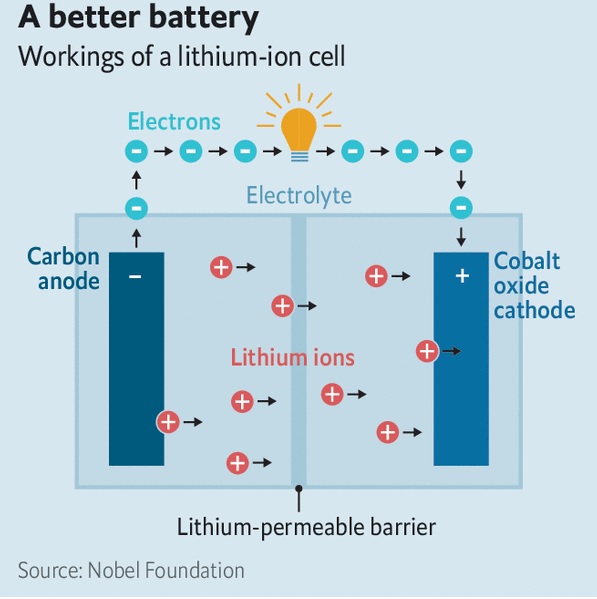
- Every Li-ion battery consists of three active components - anode, cathode and electrolyte.
- The anode and cathode is where the lithium is stored while the electrolyte carries positively charged Li-ions from the anode to the cathode and vice versa through the separator.
- The movement of the Li-ions creates free electrons in the anode, which creates a charge at the positive current collector.
- Features
- Small size
- Light weight
- High energy density
- Ability to recharge
- Longer lifespan compared to a lead acid battery
- More efficiency
- Greater driving range
- Affordable
What are the impediments in the growth of Li-ion batteries?
By 2025, the global demand for LIBs is likely to cross about $100 billion with the automobile sector leading as the fastest growing consumer.
- Fires- In India, reports of fatality and material loss due to fire from LIBs are on the rise.
- Sustainability- There are concerns around sustainability and lifecycle management of LIBs.
How to overcome the challenges?
- Safety - Both range and fast charging aspects require thorough understanding from the metal chemistries to the overall LIB system level.
- The quality of raw materials and components must be ensured for high fidelity manufacturing practices.
- Electric vehicle designs need highly efficient thermal management systems and fault-detection mechanisms to avoid thermal runaways.
- EVs need an accelerated go-to-market approach to cater to the sustainability goals driven by organisations and nations across the world.
- Environmental sustainability- As the long-term sustainability of depending on primary mineral sources (mines) is in question, recycling is key.
- Most recycling processes practise partial recovery wherein only high-margin metals are recovered from waste and the rest is discarded.
- The current recycling rate is around 5-9%.
- The Battery Waste Management Rules 2022 was notified by the government to accelerate the development of infrastructure for waste collection and improve recycling rates.
- The Extended Producer Responsibility increases the accountability battery manufacturers need to assume towards collection, refurbishment/recycle of batteries.
- The need of the hour is to accelerate the development of circular economy solutions that recycle all the metals and facilitate a cradle-to-cradle (infinite loop) approach.
- A strong collaboration among technologists, policy-makers and governments is required to help manage the EV revolution.
References
- The Hindu Businessline│ Many challenges of lithium ion batteries
- PIB│Government notifies Battery Waste Management Rules, 2022
Quick facts
Battery Waste Management Rules, 2022
- Ministry of Environment, Forest and Climate Change published the Battery Waste Management Rules to ensure environmentally sound management of waste batteries.
- The new rules will replace Batteries (Management and Handling) Rules, 2001.
- Coverage - The rules cover all types of batteries, viz. Electric Vehicle batteries, portable batteries, automotive batteries and industrial batteries.
- EPR - The rules function based on Extended Producer Responsibility (EPR) which mandates the producers (including importers) of batteries to collect and recycle/refurbish waste batteries.
- Online portal - The rules will enable setting up a centralized online portal for exchange of EPR certificates between producers and recyclers/refurbishers to fulfil the obligations of producers.
- Recovery - It mandates minimum percentage of recovery of materials from waste batteries.
- It also prescribes the use of certain amount of recycled materials in making of new batteries.
- Polluter Pays Principle - Environmental compensation will be imposed for non-fulfilment of EPR targets and obligations set out in the rules.



