Mains: GSII – International relations
Why in News?
The Quad leaders are expected to meet in Manila in November 2026 alongside the ASEAN Summit, marking their first summit-level meeting since Trump's second term began.
What is the Quad?
- Quad (Quadrilateral Security Dialogue) – An informal strategic grouping comprising India, the United States, Japan and Australia.
- Origin – Initially formed in 2007 and revived in 2017 to strengthen cooperation in the Indo-Pacific.
- Objective – Promote a free, open, inclusive and rules-based Indo-Pacific.
- Nature – It is not a formal military alliance and has no permanent secretariat or binding treaty obligations.
- Cooperation Areas – Maritime security, defence cooperation, critical technologies, resilient supply chains, infrastructure, health and disaster management.
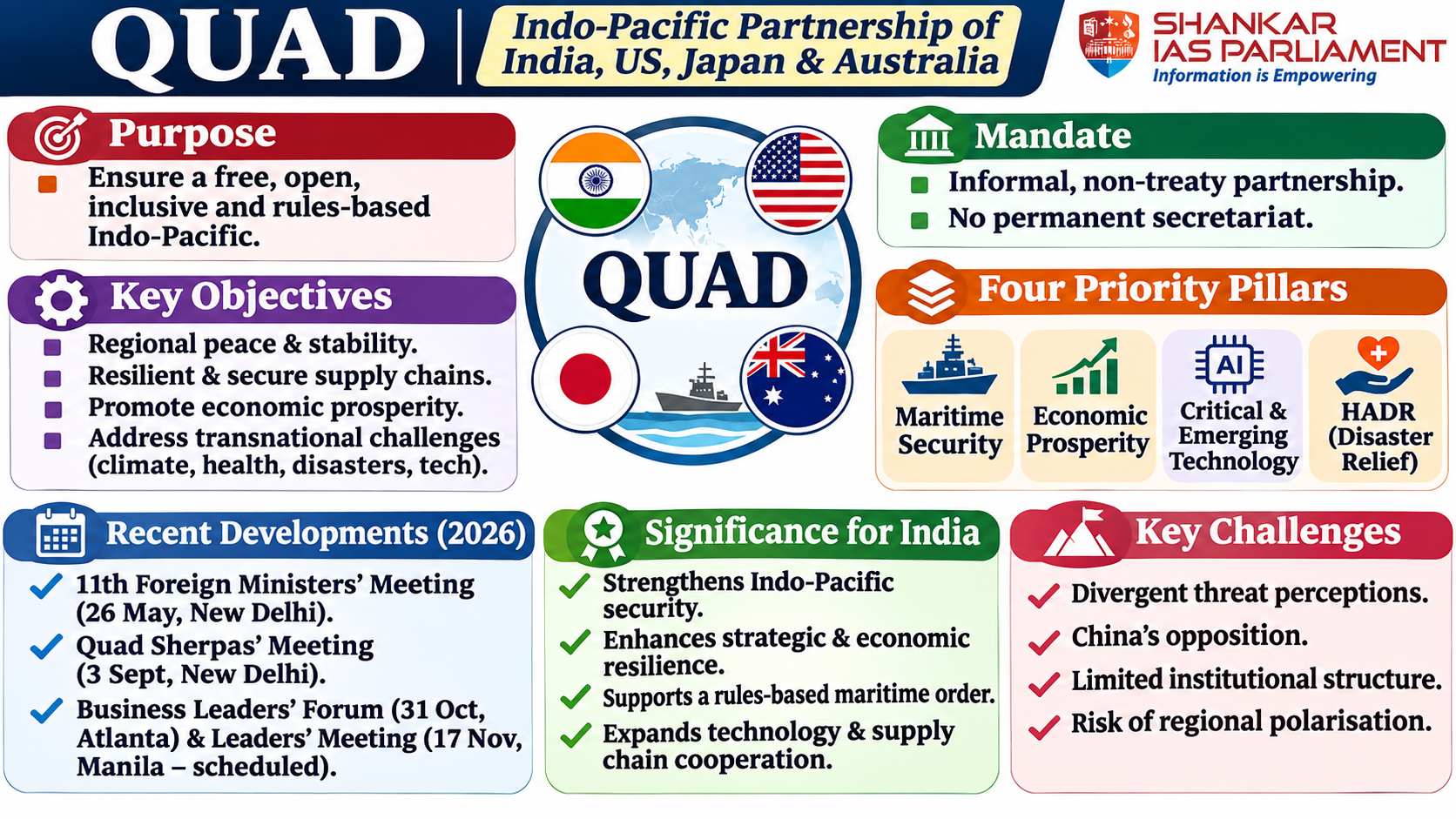
- Recent Developments
- Previous Summit – Held in Wilmington, U.S., in 2024.
- Foreign Ministers' Meetings – Members held two meetings in 2025 and three in 2026, despite political differences.
- Maritime Cooperation – The Indo-Pacific Maritime Domain Awareness initiative was elevated to the Indo-Pacific Maritime Surveillance Collaboration framework in May 2026.
- Proposed Manila Summit – The Philippines is expected to host the next leaders' meeting alongside the ASEAN Summit, reinforcing ASEAN centrality.
- JAI Cooperation – India, Japan and Australia held a Defence Ministers' meeting in Cebu, demonstrating continued trilateral cooperation.
What are the Major Challenges Confronting the Quad?
- Uncertainty over U.S. Commitment – Trump's focus on Russia–Ukraine, NATO and West Asia creates uncertainty over U.S. Indo-Pacific engagement.
- Burden-sharing and Strategic Differences – U.S. demands for greater defence burden-sharing and its review of AUKUS raise concerns among regional partners.
- Growing Chinese Assertiveness – China's expanding maritime presence and tensions in the South China Sea and Taiwan Strait threaten regional stability.
- Institutional Weakness – Absence of a permanent secretariat and binding framework makes the Quad dependent on political commitment.
- Divergent Strategic Priorities – Differences in threat perceptions and India's strategic autonomy create challenges to collective strategic alignment.
What are the Strategic Responses by Indo-Pacific Countries?
- Japan – Strengthening security partnerships through the OCEAN framework.
- Australia – Expanding defence ties with India, Japan and Pacific countries.
- India – Following strategic autonomy and multi-alignment while diversifying defence partnerships.
- JAI Cooperation – India, Japan and Australia deepening trilateral defence cooperation.
- France – Expanding strategic engagement with Indo-Pacific countries.
What is the Strategic Significance of the Proposed Manila Summit?
- ASEAN Centrality – Holding the summit alongside the ASEAN Summit reinforces ASEAN's central role in the Indo-Pacific security architecture.
- China's Assertiveness – The Philippines' maritime disputes with China provide strategic significance to the summit's location.
- Rules-Based Order – Quad leaders are expected to reiterate respect for sovereignty and international law in the South and East China Seas.
- U.S. Strategic Reassurance – The summit provides an opportunity for Washington to reaffirm its Indo-Pacific commitments.
- Regional Stability – Strengthening coordination among Quad members can contribute to a balanced regional security environment.
What is the Way Forward?
- Sustained Political Engagement – Institutionalise regular leaders' and foreign ministers' meetings to maintain strategic continuity.
- Strengthen Maritime Cooperation – Expand maritime domain awareness, intelligence-sharing and coordinated responses to maritime threats.
- Respect Strategic Autonomy – Recognise differences in national interests and avoid imposing alliance-like obligations on members.
- Deepen Economic Cooperation – Expand cooperation in resilient supply chains, critical minerals, semiconductors and emerging technologies.
- Strengthen ASEAN Centrality – Ensure that Quad initiatives complement ASEAN-led regional mechanisms.
- Promote Regional Public Goods – Enhance cooperation in disaster management, infrastructure, healthcare, climate resilience and connectivity.
What lies ahead?
- The Quad's future depends on its ability to maintain strategic coordination despite changing political priorities and divergent national interests.
- While U.S. engagement remains critical, India, Japan and Australia must strengthen independent regional partnerships.
- The Quad should evolve as a flexible strategic partnership based on shared interests rather than a rigid military alliance, supporting a free, open and rules-based Indo-Pacific.
Reference
The Hindu| Challenge of Holding the QUAD Together



