Prelims: Current events of National and International Importance| Environment
Why in News?
Ladakh's State Bird, the endangered Black-necked Crane, has recorded an increase in population in a year, said the UT administration.
Key Census Highlights
- Key breeding site – Chushul recorded the highest count (16), followed by Tso Kar and Kargyam (15 each) and Korzok (14) - the four major sites held about 56% of all birds counted across the Changthang range.
- Significant Growth – The population increased by nearly 25%, rising from 87 birds in 2025 to 108 birds in 2026.
- Population Trends – The 2026 count included 86 adults and 22 juveniles, compared to 70 adults and 17 juveniles recorded in 2025.
- Adult numbers grew about 12% a year between 2021 and 2025.
- Conservation efforts – Protection of nesting sites from dogs, with credit to Environment Protection Force personnel and local communities.
- BNHS has sterilised over 2,950 free-ranging dogs.
- Cultural aspect – India’s first Black-Necked Crane Festival was held in Ladakh in August 2026.
Black-necked Crane
- Scientific name – Grus nigricollis.
- Local name – Chathung-thung in Ladakh, also called the Tibetan crane.
- Habitat – Breeds in high-altitude marshes and lakes of the Tibetan Plateau and eastern Ladakh.
- It has been the State Bird of Ladakh since 2021; earlier, of erstwhile Jammu & Kashmir.
- Ladakh is its only breeding area in India.
- Only alpine species among the world’s 15 cranes.
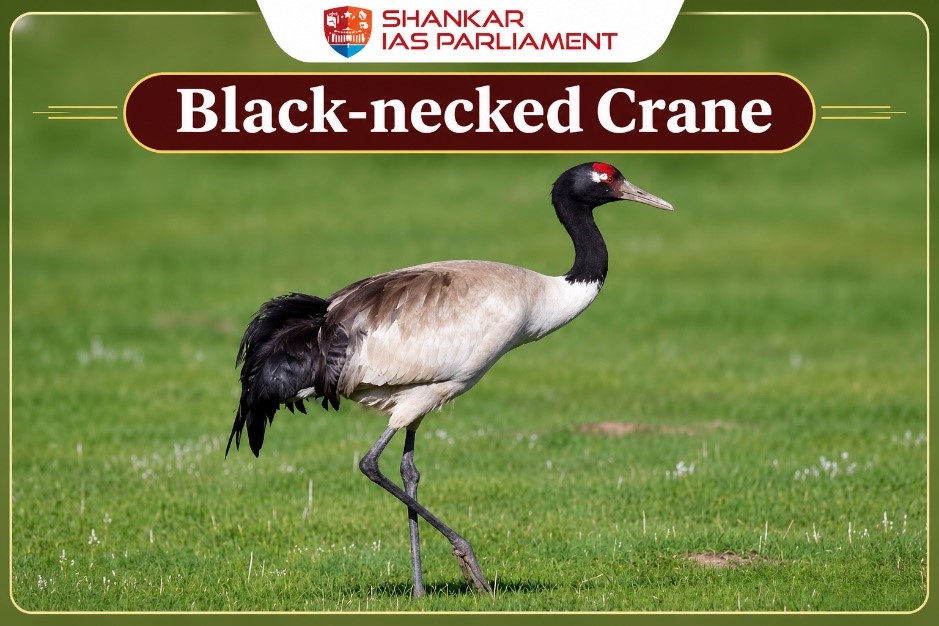
- Appearance – Mostly grey, with a black head and neck and a red crown.
- Conservation Status
- IUCN – Near Threatened (downgraded from Vulnerable in 2020).
- Wildlife (Protection) Act, 1972 – Schedule I.
- CITES – Appendix I.
- Threats – Feral dogs damaging eggs and chicks; habitat loss from settlements and construction.
Quick facts
|
Tso Kar Wetland Complex
|
- Location – Changthang region, Leh district, Ladakh.
- Type – High-altitude wetland complex in the Trans-Himalaya.
- Ramsar Site – Designated as India’s 42nd Ramsar Site in December 2020.
- Significance – One of India’s key breeding grounds for the black-necked crane.
- Other birds – Bar-headed goose, great crested grebe, brown-headed gull, ruddy shelduck.
|
Reference
The Tribune| Black-necked Crane Population Rises to 108



