What is the issue?
There have been mounting demands on caste based census coming from different quarters of the country.
What is caste census?
- Caste census is the procedure of systematically acquiring and recording the caste-wise tabulation of India’s population
What is the need for such a demand?
- To justify the preservation of caste-based affirmative action programmes for better planning and targeting of welfare schemes
- To provide quantifiable data to support the existing levels of reservation as required by Supreme court for groups like OBC
- To favour the political parties if particular groups are established as dominant in specific geographies
- To debate on issues like disproportionate benefits from reservation by particular groups within each category
- To address the inequities in the society
What is the government’s stand?
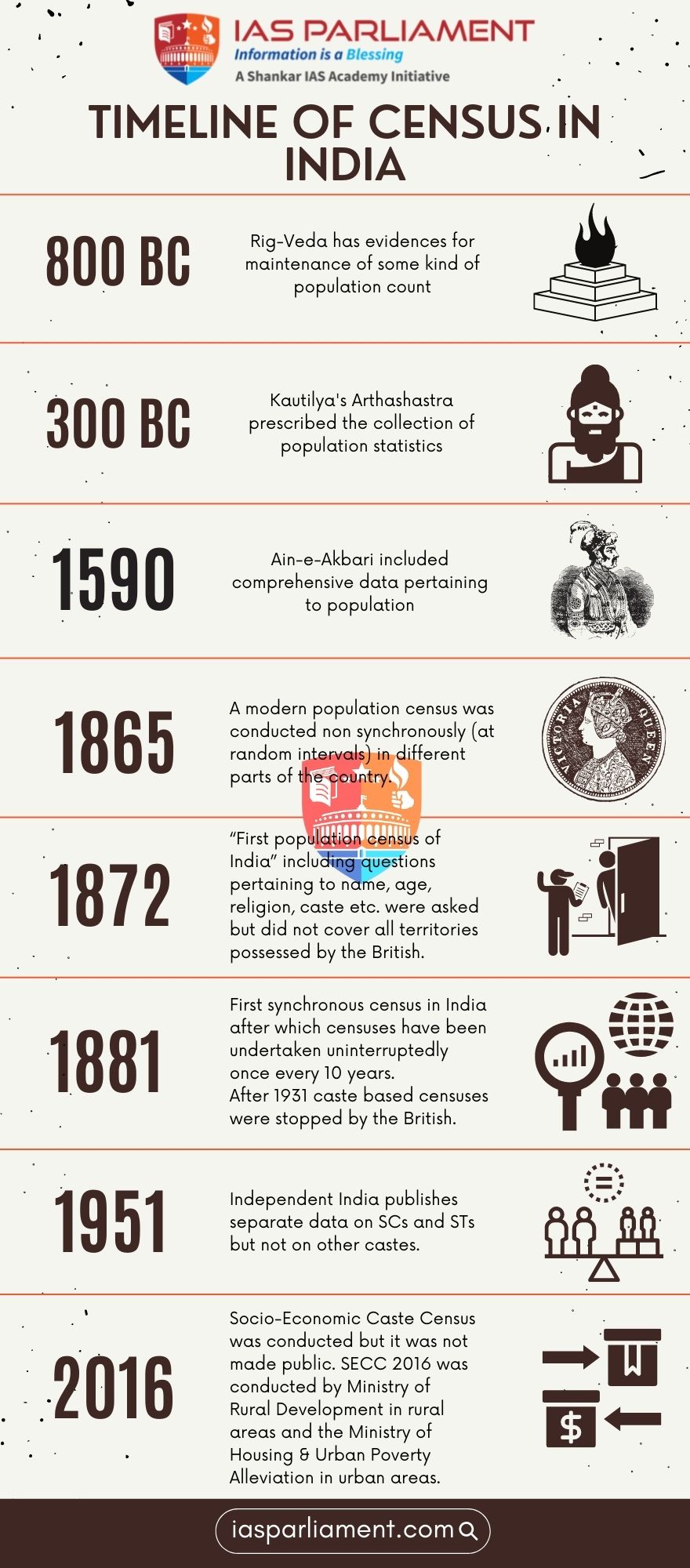
- The Union of India after Independence decided as a matter of policy not to enumerate caste wise population other than SCs and STs.
- The government cites that a census of the backward castes is administratively difficult and cumbersome
- Having caste as a part of census is so complex that it may jeopardise the decennial census itself.
- Very high number of castes and sub-castes with phonetic variations and similarities adds to the burden
- Even the Census of 1931 that included caste was not complete and accurate
- The caste census might evoke varying responses from different groups
- Government argues that caste-based census is against the idea of a casteless society
What are the gaps in the existing caste data?
- There is a Central list of OBCs and State-specific list of OBCs.
- Some States do not have a list of OBCs.
- Some States have a list of OBCs and a sub-set called Most Backward Classes.
- There are certain open-ended categories in the lists such as orphans and destitute children.
- Names of some castes are found in both the list of Scheduled Castes and list of OBCs.
- Scheduled Castes converted to Christianity or Islam are also treated differently in different States.
- The status of a migrant from one State to another and the status of children of inter-caste marriages, in terms of caste classification, are also contentious.
How can the differences be accommodated?
- A preliminary socio-anthropological study can be done at the State and district levels to establish all sects and sub-castes present in the population
- These can be tabulated under caste names that have wider recognition based on synonymity and equivalence
- Thereafter, it may be possible to do a field enumeration that can mark any group under castes found in the available OBC/BC lists.
Source: The Hindu



