Prelims: Current events of national and international importance | Conservation
Why in News?
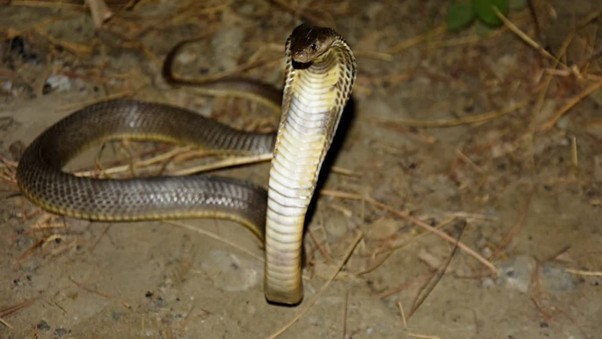
A rare Caspian Cobra has been spotted in the upper forest range of Chamba district in Himachal Pradesh, recently.
- Scientific Name - Naja oxiana
- Family - Elapidae.
- The Caspian Cobra also known as the Central Asian, Oxus, or Russian cobra is endemic to Central Asia.
- Geographic Distribution - It is typically found across Iran, Afghanistan, Turkmenistan, Uzbekistan, Kyrgyzstan, Tajikistan, and northern Pakistan.
- Indian Footprint - Historically considered exceptionally rare, confined mostly to far northwestern pockets including parts of Jammu & Kashmir and localized ranges in Himachal Pradesh.
- Preferred Habitat - The Caspian Cobra thrives in arid and semi-arid landscapes, rocky or stony foothills, embankments, and scrublands.
- Behaviour - It is a highly capable climber and swimmer, frequently utilizing holes in embankments or trees for shelter.
- Key characteristics
- Its hood is elongated and gradually tapering, quite distinct from the broadly ovoid hood of the Indian Cobra.
- Adult Caspian Cobras are uniform light to chocolate brown or yellowish and entirely lack any distinct hood markings (spectacle marks) or lateral throat spots.
- It is characterized by smooth, dull, and strongly oblique dorsal scales, with the outer rows noticeably larger than the rest.
- Venom Toxicity - Toxicological studies rank Naja oxiana as potentially the most venomous cobra species in the world.
- Its crude venom is exceptionally rich in short neurotoxins and cytotoxins, capable of inducing rapid neuromuscular blockade and cell death.
- Conservation Status
- IUCN Red List Status- Near Threatened (NT).
- CITES Status -Listed under Appendix II.
- Threats - Its populations are increasingly vulnerable to intensive habitat fragmentation and economic development in river valleys and piedmont deserts across Central Asia.
Reference
ETV Bharat | Rare Caspian Cobra



