What is the issue?
Although the share of agriculture in India’s total emissions has gradually declined, it has increased in absolute terms to a level similar to China’s in absolute terms emissions.
What is India’s status with respect to emissions?
- As per the World Air Quality Report 2020, 22 of the 30 most polluted cities in the world are in India and Delhi is the world’s most polluted capital.
- According to the Global Carbon Atlas, India ranks third in total greenhouse gas emissions by emitting annually around 2.6 billion tonnes (Bt) CO2eq.
- India’s per capita emission is just 1.8 tonnes, significantly lower than the world average of 4.4 tonnes per capita.
- India ranked seventh on the list of countries most affected due to extreme weather events, incurring losses of $69 billion (in PPP) in 2019 (Germanwatch, 2021).
- In India, energy sector contributes highest emission (44 %), followed by manufacturing and construction sector (18 %), agriculture, forestry and land use sectors (14 %), with remaining being shared by transport, industrial processes and waste sectors.
- Share of agriculture in total emissions has gradually declined from 28% (1994) to 14% (2016).
- But in absolute terms, emissions from agriculture have increased to about 650 Mt CO2 in 2018, which is similar to China’s emissions from agriculture.
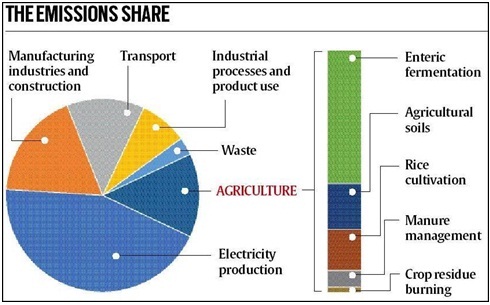
- Agricultural emissions in India are primarily from livestock sector (54.6 %), use of nitrogenous fertilisers (19 %), rice cultivation (17.5 %), livestock management (6.9 %) and burning of crop residues (2.1 %).
What is the need for a carbon policy for agriculture?
- A carbon policy for agriculture is needed not only to reduce its emissions but also to reward farmers through globally tradable carbon credits.
- With the world’s largest livestock population (537 million), India needs better feeding practices with smaller numbers of cattle by raising their productivity.
- Direct seeded rice and alternative wet and dry practices can reduce the carbon footprint in rice fields
- Switching areas from rice to maize or other less water-guzzling crops can reduce the emissions from agriculture.
- Opening up corn for ethanol can help not only reduce our huge dependence on crude oil imports but also reduce the carbon footprint.
- Agricultural soils are the largest single source of N2O emissions in India where fertigation and soluble fertilisers can promote fertiliser use efficiency.
Source: The Indian Express



