Mains: GSIII – Environment| Economic Development
Why in News?
The Ministry of Road Transport and Highways proposed BS-VII emission standards in October 2026, introducing real-world emissions testing, brake and tyre pollution controls, and EV battery durability requirements, with phased implementation from April 2029.
What are Bharat Stage (BS) Emission Standards?
- Bharat Stage Standards – These are government-prescribed norms regulating emissions from motor vehicles to control air pollution.
- Current Standards – India implemented BS-VI standards nationwide in April 2020, tightening limits on pollutants such as nitrogen oxides (NOx) and particulate matter (PM).
- Objective – Reduce vehicular pollution, improve air quality and promote cleaner vehicle technologies.
What are the Key Changes Proposed under BS-VII?
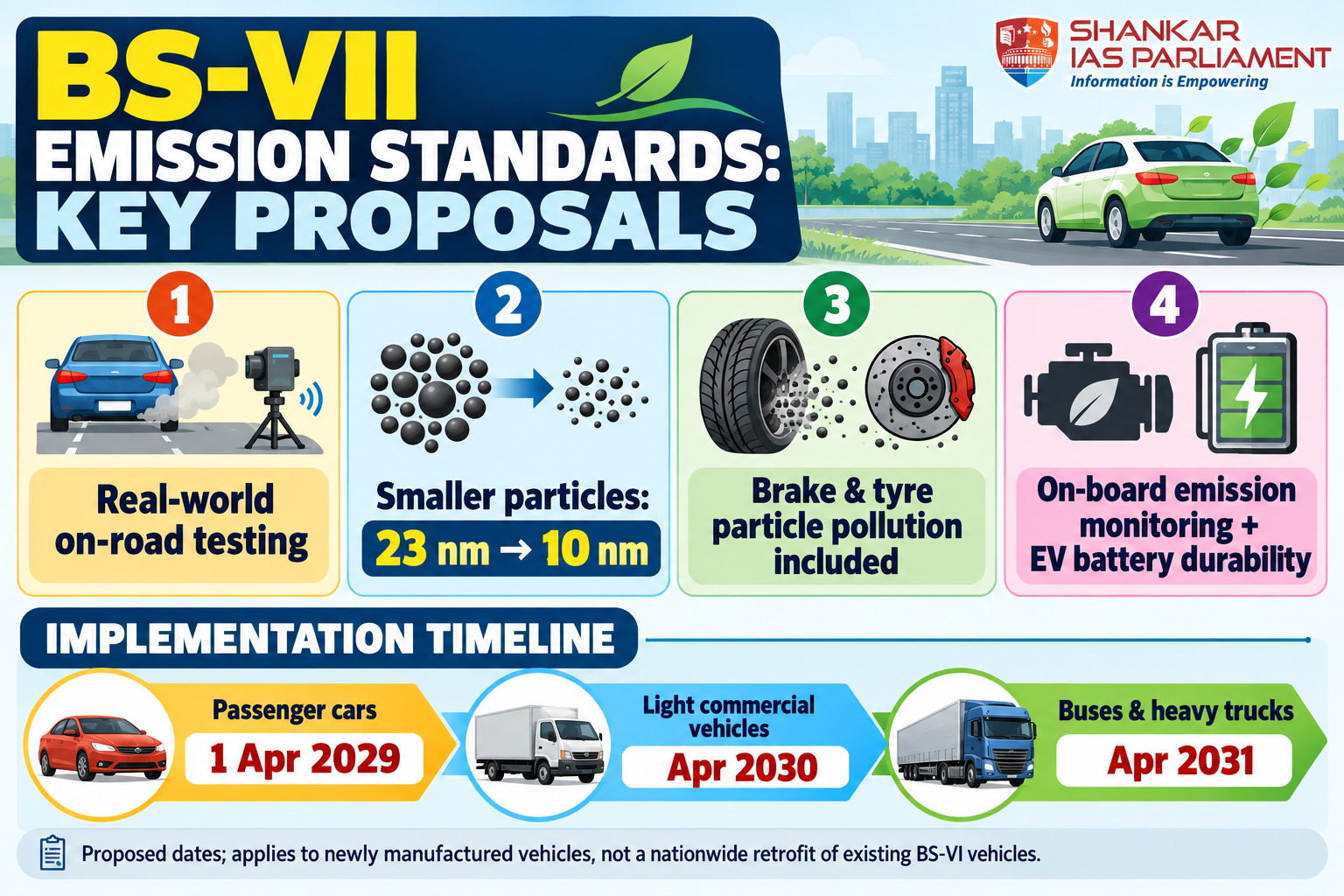
- Real-World Emissions Testing – Vehicles would undergo on-road emissions testing using portable equipment, in addition to laboratory testing.
- Smaller Particles – The particle-number measurement threshold would be reduced from 23 nanometres to 10 nanometres.
- Brake and Tyre Pollution – The standards would regulate particulate pollution caused by brake wear and tyre abrasion, beyond exhaust emissions.
- Emission Monitoring – On-board monitoring systems would detect specified emissions exceedances and track emission-control performance.
- Battery Durability – Electric vehicles (EVs) and plug-in hybrids would have to meet battery-energy retention benchmarks.
- Environmental Vehicle Passport – A proposed passport would provide information on fuel consumption, battery health and pollutant emissions.
|
Proposed Implementation Timeline
|
|
Vehicle category
|
Proposed implementation
|
|
Passenger cars
|
April 1, 2029
|
|
Light commercial vehicles
|
April 2030
|
|
Buses and heavy trucks
|
April 2031
|
The draft does not propose a nationwide programme to retrofit or replace existing BS-VI vehicles. The new standards would apply to vehicles manufactured from the specified implementation dates.
What are the Major Emission Control Provisions?
- Tailpipe Emissions – For passenger cars, the draft retains the principal limits for carbon monoxide (CO), nitrogen oxides (NOx) and particulate matter (PM).
- Proposed Limits for Cars –
|
Pollutant
|
Petrol cars
|
Diesel cars
|
|
Carbon monoxide
|
1,000 mg/km
|
500 mg/km
|
|
Nitrogen oxides
|
60 mg/km
|
80 mg/km
|
|
Particulate matter
|
4.5 mg/km
|
4.5 mg/km
|
- Brake Particles – Limits for passenger cars are proposed from April 2031, with a common limit of 3 mg/km across powertrains from April 2035.
- Tyre Abrasion – Requirements are proposed from April 2031, with numerical limits to be notified separately.
- Emission Durability – Passenger-car compliance would be assessed up to 160,000 km or eight years, followed by an additional period extending to 200,000 km or 10 years.
- Battery Durability Requirements for EVs – EVs and plug-in hybrids would be required to retain
- At least 75% of original battery capacity after five years or 1,00,000 km.
- At least 67% after eight years or 1,60,000 km.
What is the Significance of BS-VII Standards?
- Cleaner Air – Reduces exhaust emissions and non-exhaust pollution from brakes and tyres.
- Better Monitoring – On-road testing and onboard systems improve the assessment of actual vehicle emissions.
- Sustainable Mobility – Battery-durability requirements encourage greater accountability for EV performance.
- Technological Advancement – Promotes improvements in emission-control systems, sensors and vehicle software.
- Lifecycle Approach – Extends the focus from emissions at manufacture to vehicle performance over time.
What are the Challenges in Implementation?
- Higher Costs – Advanced emission-control technologies, testing and certification may increase vehicle prices.
- Technological Complexity – Manufacturers may need to upgrade sensors, engine controls and exhaust-treatment systems.
- Implementation Timeline – Automakers have raised concerns about limited preparation time and have reportedly sought a later rollout.
- EV Development Trade-off – Compliance-related engineering requirements could compete with resources allocated to EV development.
- Regulatory Uncertainty – Brake, tyre and battery requirements need detailed limits and testing procedures before finalisation.
What Could Be Done?
- Phased Implementation – Provide adequate lead time and introduce standards gradually to help manufacturers adapt.
- R&D Support – Encourage investment in affordable emission-control technologies, cleaner engines and durable EV batteries.
- Testing Infrastructure – Strengthen vehicle testing centres and on-road emission monitoring facilities.
- Industry Collaboration – Coordinate with automakers, research institutions and regulators to finalise practical standards and ensure effective compliance.
What lies ahead?
- The BS-VII standards represent a shift from conventional exhaust-emission control towards an approach covering real-world emissions, and battery durability.
- Their success will depend on clear technical regulations, adequate preparation time for manufacturers and effective enforcement without compromising cleaner mobility goals.
Reference
The Hindu| India’s proposed BS-VII vehicle emission rules



