0.1341
7667766266
x

BRICS: Summary

iasparliament Logo
September 11, 2026

Evolution, Cooperation and India’s Leadership

BRICS has evolved from a small grouping of emerging economies into a significant platform for political, economic, financial and developmental cooperation among major countries of the Global South.

What began as the acronym BRIC, coined by Goldman Sachs in 2001, has developed into a broader geopolitical grouping spanning Asia, Africa, the Middle East and Latin America.

In 2026, India holds the BRICS Presidency for the fourth time, seeking to strengthen the grouping as an inclusive, effective and solutions-oriented forum.

Evolution of BRICS
  • The term BRIC was coined in 2001 by Goldman Sachs in its paper “The World Needs Better Economic BRICs”.
  • It identified Brazil, Russia, India and China as economies that could become among the world’s largest over the following decades.
  • The growing economic significance of these countries subsequently led to the formation of a formal political cooperation mechanism.
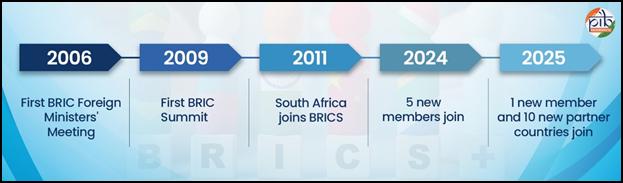
  • BRIC was formally established as a political cooperation forum in 2006, while the first BRIC Summit was held at Yekaterinburg, Russia, in 2009. The 2008 global financial crisis was an important catalyst.
  • It exposed weaknesses in the existing international financial architecture and encouraged the BRIC countries to demand greater representation for emerging economies in institutions such as the IMF and World Bank.
  • South Africa joined the grouping in 2011, transforming BRIC into BRICS and expanding its geographical representation.
  • Cooperation subsequently moved beyond economic issues to encompass development, health, climate change, technology, trade, finance and security.
  • A major expansion occurred in January 2024, when Egypt, Ethiopia, Iran, Saudi Arabia and the UAE became full members.
  • Indonesia joined in January 2025, taking full membership to 11 countries: Brazil, China, Egypt, Ethiopia, India, Indonesia, Iran, Russia, Saudi Arabia, South Africa and the UAE.

https://static.pib.gov.in/WriteReadData/userfiles/image/2026/sep/image004_20260910123855_5e2e2a.jpg

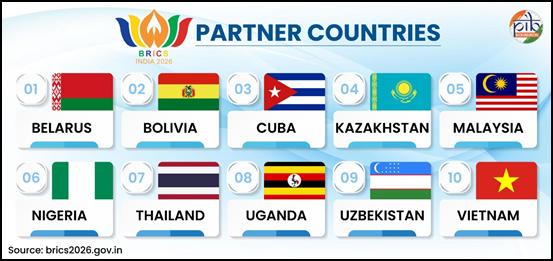
  • BRICS also created a Partner Country category, with ten countries—Belarus, Bolivia, Cuba, Kazakhstan, Malaysia, Nigeria, Thailand, Uganda, Uzbekistan and Vietnam—joining the framework during 2025.
  • This expansion has widened BRICS’ outreach and strengthened possibilities for South-South cooperation.

BRICS as a Platform for Global South
https://static.pib.gov.in/WriteReadData/userfiles/image/2026/sep/image001_20260910123729_1efb39.jpg

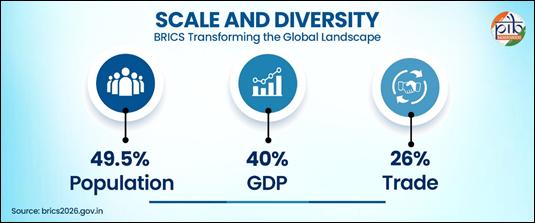
  • The expanded BRICS represents substantial global demographic and economic weight, accounting for approximately 49.5% of the world’s population, 40% of global GDP and 26% of global trade, according to the article.
  • Its central objective is to promote a more representative, legitimate and balanced international order.
  • BRICS advocates greater voice and equity for developing countries in global institutions, including the WTO and international financial architecture.
  • Its agenda encompasses:
    • Economic and financial cooperation
    • Trade and investment
    • Climate change and sustainable development
    • Food and energy security
    • Agriculture
    • Counter-terrorism
    • Technology and telecommunications
    • Health
    • Labour and employment
    • International financial governance
  • Thus, BRICS increasingly functions not merely as an economic grouping but as an important platform for coordinating positions on global governance and advancing the interests of developing economies.

https://static.pib.gov.in/WriteReadData/userfiles/image/2026/sep/image002_20260910123815_c20699.jpg

Institutional and Financial Cooperation

  • One of BRICS’ major achievements has been the development of alternative financial mechanisms.
  • At the 2012 Delhi Summit, members explored the creation of a development bank and strengthened arrangements for local-currency trade and financial stability.
  • This eventually contributed to the establishment of the New Development Bank (NDB), which finances infrastructure and sustainable development projects.
  • BRICS also developed the Contingent Reserve Arrangement (CRA) as a mechanism to provide short-term liquidity support to members facing financial pressures.
  • These initiatives demonstrate BRICS’ attempt to complement existing global financial institutions while increasing the role of emerging economies in development finance.

India’s Previous BRICS Presidencies

  • India has chaired BRICS in 2012, 2016 and 2021, with each Presidency reflecting contemporary global challenges.
  • 2012 – Delhi Summit:
    Held under the theme “BRICS Partnership for Global Stability, Security and Prosperity,” the summit focused on global governance reform, sustainable development, food and energy security.
  • The Delhi Declaration and Action Plan strengthened institutional cooperation. The summit also laid the foundation for the NDB and CRA and expanded cooperation in agriculture, health and science.
  • 2016 – Goa Summit:
    Under the theme “Building Responsive, Inclusive and Collective Solutions,” India emphasised counter-terrorism, trade, innovation and multilateral cooperation.
  • The NDB became operational and began financing projects, including renewable energy. India also promoted cooperation on HIV/AIDS, tuberculosis, clean energy and energy security.
  • The BIMSTEC Outreach Summit expanded BRICS engagement with the wider Bay of Bengal region.
  • 2021 – Virtual Summit:
    The 13th BRICS Summit, held under the theme “BRICS@15: Intra-BRICS Cooperation for Continuity, Consolidation and Consensus,” focused on institutional continuity and cooperation in health, digital technology, counter-terrorism and sustainable development.
  • Major initiatives included the BRICS Counter-Terrorism Action Plan, Digital Health Summit, Vaccine R&D Centre and Remote Sensing Satellite Constellation.

India’s 2026 BRICS Presidency

  • India assumed the Presidency on 1 January 2026 under the theme “Building for Resilience, Innovation, Cooperation and Sustainability.”
  • The emphasis is on development, sustainability, innovation, institutional effectiveness and the aspirations of the Global South.
  • During the year, India organised more than 350 meetings and high-level engagements across 25 cities. Cooperation expanded across the three traditional BRICS pillars:
    • Political and security cooperation
    • Economic and financial cooperation
    • Cultural and people-to-people exchanges
  • Several practical initiatives emerged. In agriculture, BRICS agreed on Centres of Excellence on Agro-Ecology, a Network on Digital Agriculture and the AGRIN network dealing with agricultural inputs, genetic resources and information.
  • In health, initiatives included the BRICS Mission for Healthy Lifestyle, cooperation on traditional and complementary medicine, and networks for mental-health training.
  • Traditional knowledge and community-based climate adaptation were also given greater importance.
  • India also promoted cooperation in skills, women’s workforce participation, social security and digital public infrastructure through BRICS CONNECT for Skilling. Energy cooperation was strengthened through initiatives on smart grids and energy storage.
  • Other areas include sustainable urban mobility, MSME financing and internationalisation, startup incubation, scientific research, logistics, global value chains, customs cooperation, standardisation, youth cooperation and sports technology.

Significance and Challenges

  • The growing membership gives BRICS greater demographic, economic and geopolitical influence.
  • It provides emerging economies with a collective platform to address concerns regarding global financial governance, development, climate change, technology and trade.
  • However, the diversity of BRICS also creates challenges. Members differ significantly in their political systems, economic structures, strategic interests and foreign-policy priorities.
  • Building consensus among such diverse countries can therefore be difficult.
  • India’s 2026 Presidency seeks to address this challenge by focusing not simply on expanding BRICS but on converting representation into practical cooperation and tangible outcomes.

Conclusion

  • BRICS has travelled from a four-country economic concept to a broad platform for political, economic, financial and social cooperation.
  • Its expansion reflects the growing influence and aspirations of the Global South. For India, BRICS offers an opportunity to promote strategic autonomy, South-South cooperation, global governance reform and development-oriented multilateralism.
  • India’s fourth Presidency in 2026 comes amid geopolitical uncertainty, economic fragmentation, technological disruption and climate pressures.
  • Its central task is therefore to build consensus among diverse members and make BRICS more effective, inclusive and action-oriented.
  • The success of India’s Presidency will ultimately depend on its ability to transform the grouping’s growing representation into concrete cooperation and a stronger, more balanced global order

Reference

PIB| BRICS

There are no reviews yet. Be the first one to review.

ARCHIVES

sidetext