Prelims: Current events of national and international importance | Environment
Why in News?
Scientists have discovered a new species of blind, blood-red eel, named Rakthamichthys anchi, in underground aquifers connected to dug-out wells in the Goalpara district of Assam.
|
Genus Rakthamichthys
|
- The genus consists of subterranean swamp eels that are endemic to India.
- Members of the genus exhibit adaptations such as elongated bodies, reduced eyesight and red pigmentation.
- The term Rakthamichthys is derived from the Malayalam word raktham, meaning "blood", and the Greek word ichthys, meaning "fish".
|
Rakthamichthys Anchi
- The eel was found in two wells, each about 7 metres deep, in Goalpara district.
- Only 4 specimens have been recorded so far, indicating that the species may be extremely rare.
- The species name anchi comes from the Garo language word meaning "blood".
- The species lacks visible eyes and body pigmentation; adaptations associated with life in complete darkness.
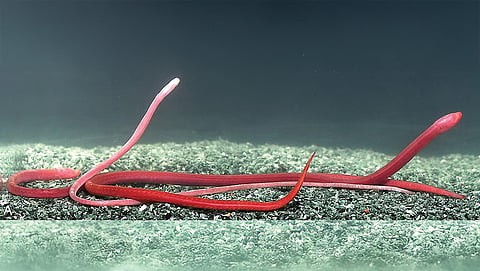
- Its characteristic blood-red colour results from blood vessels being visible through its translucent skin.
- Researchers used micro-computed tomography (micro-CT) scanning and DNA analysis to confirm that it represents a distinct species.
- Significance - This is the 2nd remarkable subterranean fish discovery from the same region within a short period, following the discovery of Gitchak nakana.
- The finding suggests that the underground aquifers of northeastern India may harbour a rich and largely unexplored ecosystem.
Reference
Down to Earth | Rakthamichthys Anchi’



