Mains: GS III – Environment pollution and degradation
Why in News?
Recently, the Bioremediation process has gained attention and importance due to ever increasing pollutions in many waterbodies in India.
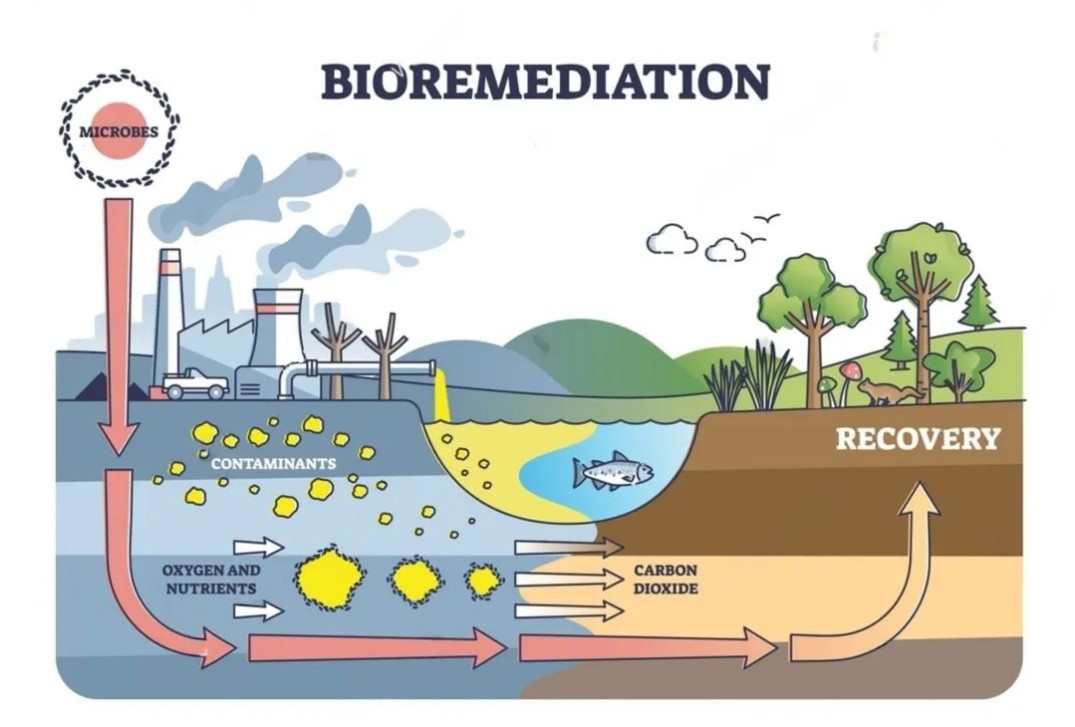
What is bioremediation?
- Bioremediation – It literally means “restoring life through biology.”
- It harnesses microorganisms such as bacteria, fungi, algae and plants to sequester or transform toxic substances such as oil, pesticides, plastics, or heavy metals.
- These organisms metabolise these pollutants as food, breaking them down into harmless by-products such as water, carbon dioxide, or organic acids.
- In some cases, they can convert toxic metals into less dangerous forms that no longer leach into the soil or groundwater.
- Types – There are two broad types:
- In situ bioremediation, where treatment happens directly at the contaminated site — think oil-eating bacteria sprayed on an ocean spill.
- Ex situ bioremediation, where contaminated soil or water is removed, treated in a controlled facility, and returned once cleaned.
- Modern bioremediation combines traditional microbiology with cutting-edge biotechnology.
- First, new biotechnologies are enabling humans to gain unprecedented insight into biology, allowing them to identify biomolecules with useful characteristics.
- Second, these technologies allow humans to replicate these biomolecules under desired conditions of use, such as sewage plants or agricultural lands.
- For example, genetically modified (GM) microbes are designed to degrade tough chemicals like plastics or oil residues that natural species struggle with.
- Biosensing – Synthetic biology also allows for “biosensing”, organisms that change colour or fluorescence when they detect toxins, providing early warnings of contamination.
Why does India need bioremediation?
- Heavy industrialization in India – India’s rapid industrialisation has come at a heavy environmental cost.
- Although pollution has been reducing, rivers such as the Ganga and Yamuna receive untreated sewage and industrial effluents daily.
- Oil leaks, pesticide residues, and heavy-metal contamination threaten both ecosystems and public health.
- Issues with traditional methods – Traditional clean-up technologies are expensive, energy-intensive, and often create secondary pollution.
- Potential of Bioremediation – It offers a cheaper, scalable, and sustainable alternative, especially in a country where vast stretches of land and water are affected but resources for remediation are limited.
- Advantage of India’s diverse biodiversity – Indigenous microbes adapted to local conditions, such as high temperatures, salinity, or acidity, can outperform imported strains in environmental recovery.
Where does India stand today?
- The Department of Biotechnology (DBT) – It has supported several projects through its Clean Technology Programme, encouraging partnerships between universities, public research institutions, and industries.
- CSIR-National Environmental Engineering Research Institute – It has a mandate to propose and implement programmes related to bioremediation.
- IITs – Researchers at the Indian Institute of Technology have experimented with a nanocomposite material synthesised from cotton that can be used to mop up oil spills and others have identified bacteria that can consume toxic pollutants in soils.
- Startups – Firms like Biotech Consortium India Limited (BCIL) and Econirmal Biotech offer microbial formulations for soil and wastewater treatment.
- Challenges – Widespread adoption faces several challenges
- Technical ones such as a lack of site-specific knowledge and the complex nature of pollutants, and
- Regulatory ones such as a lack of unified bioremediation standards.
What are other countries doing?
- Japan – It integrates microbial and plant-based cleanup systems into its urban waste strategy.
- The European Union – It funds cross-country projects that use microbes to tackle oil spills and restore mining sites.
- China – It has made bioremediation a priority under its soil pollution control framework, using genetically improved bacteria to restore industrial wastelands.
What are the opportunities and risks?
- Ecology restoration – Bioremediation can help restore rivers, reclaim land, and clean industrial sites, while creating jobs in biotechnology, environmental consulting, and waste management.
- Integration of schemes – It can also integrate with the government’s Swachh Bharat Mission, Namami Gange, and other green technology initiatives.
- Concerns with GMOs – The introduction of genetically modified organisms (GMOs) into open environments need to be strictly monitored to prevent unintended ecological effects.
- Lack of monitoring – Inadequate testing or poor containment or monitoring can create fresh problems while solving old ones.
What needs to be done?
- National standards – There is a need to develop national standards for bioremediation protocols and microbial applications.
- India will need new biosafety guidelines, certification systems, and trained personnel to scale this technology responsibly.
- Building regional bioremediation hubs – Linking universities, industries, and local governments would enable better understanding of local issues and identifying appropriate technologies for their resolution.
- This can be implemented through support for local startups and community projects through the DBT–BIRAC ecosystem.
- Public engagement – It would raise awareness that microbes can be allies, not threats, in environmental restoration
Reference
The Hindu| Bioremediation



