Mains: GS II – International relations
Why in News?
Recently, at a meeting in New Delhi on Thursday, the national security chiefs of BIMSTEC member countries endorsed a set of guiding principles for maritime law enforcement and disaster relief operations, highlighting the grouping’s growing focus on regional security.
What is BIMSTEC?
- BIMSTEC – Bay of Bengal Initiative for Multi-Sectoral Technical and Economic Cooperation.
- It is a regional multilateral organization uniting seven South and Southeast Asian countries.
- Formation – Formed in 1997 via the Bangkok Declaration, it fosters rapid economic growth, technical collaboration, and trade.
- Representing about 22% of the global population, BIMSTEC is headquartered in Dhaka, Bangladesh.
- Member States – BIMSTEC acts as a natural bridge connecting South Asia with Southeast Asia.
- Its seven members depend on the Bay of Bengal and share contiguous ecological and economic interests:
- Five South Asian nations – Bangladesh, Bhutan, India, Nepal, and Sri Lanka
- Two Southeast Asian nations –Myanmar and Thailand
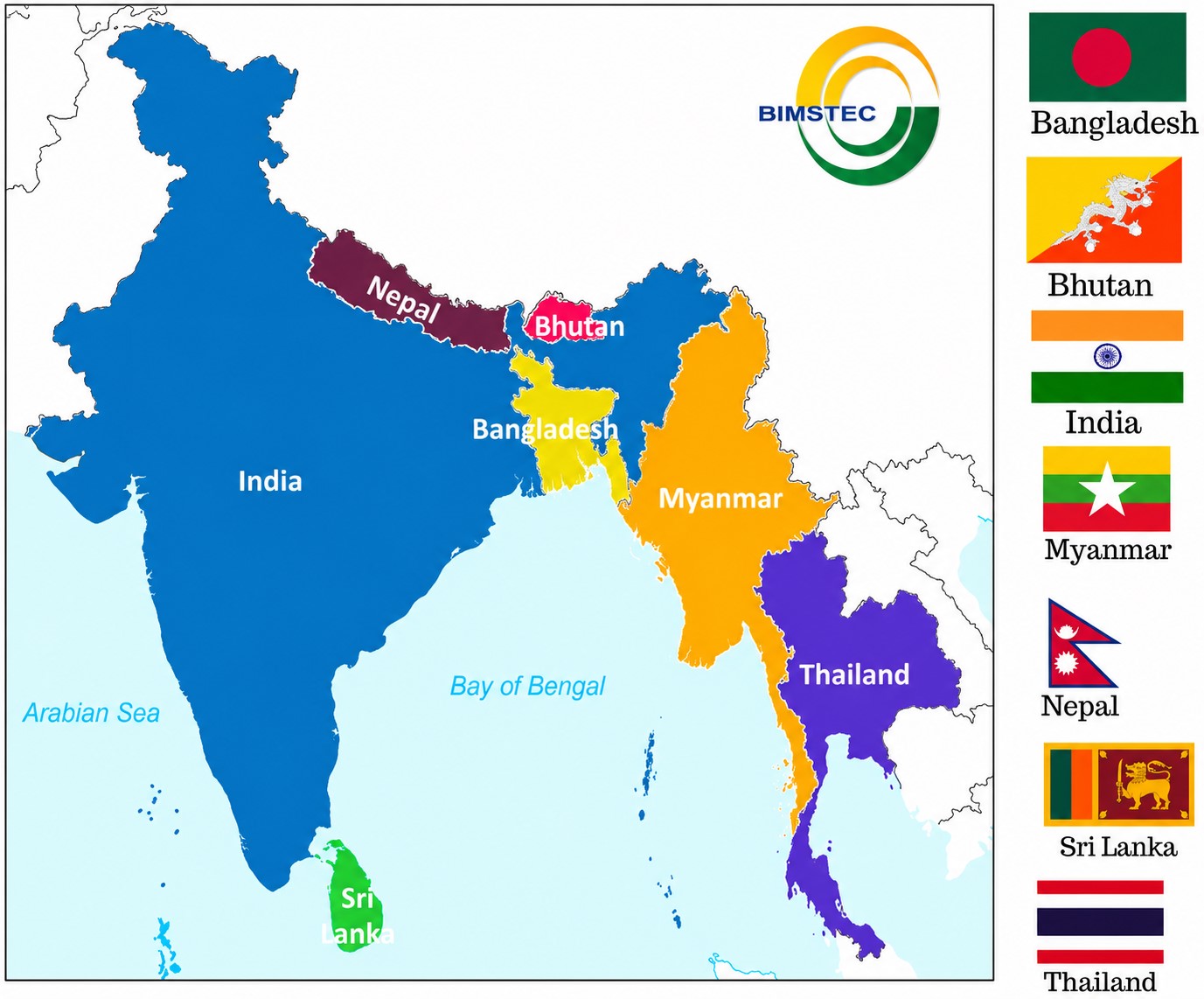
- Core Objectives and Focus – The grouping aims to harness shared regional growth through active collaboration and mutual assistance. Historically, it has identified 14 priority sectors of cooperation, including:
- Trade and Investment
- Energy and Technology
- Transportation and Connectivity
- Agriculture and Fisheries
- Tourism and Public Health
What is the significance of BIMSTEC?
- Viable Alternative to SAARC – With SAARC largely paralyzed by political disputes, BIMSTEC has become the preferred platform for regional cooperation.
- It offers a constructive, obstruction-free environment for countries to collaborate on trade and infrastructure.
- Alignment with Indian Foreign Policy – For India, BIMSTEC is central to the "Neighbourhood First" and "Act East" policies.
- It provides a vital route to integrate India's landlocked northeastern states with the Bay of Bengal, primarily through connectivity projects in Bangladesh and Myanmar
- Countering Chinese Influence – The grouping allows littoral states (like Bangladesh, Sri Lanka, and Thailand) to partner with democratic powers, acting as a crucial diplomatic counterweight to China's Belt and Road Initiative (BRI) and "cheque book diplomacy" in the Indo-Pacific.
- Trade and Investment – BIMSTEC aims to boost intra-regional trade through frameworks like the BIMSTEC Free Trade Area, reducing tariffs and strengthening regional supply chains.
- Connectivity and Infrastructure – The grouping is prioritizing multidimensional transport links, including maritime shipping, energy grids, digital networks, and the India-Myanmar-Thailand Trilateral Highway.
- Security and Disaster Management – Members collaborate on counter-terrorism, cybersecurity, maritime security, and Humanitarian Assistance and Disaster Relief (HADR).
- It operates specialized bodies like the BIMSTEC Centre for Weather and Climate in Noida, India.
BIMSTEC is crucial because it bridges South and Southeast Asia, uniting 22% of the global population (1.7 billion people) and a $3.8 trillion combined GDP.
What are the challenges associated with BIMSTEC?
- Trade Delays – The BIMSTEC Free Trade Area framework was proposed in 2004, but after two decades of negotiations, many of its constituent agreements remain unimplemented.
- Connectivity Stagnation –Flagship transport initiatives, such as the Motor Vehicles Agreement and the Coastal Shipping Agreement, have faced severe delays due to regulatory mismatches and security concerns.
- Underfunded Secretariat – The permanent secretariat in Dhaka was only established in 2014 and continues to suffer from staffing shortages, a limited mandate, and inadequate funding.
- No Dispute Mechanism – Unlike ASEAN, the bloc lacks a formal dispute resolution mechanism, leading to policy paralysis.
- Regional Imbalance – As the largest member by far, India dominates the organization.
- Smaller nations (such as Nepal and Bhutan) sometimes fear asymmetrical benefits and worry about India’s unilateral actions.
- Competing Interests – Member states often balance competing regional influences.
- Myanmar and Thailand, for example, have strong ties to ASEAN, while countries like Sri Lanka and Nepal frequently navigate geopolitical competition between India and China.
- Domestic Turmoil – The internal civil conflict in Myanmar and recent regime transitions in Bangladesh have severely disrupted regional planning and the execution of transnational connectivity projects (e.g., the India-Myanmar-Thailand Trilateral Highway).
- Transnational Threats – The grouping deals with complex, evolving threats including cybercrime, terrorism, and maritime law enforcement that require intense cooperation between National Security Advisors.
- Climate Vulnerability – The Bay of Bengal is heavily susceptible to natural disasters, yet the grouping still lacks a cohesive, fully proactive disaster management mechanism
What could be done to make BIMSTEC more effective?
- Finalizing the FTA – The BIMSTEC Free Trade Area framework has been in negotiation for two decades.
- Concluding negotiations on trade in goods, services, and investments will provide a major boost to regional commerce.
- Empowering the Secretariat – The organization requires greater financial independence.
- Expanding the Secretariat's operational budget and mandate allows it to effectively monitor and execute regional projects rather than relying entirely on voluntary national contributions.
- Enhancing Connectivity – Accelerating multi-modal transport agreements, simplifying customs procedures, and pushing forward digital public infrastructure initiatives will streamline supply chains across the Bay of Bengal.
- Prioritizing Regular Leadership – Hosting consistent, annual summits alongside active business forums helps translate policy goals into tangible economic and strategic outcomes.
References
The Indian Express| BIMSTEC
WIONEWS| BIMSTEC NSA



