Prelims: Current events of national and international importance | Environment
Why in News?
The Ministry of Road Transport and Highways (MoRTH) has proposed the implementation of Bharat Stage VII (BS-VII) emission standards.
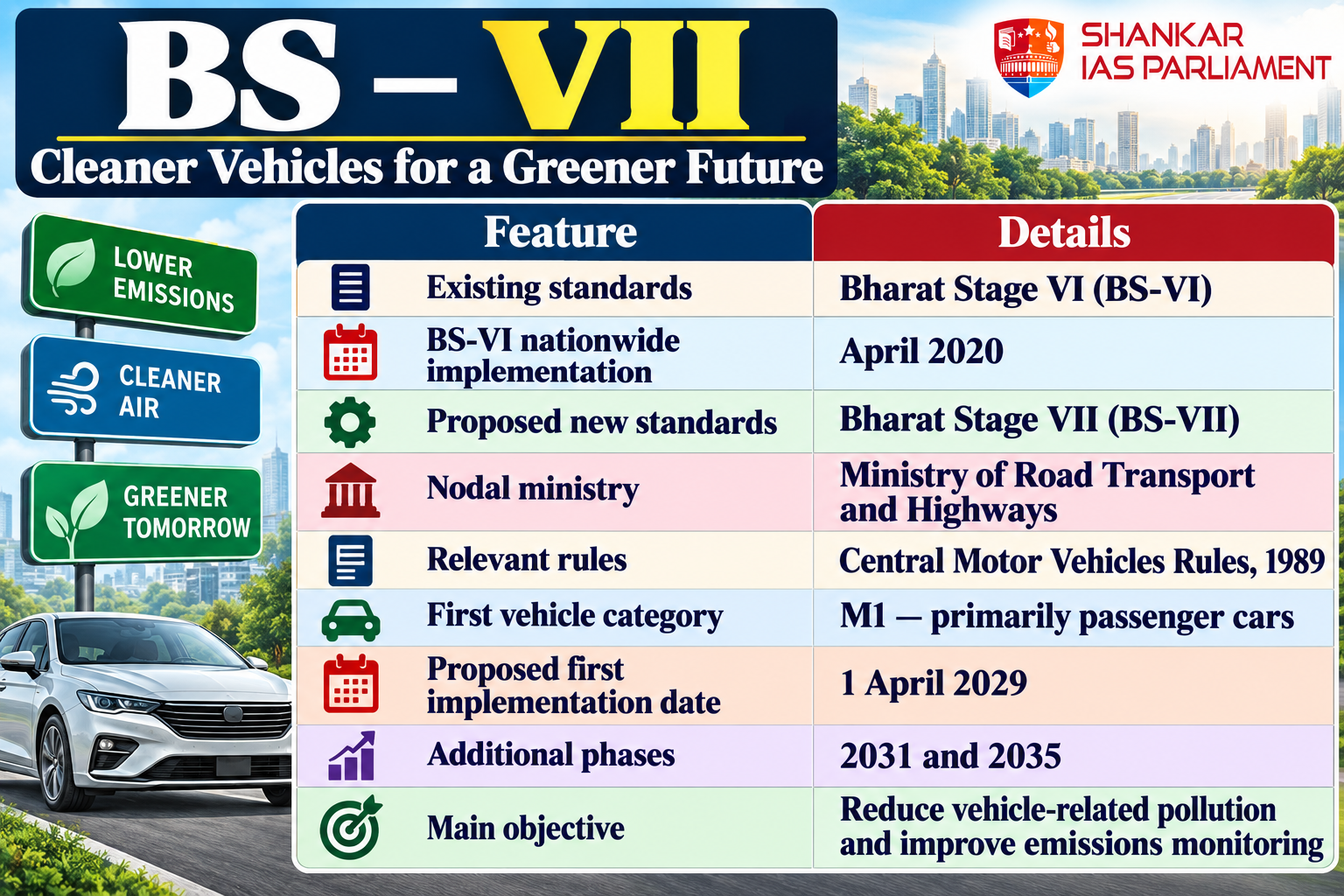
- The implementation for passenger cars in the M1 category is scheduled to commence on 1 April 2029.
- The draft introduces enhanced monitoring requirements for real-world emissions, brake particle pollution, tyre abrasion, and electric vehicle battery durability.
- The government has solicited public feedback on the proposed amendments to the Central Motor Vehicles Rules, 1989.
Proposed Emission Standards for Passenger Vehicles
|
Pollutant
|
Petrol-type engines
|
Diesel engines
|
|
Carbon monoxide (CO)
|
1,000 mg/km
|
500 mg/km
|
|
Nitrogen oxides (NOx)
|
60 mg/km
|
80 mg/km
|
|
Particulate matter (PM)
|
4.5 mg/km
|
4.5 mg/km
|
- Additional proposed regulatory requirements include the following:
- Measurement of smaller particulate matter by reducing the particle-number measurement threshold from 23 nanometers to 10 nanometers.
- Implementation of controls to reduce evaporative emissions from fuel systems.
- Conducting emissions testing under real-world driving conditions.
- Ongoing monitoring of emissions-control system performance throughout the vehicle's operational lifespan.
Major New Features of BS-VII
- Real-world driving emissions (RDE)
- Emissions will be evaluated under real-world driving conditions utilizing portable emission measurement systems.
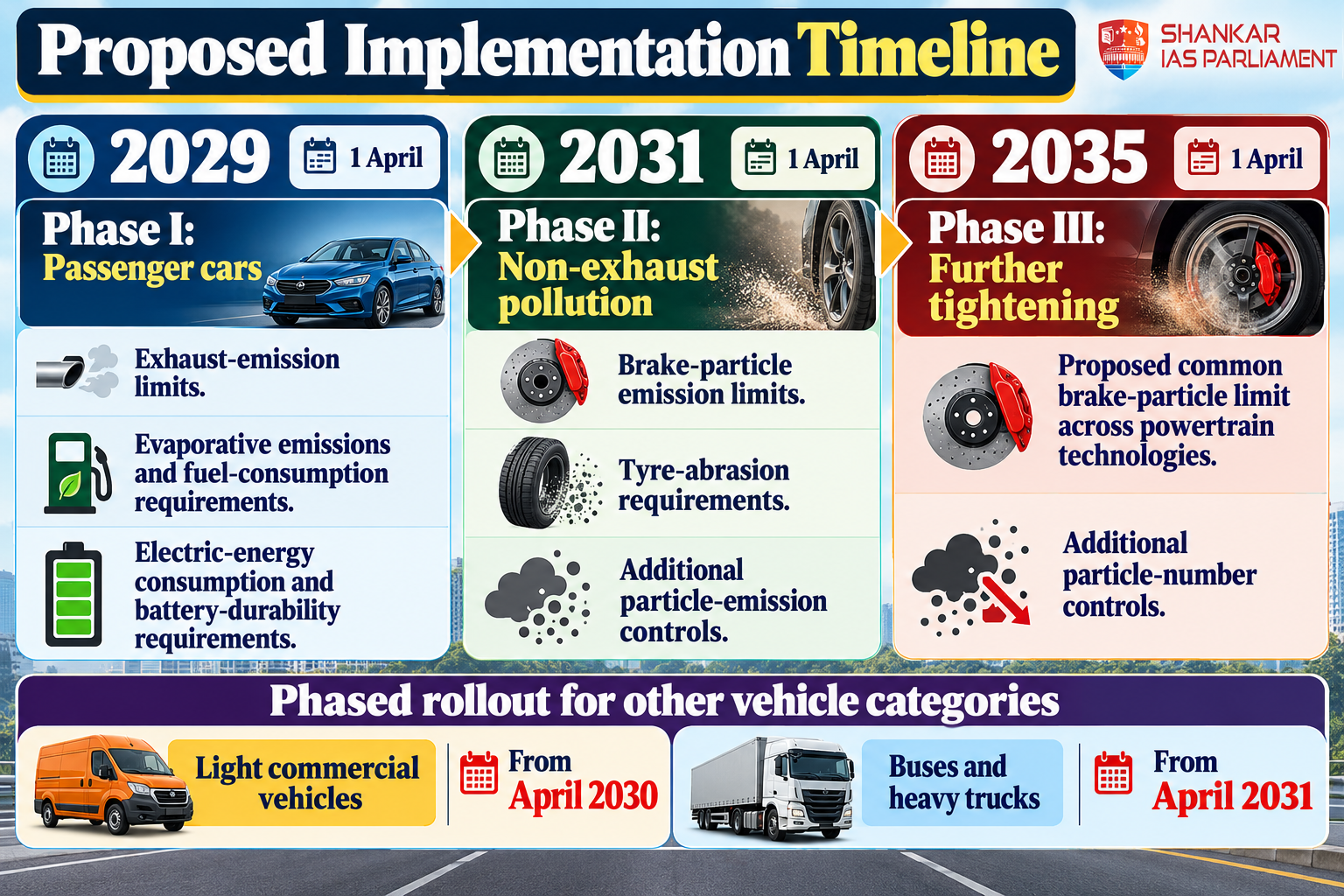
- The draft regulation stipulates that on-road testing will be incorporated into the type approval process beginning in April 2030.
- The proposed conformity factor for nitrogen oxides (NOx) and particle number emissions is set at 1.0.
- On-board Monitoring Requirements – Vehicles must be equipped with systems for the following functions:
- On-board diagnostics (OBD).
- Monitoring emissions and detecting instances where specified thresholds are exceeded.
- Monitoring both fuel consumption and electric energy consumption.
- Ensuring that specified monitoring data are accessible via diagnostic systems and, when required, through over-the-air methods.
- Brake Particle Emissions – Braking systems emit particles as friction materials degrade. The Bharat Stage VII (BS-VII) standards propose regulation of this non-exhaust pollution source.
|
Proposed effective date
|
Vehicle category
|
Brake-particle mass limit
|
|
April 2031
|
Pure electric vehicles
|
3 mg/km
|
|
April 2031
|
Other specified powertrains
|
7 mg/km
|
|
April 2035
|
All powertrains
|
3 mg/km
|
- Tyre Abrasion
- Tyres generate particulate matter during interaction with road surfaces.
- The draft regulation introduces abrasion requirements for C1 tyres, effective from April 2031.
- Specific numerical limits will be communicated in a separate notification.
- Durability of Electric Vehicle Batteries – The following minimum benchmarks for battery performance are proposed:
|
Period / distance
|
Minimum retained performance
|
|
First 5 years or 100,000 km
|
75%
|
|
Up to 8 years or 160,000 km
|
67%
|
- The applicable threshold is evaluated based on either the specified time or distance limit, whichever is reached first.
- Detailed test procedures and requirements will be communicated separately.
- Environmental Vehicle Passport – The proposed passport is designed to provide comprehensive information on the following aspects:
- Fuel consumption metrics.
- Electric energy consumption data.
- Battery state-of-health indicators.
- Pollutant emission levels.
- The primary objective is to enhance access to vehicle performance and environmental impact information.
Vehicles and Fuels Covered
- The proposed framework encompasses multiple powertrain configurations and fuel types, including the following:
- Petrol and diesel.
- Compressed natural gas (CNG).
- LPG.
- Ethanol blends, including E20.
- Hydrogen.
- Methanol.
- Hybrid vehicles.
- Electric vehicles, with respect to relevant energy consumption, battery specifications, and non-exhaust emission requirements.
- The draft further introduces provisions for the approval of geofencing-equipped petrol and diesel vehicles as BS-VII-G vehicles.
Reference
The Hindu | BS IV



