Introduction:
- Maritime trade – India stands among the world’s leading trade nations, with the majority of its trade flowing through maritime routes.
- The sea is not merely a transport medium for India; it is the backbone of commerce.
- It supports energy security and drives economic growth across diverse sectors of the national economy.
- From crude oil imports to merchandise exports, maritime connectivity underpins virtually every sector of India’s economy.
- Coastal shipping & inland waterways – They further strengthen this lifeline, ensuring resilience and efficiency in trade.
- Insurance dependence – India's maritime trade has expanded, but key marine insurance services remain largely dependent on foreign providers.
- This leads to an annual outflow of USD 45–60 million in Protection and Indemnity (P&I) premiums, besides higher marine insurance payments abroad.
Bharat Maritime Insurance Pool (BMIP)
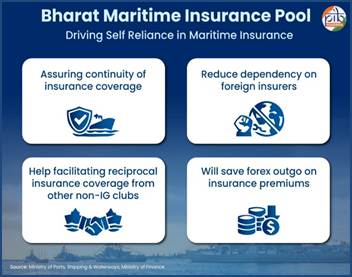
- BMIP – It has been conceived as a sovereign solution to this strategic gap in domestic maritime insurance capacity.
- Objective – To ensure affordable, sovereign coverage for vessels and cargo, enhancing resilience against global risks.
- Launch – Approved on 18 April 2026 and formally launched on 12 May, 2026, the BMIP is India’s first domestic maritime insurance pool of Rs. 13,906.50 crore (USD 1.5 billion).
- It assures sovereign backing of Rs. 12,980 crore (USD 1.4 billion).
- For the first time, Indian companies are insuring Indian ships independently for higher-value vessels.
- Coverage – Hull & Machinery, Cargo against War perils in High-Risk Area and Protection & Indemnity.
India’s Maritime Sector: A Nation of the Seas
- Port infrastructure – India operates 12 Major and 217 Non‑Major Ports, handling diverse cargo types nationwide.
- India's major & non-major ports handled 1,668 million metric tonnes of cargo during 2025–26, a figure rising with economic growth and trade expansion.
- India’s coastline – Extends around 11,098 kilometres, among the world’s longest, with natural harbours and port sites.
- Exclusive Economic Zone – Spans 2.4 million square kilometres, granting sovereign rights over marine resources and fishing activities.
- Inland waterways – Exceed 14,500 kilometres, offering rivers, canals, and backwaters for cost‑effective freight movement.
- Coastal states & territories – Border the sea, positioning population and industry to benefit from maritime trade.
- Maritime livelihoods – Support over 30 million people, including fishers, port workers, seafarers, and shipbuilders.
Why does India need BMI Pool?
- Growth of Indian-flag fleet – It has grown to 1,609 ships and 14.33 million GT as of mid-2026, a roughly 36% increase in tonnage since 2015.
- 95% of India's trade value and 70% of trade volume flows through maritime routes.
Maritime Insurance: The Invisible Lifeline
- Marine insurance is mandatory for global trade.
- Hull and machinery policies protect vessels, cargo insurance safeguards goods, and Protection and Indemnity (P&I) covers liabilities like pollution or crew injury.
- War Risk insurance shields against piracy and conflict.
- Together, these make insurance a legal and commercial necessity for India’s shipping economy.
Overdependence on Foreign P&I Clubs
The International Group of Protection and Indemnity Clubs is made up of 13 main clubs. Together, they insure about 90% of the world’s large ships against risks like cargo loss, pollution, collisions, and crew injuries.
- India has been dependent on foreign insurers for the insurance value chain. Indian shipowners rely almost entirely on 13 international P&I clubs, mostly based in the West.
- This dependence leaves India vulnerable to sudden coverage withdrawal or politically influenced decisions, underscoring the importance of a homegrown alternative.
Geopolitical Volatility and Trade Disruption
- Conflicts in the Red Sea and tensions near the Strait of Hormuz have disrupted vital routes.
- With a major share of crude oil imported by sea, India’s energy security depends on uninterrupted coverage.
- During this period, foreign insurers increased insurance premiums or stopped providing cover.
- This increased costs sharply for ship owners, raising the need for a domestic safety net.
Absence of Domestic Expertise
- Earlier, India did not have institutional depth in marine underwriting and claims management.
- BMIP builds this expertise indigenously, laying the foundation for a world‑class domestic insurance sector and reducing reliance on foreign hubs like London or Switzerland.
BMI Pool: Design, Structure and Coverage
- The pool provides marine insurance cover to safeguard vessels and cargo on trade routes.
- It functions through collective insurer participation and structured governance to manage large maritime risks.
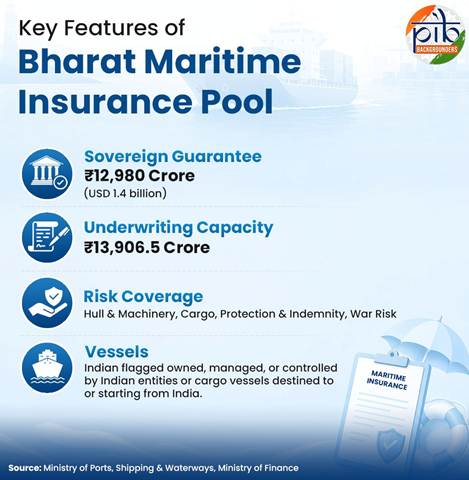
- Sovereign guarantee – Government-backed support of Rs. 12,980 crore (USD 1.4 billion) ensures financial strength. This guarantee meets obligations even during catastrophic losses.
- Underwriting capacity – The Pool can insure risks worth Rs.13,906.5 crore, i.e., USD 1.5 billion, backed up by the Sovereign Guarantee, increasing its ability to cover large maritime losses.
- Risk coverage – Hull & Machinery, Cargo, Protection & Indemnity (P&I), and War Risk are included.
- Vessel eligibility – Vessels that are Indian flagged or are owned, managed, or controlled by Indian entities, or cargo vessels destined to or starting from India, qualify.
- Duration – It has a duration of 10 years, which is extendable up to 15 years.
- Joint policy issuance – Policies will be issued by domestic insurers that are members of the Pool, using their combined underwriting capacity.
- The risks covered under these policies will then be reinsured collectively by all Pool members, in proportion to the capacity each has committed.
- Claims management – Claims up to USD 100 million are met from accumulated reserves and reinsurance recoveries.
- For larger claims, the sovereign guarantee activates only after complete exhaustion of pool reserves.
- Administration – General Insurance Corporation of India serves as the Pool Administrator, managing daily operations. It submits performance reports and supports the Pool’s efficient functioning.
- Governance – A Governing Body oversees and regulates pool operations, ensuring compliance and smooth functioning.
- Underwriting discipline – An Underwriting Committee ensures sound and consistent risk evaluation, supporting long-term financial sustainability.
Coverage Types and Scope:
- BMIP has been designed to provide comprehensive coverage across the full spectrum of maritime risk categories.
- It ensures that no vessel or cargo involved in Indian trade is left without domestic insurance protection, regardless of the route or nature of the risk.
- Hull and Machinery War coverage – It protects vessels from damage to hull structure (main body of the ship), propulsion systems (machinery that powers the ship’s movement), and installed equipment.
- This ensures the capital value of India’s merchant fleet remains secure and domestically insured.
- Cargo War coverage – It safeguards goods transported across international sea routes against loss or damage to shipments.
- Indian exporters and importers benefit even in high-risk or conflict-affected maritime corridors.
- Protection & Indemnity coverage – It addresses liabilities, including pollution, oil pollution clean-up, wreck removal, crew injury, and cargo damage.
- Indian shipowners gain domestic access to coverage previously available only through foreign clubs.
- War Perils coverage – It insures against losses from armed conflict, piracy, terrorism, and hostile vessel seizure.
- This protection is vital for Indian trade routes crossing sensitive corridors like the Red Sea, Strait of Hormuz, etc., besides the other High-Risk Areas.
Outcome & Impact
- The launch of Bharat Maritime Insurance Pool in May 2026 marks a significant milestone in India’s maritime insurance sector.
- Since its operational launch, the BMIP has ensured uninterrupted War-risk insurance for Indian maritime stakeholders.
- War-risk insurance premiums have fallen by about 35–40% since the peak of the West Asia conflict.
- As on 7th September 2026, the Pool has issued 3000 Cargo War, 92 Hull War-risk and 3 Protection & Indemnity insurance policies.
A Strong Start: What the Launch Delivered
- India’s First P&I Policy – On 30 July, 2026, India’s first Protection & Indemnity insurance policy under BMIP was issued to Shipping Corporation of India Limited.
- Issued by New India Assurance Company Limited, it provides financial protection against third-party liabilities.
- First Hull and Machinery War-risk policy – On 12 May 2026, the pool's very first policy was given for a vessel sailing through conflict zones.
- New India Assurance issued this Marine Hull and Machinery War Policy to M/s. Hoger Offshore and Marine Private Limited.
- In simple terms, an Indian ship now sails with home-grown protection against War risks.
- Cover for goods coming into India – A Marine Cargo War Policy was issued to M/s. Vedanta Sterlite Copper Limited.
- It protects the company's import of cable wires into India; this shows the pool can serve India's large industrial importers.
- It keeps the supply chains feeding Indian industry safely insured.
- Beyond shipping companies – A policy was also issued to Balrampur Chini Mills Limited, a sugar manufacturer. This proves the pool is not for shipowners alone.
- Farms, factories, and commodity traders moving goods by sea can all seek cover. The pool, therefore, works for the wider Indian economy.
- Governance and systems in place – The Governing Body and Underwriting Committee have been set up since the launch.
- General Insurance Corporation of India (GIC Re) has taken charge as the Pool Manager/Administrator.
- Systems for underwriting, claims, and regulatory compliance are also put in place. The pool is operating at full commercial scale.
Way Forward
- The Bharat Maritime Insurance Pool marks a major step in India’s maritime financial independence.
- Its role is to ensure credible operations, competitive pricing, and reliable claims handling for stakeholders.
- Medium-term focus remains on strengthening human capital, legal frameworks, and reinsurance partnerships.
- These efforts enhance resilience while keeping reliance on sovereign backing minimal.
- In the long term, the pool emerges as a regional anchor for maritime insurance in the Indian Ocean Region.
- India gains recognition as a provider of financial services and a shaper of maritime risk norms.
- As shipbuilding expands and ports handle larger cargo volumes, the pool will grow alongside India's maritime ambitions.
- Its capacity and coverage stand as a lasting pillar of India’s maritime infrastructure.
Reference
PIB | Bharat Maritime Insurance Pool



