Prelims: Current events of National and International Importance | Science and Technology
Why in News?
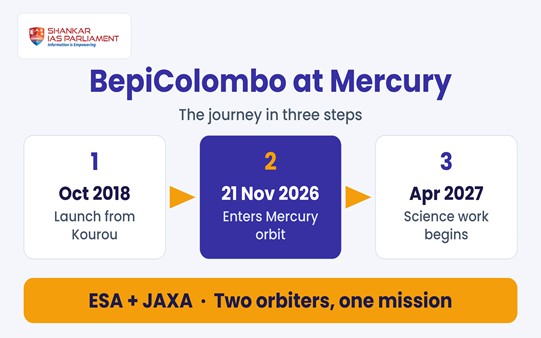
BepiColombo, the joint ESA–JAXA mission, entered orbit around Mercury on November 21, 2026, after an eight-year journey.
- A software glitch cut the braking burn short (about 77% of the planned velocity change), leaving a 75-hour orbit instead of 58; the spacecraft is safe.
About the Mission
- Partners – The European Space Agency (ESA) leads, with Japan’s JAXA; named after Italian scientist Giuseppe “Bepi” Colombo.
- ESA’s role – Provides the Mercury Planetary Orbiter (MPO) and the Mercury Transfer Module; launched on Ariane 5 from Kourou on October 20, 2018; flown from ESOC, Germany.
- JAXA’s role – Provides the Mercury Magnetospheric Orbiter, Mio.
- Features – Two orbiters on one stack, carrying 16 instruments; solar electric propulsion and nine flybys (Earth once, Venus twice, Mercury six times) slowed it for “weak stability capture”.
Aims
- Origin – How a planet so close to the Sun formed and evolved.
- Planet – Mercury’s surface, composition and interior.
- Environment – Its magnetic field, thin exosphere and interaction with the solar wind.
- Physics – Test Einstein’s general relativity.
- Next steps – Orbiters separate on December 9–10, 2026; MPO reaches its science orbit by March 2027; science begins in April 2027.
Significance
- First of its kind – Europe’s and Japan’s first Mercury mission and the first with two orbiters; NASA’s Mariner 10 and MESSENGER visited earlier.
- Science – Clues to how rocky planets form near stars, including Earth; a team of nearly 600 scientists will analyse the data.
- Technology – One of ESA’s most complex arrival sequences; a model for ESA–JAXA cooperation.
Quick facts
|
Mercury
|
- Position – Closest and smallest planet; no moons or rings.
- Motion – Orbits the Sun in 88 days; rotates once in about 59 days.
- Surface – About 430°C by day and −180°C at night; thin exosphere.
- Structure – Large iron core; Caloris Basin; water ice in polar craters.
|
Reference
Reference
India Today | BepiColombo



