Why in News?
Recently, #JusticeForRaygun widely shared on social media due to encounters between baboons and people in Pretoria.
A young male baboon named Raygun burned to death by the teenagers in Africa.
- Scientific name – Papio.
- Baboons – They are world's largest monkeys, and there are 5 different species of baboons.
- 5 species – Olive, Yellow, Chacma, Guinea, and Sacred baboon
- Habitat – Savanna, woodlands, bushlands, mountains, tropical forests and semi-arid regions.
- Distribution – Dry regions of Africa and Arabia.
- Morphology – Long bodies, not including substantial tails of varying lengths, large head, cheek pouches, dog-like noses and powerful jaws.
- Long snout, sharp canines, red (or black) backside, thick fur and its colour varies depending on the species.
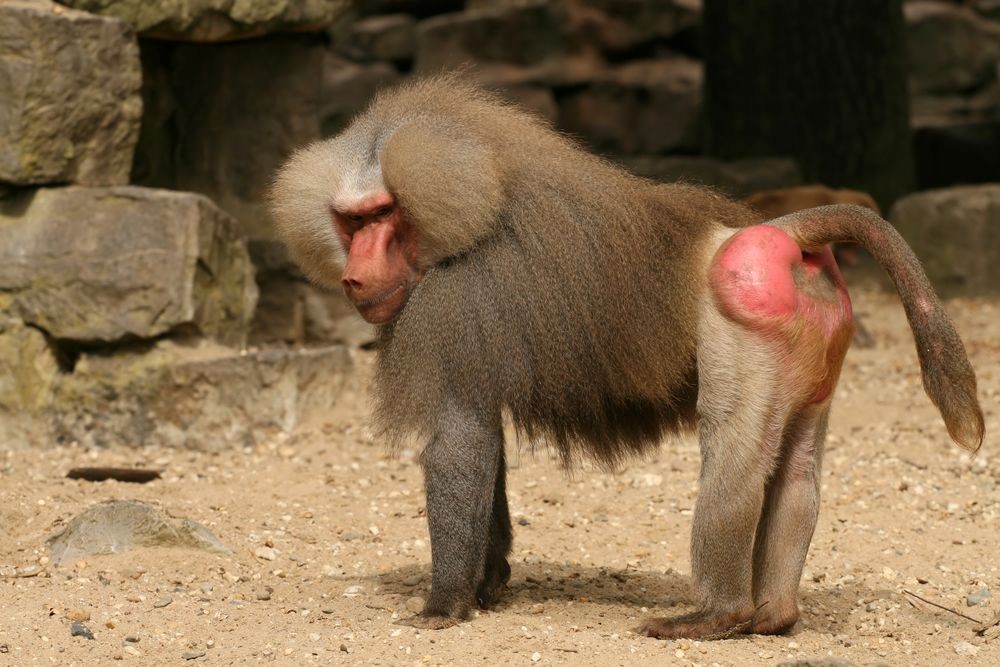
- Sexual Dimorphism
- Males – They are largest species, but females are only half this size.
- They have a thick coat of fur, especially around their chest and head, where they have thick manes.
- Uniqueness – It doesn’t have a prehensile (gripping) tail, meaning their tails are not used as a hand.
- Behaviour – Highly social, intelligent, travel in large noisy troops, and communicating by calls.
- Diet – They are omnivorous feed on fruits, grasses, seeds, eggs, insects, bark, roots, birds, rodents, antelopes and sheep.
- Threats:
- Hunted for their skins
- Overgrazing
- Agricultural expansion
- Irrigation projects
- Overall human settlement growth.
- Conservation status
- IUCN status – Least concern.
- CITES – Appendix II.
References
- Down to Earth| Baboons and Human Fear
- National Geographic| Baboons
- AFW| Baboons