0.1000
7667766266
x

Autonomy for Major Ports

iasparliament Logo
November 23, 2024

Why in news?

In a recent proposal Government looks to reduce red tape and reduce port infrastructure delays.

What are the ports reform proposal by Government of India?

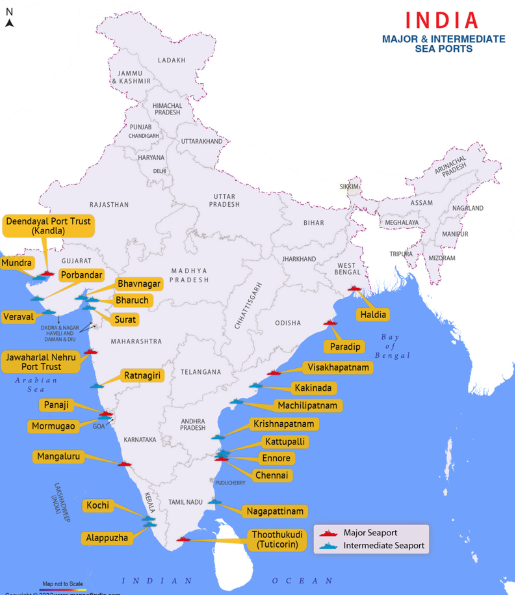
  • Ports in India – With a coastline of over 7,500 kilometers, India is home to 12 major ports and over 200 non-major ports.
  • Proposal – The Ministry of Ports, Shipping and Waterways is considering expanding the autonomy of major ports in making decisions.
  • Expand financial powers – India’s 12 major ports to undertake capital expenditure (capex) at their discretion only on using their internal resources.
  • Categorize ports – Government plans to categorize India’s 12 major ports into four groups based on the size of operations and other factors.
    • It will determine the ceiling for capex that can be undertaken without the need for approval.
  • Elevating to enterprise model – This is part of a broader initiative to bring major ports onto the same operating field as central public sector enterprises.

In 2023-24, major ports handled 721 million tonne (mt) of cargo, marking an 11.8 per cent growth year-on-year, while non-major ports handled 817 mt, growing by 4.4 per cent.

major ports

Legislations governing ports in India

  • Port trust - A port trust is a statutory authority in India that manages trade and shipping through a commercial seaport.
    • The first Port Trust Board was established in 1870 for Calcutta Port.
  • The Major Port Trusts Act of 1963 – It established port authorities for some major ports in India for  the administration, management, and control of those ports.
    • The act brought the administration of Port Trust Boards under the national government.
  • The Major Port Authorities Act, 2021 – The act aims to make major ports in India more competitive with private players, and to improve the governance of ports.
  • Significance – The act gives major ports more autonomy, and vests their administration, control, and management with the Boards of Major Port Authorities.
    • Ports can approve up to Rs 100 crore independently.
    • Spending over Rs 500 crore needs clearance from inter-ministerial bodies such as the GatiShakti Network Planning Group, the Public Investment Board, and the Union Cabinet.

Other initiatives

  • Maritime India Vision 2030 (MIV 2030) – A blueprint to accelerate and harmonize the growth of India's maritime sector over the next decade.
  • Sagar Mala project – A program launched in 2017 to invest $123 billion in 415 projects related to port modernization and new port development.
  • Distriparks – Areas where companies are established to perform trade and transport-related value-added services.

What are the significances of  enhancing port autonomy?

  • Port development – Major ports may self-fund capital projects without ministry approval.
  • Reduce bureaucratic hurdles It allows the ports to execute the critical projects in swift manner.
  • Boost competitiveness It increases the efficiency of cargo handling in major ports like Paradip, Vizag, and Kandla.
  • Economic growth – Improved port infrastructure reduces logistics costs, enhancing trade volumes and bolstering India's position in global trade networks.
  • Boosting regional trade – Improved port operations can position India as a hub for regional trade, enhancing connectivity with neighboring countries.
  • Reducing turnaround time – Streamlining operations reduces cargo handling delays, improving efficiency and reliability in trade logistics.
  • Providing level playing field – Autonomy enables state-owned ports to compete effectively with private ports, which often enjoy operational flexibility.

 What lies ahead?

  • Improve infrastructure and streamline operations to compete with leading global ports.
  • Reduce logistics costs and boosting efficiency to attract higher trade volumes.
  • Strengthening regional connectivity improve their capacity and efficiency.

Quick facts

Ports in India are categorized based on their administration, cargo handling capabilities, location, and functions.

  • On the basis of administration
    • Major ports - Ports administered directly by central government.
    • Non-major ports - Ports that administered by state governments.
  • On the basis of Cargo handled
    • Industrial ports - It handles large-scale industrial shipments specializes in bulk cargo like grain, ore, oil, and chemicals.
    • Commercial ports - Which handles a wide range of consumer goods and containerized cargo
  • On the basis of location
    • Inland ports - Located away from the sea, but connected to it by a river, canal, or lake. Inland ports are often used for storing and dispatching cargo.
    • Outports – It is located in deep waters that serves the main port to handle large ships.
  • On the basis of specialized functions
    • Oil ports – Also known as oil terminals that store, process, and ship oil products.
    • Ports of call – It is an intermediate stop for ships to transshipment of cargo or fuel refilling.
    • Packet stations – It is also known as ferry ports that is exclusive for transportation of passengers and mail.
    • Entre port – A collection center for goods from different countries that are then exported
    • Naval ports – Ports which have only strategic importance. These ports serve warships and have repair workshops for them.

Reference

Business Standard |Government Proposal to Increase Port Autonomy


Login or Register to Post Comments
There are no reviews yet. Be the first one to review.

ARCHIVES

sidetext
Free UPSC Interview Guidance Programme
sidetext