Prelims: Current events of national and international importance
Why in News?
Recently, nearly 12% of Americans have used GLP-1 drugs for weight loss, including about one-fifth of women aged 50 to 64, according to a journal report.
- Glucagon – Like Peptide 1 (GLP 1) – It is a naturally occurring peptide hormone.
- It is water soluble molecules ranging for a few 200 amino acids in length.
- It is incretin hormone and a neurotransmitter.
Incretin hormones are a group of gut hormones that play a crucial role in regulating blood glucose levels after eating.
Neurotransmitter is a chemical messenger that transmits signals between neurons or from neurons to other cells like muscle or gland cells.
- Secreted from – The small intestine and from the hindbrain (regulating vital functions and coordinating movement).
- It is produced in the gut by enteroendocrine L-cells after we eat a meal.
- Features – Natural GLP-1 is so short-lived.
- GLP-1 works for just a few minutes, so after you eat a meal and GLP-1 is secreted naturally, it gives an immediate effect that lasts maybe 30 minutes.
- To last longer in the body, GLP-1 is attached to fatty acids, which help the drug stick to a blood protein (albumin), which carries
- Carries it around the body
- Protects it from being broken down too quickly.
- Functions - Travels to the pancreas, where it helps to regulate our blood sugar by increasing insulin and decreasing glucagon. It helps control body weight.
- GLP-1 binds to in many organs in the body, also has beneficial effects in many of these organs, such as the kidney, liver, and cardiovascular system.
- It is chopped up by metabolic enzymes known as DPP-4 and cleared by the kidneys.
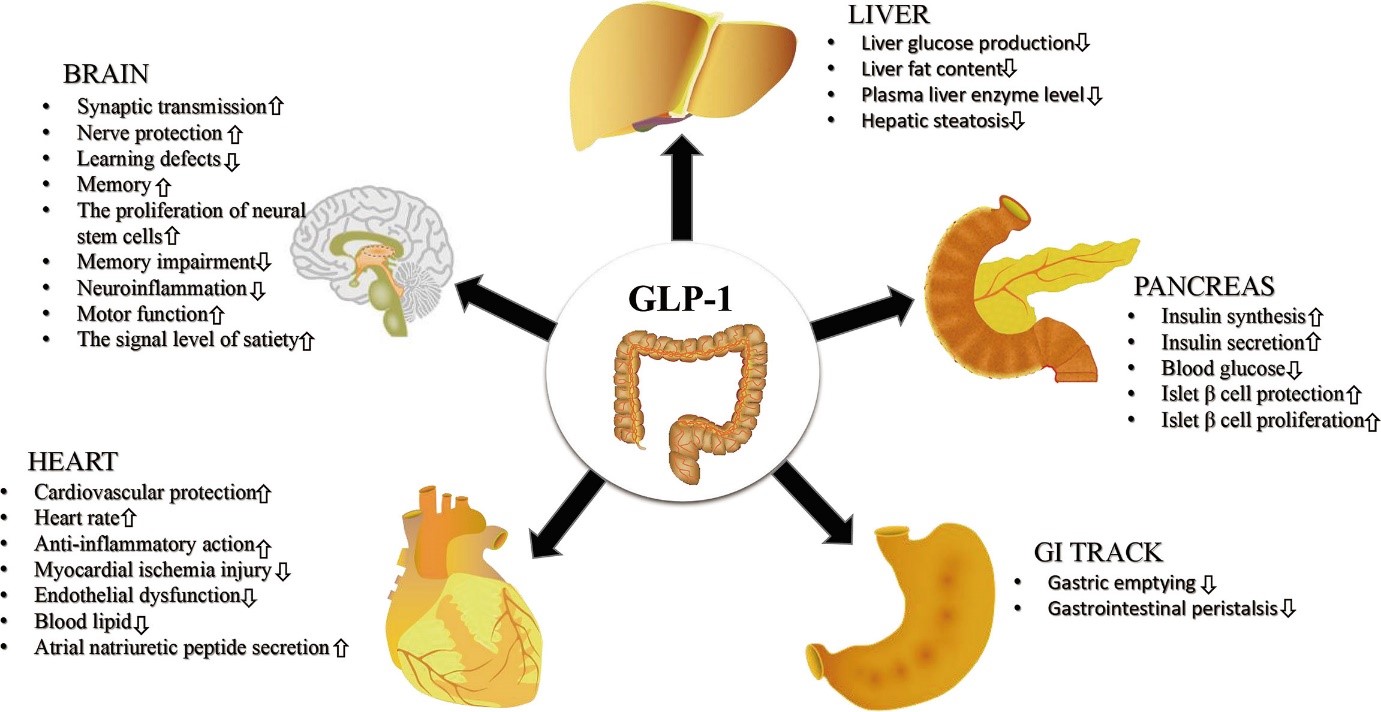
- Blood glucose-dependent – The GLP-1 start to act only if the blood glucose is elevated.
- Impacts - The brain associated with control of hunger and satisfaction, to effectively tell us that we have had enough to eat and need to stop eating.
References
- Medicalxpress| GLP-1
- The Indian Express| Glucagon – Like Peptide 1 (GLP 1)



