Mains : GS III – Internal Security
Why in News?
The AFSPA Act has been extended in Manipur, Nagaland and Arunachal Pradesh.
What is the Armed Forces (Special Powers) Act (AFSPA), 1958, and how is an area declared "Disturbed"?
- Statutory Purpose – Enacted in 1958, AFSPA grants extraordinary legal powers to the Armed Forces and Central Armed Police Forces (CAPF) to restore public order in regions designated as "disturbed" due to insurgency, armed rebellions, or severe internal conflict.
- Declaration of a "Disturbed Area" (Section 3) – Under the AFSPA Act, an area can be declared "disturbed" if disputes between racial, religious, language, or regional groups/castes threaten public peace.
- Dual Power – Both the Central Government (Ministry of Home Affairs – MHA) and the State Governments possess the legal authority to issue a Disturbed Area Notification.
- Constitutional Basis and Judicial Validity – Supreme Court Benchmark (Naga People's Movement of Human Rights v. Union of India, 1997) – The Supreme Court upheld the constitutional validity of AFSPA while enforcing key procedural safeguards, requiring periodic review of notifications and mandatory handover of arrested persons.
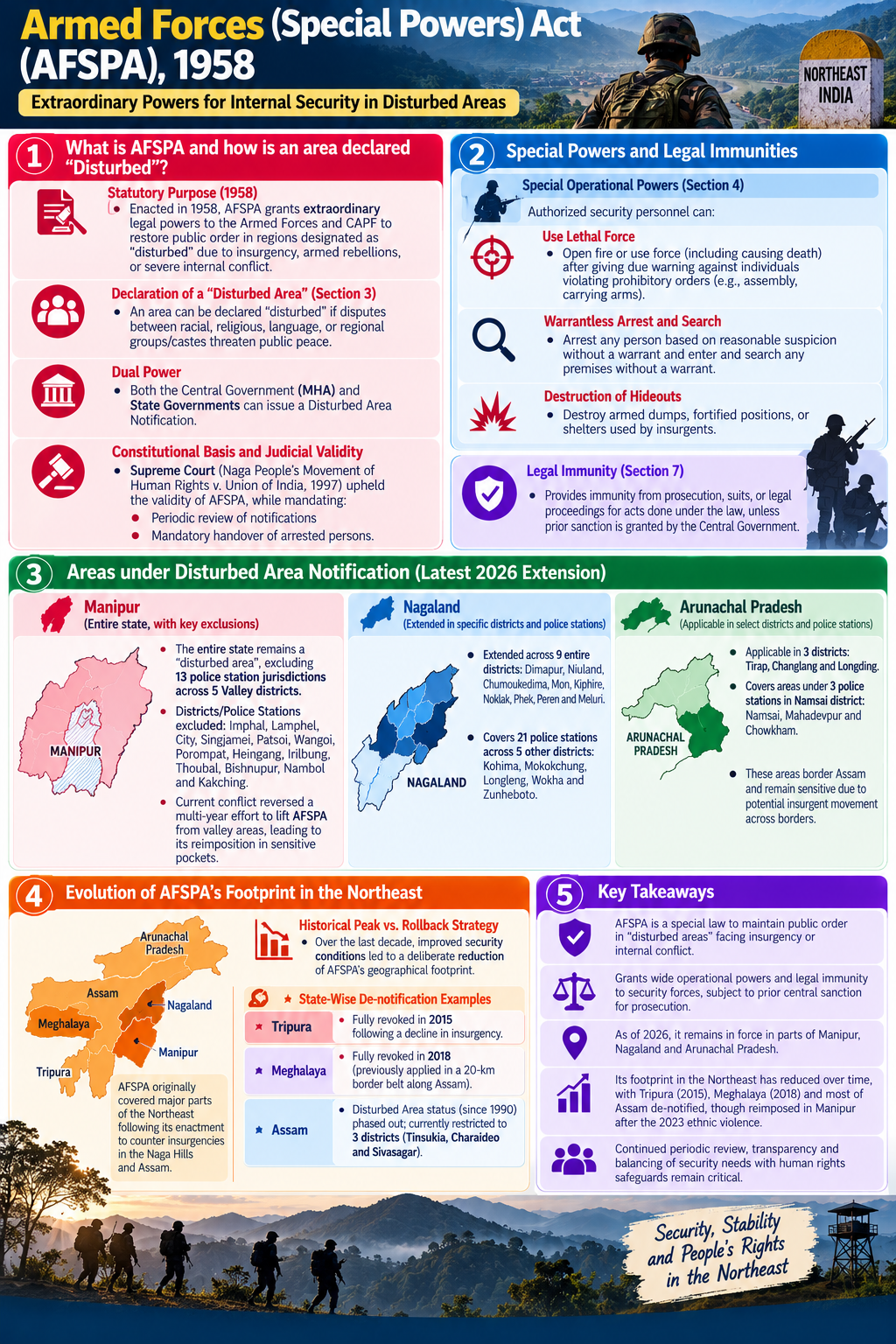
What special powers and legal immunities does AFSPA grant to the security forces?
- Special Operational Powers– According to (Section 4) of AFSPA Act Authorized security personnel can –
- Use Lethal Force – Open fire or use force (including causing death) after giving due warning against individuals acting in contravention of prohibitory orders (e.g., assembly of persons, carrying arms).
- Warrantless Arrest and Search – Arrest any person based on reasonable suspicion without a warrant and enter and search any premises without a warrant.
- Destruction of Hideouts – Destroy armed dumps, fortified positions, or shelters used by insurgents.
- Legal Immunity (Section 7) – Provides immunity from prosecution, suits, or legal proceedings for acts done under the law, unless prior sanction is granted by the Central Government.
Which areas remain under the Disturbed Area Notification following the latest 2026 extension?
- Manipur – The entire state remains declared as a "disturbed area", excluding 13 police station jurisdictions across 5 Valley districts (Imphal, Lamphel, City, Singjamei, Patsoi, Wangoi, Porompat, Heingang, Irilbung, Thoubal, Bishnupur, Nambol, and Kakching).
- The current conflict reversed a multi-year effort to lift the law from valley areas, leading the Centre to reimpose AFSPA in sensitive pockets.
- Nagaland – Extended across 9 entire districts (Dimapur, Niuland, Chumoukedima, Mon, Kiphire, Noklak, Phek, Peren, and Meluri) and areas under 21 police stations across 5 other districts (Kohima, Mokokchung, Longleng, Wokha, and Zunheboto).
- Arunachal Pradesh – Applicable in 3 districts (Tirap, Changlang, and Longding) and areas under 3 police stations (Namsai, Mahadevpur, and Chowkham) in Namsai district bordering Assam.
How has AFSPA's geographical footprint evolved across the Northeast over time?
- Historical Peak vs. Rollback Strategy – AFSPA originally covered major parts of the region following its enactment to counter armed insurgencies in the Naga Hills and Assam.
- Over the last decade, improved security conditions led to a deliberate reduction of its footprint.
- State-Wise De-notification Examples –
- Tripura – Fully revoked AFSPA in 2015 following a decline in insurgency.
- Meghalaya – Fully revoked in 2018 (previously applied in a 20-km border belt along Assam).
- Assam – Disturbed Area status (in place since 1990 state-wide) has been phased out, and is currently restricted to just 3 districts (Tinsukia, Charaideo, and Sivasagar).
- Reversal in Manipur – While AFSPA’s reach was contracting having been removed from all valley police stations by April 2023—the outbreak of ethnic violence in May 2023 halted this rollback, forcing a selective reimposition by the Centre to maintain law and order.
Reference
The Hindu | AFSPA



