Prelims: Current events of national and international importance | Geography
Why in News?
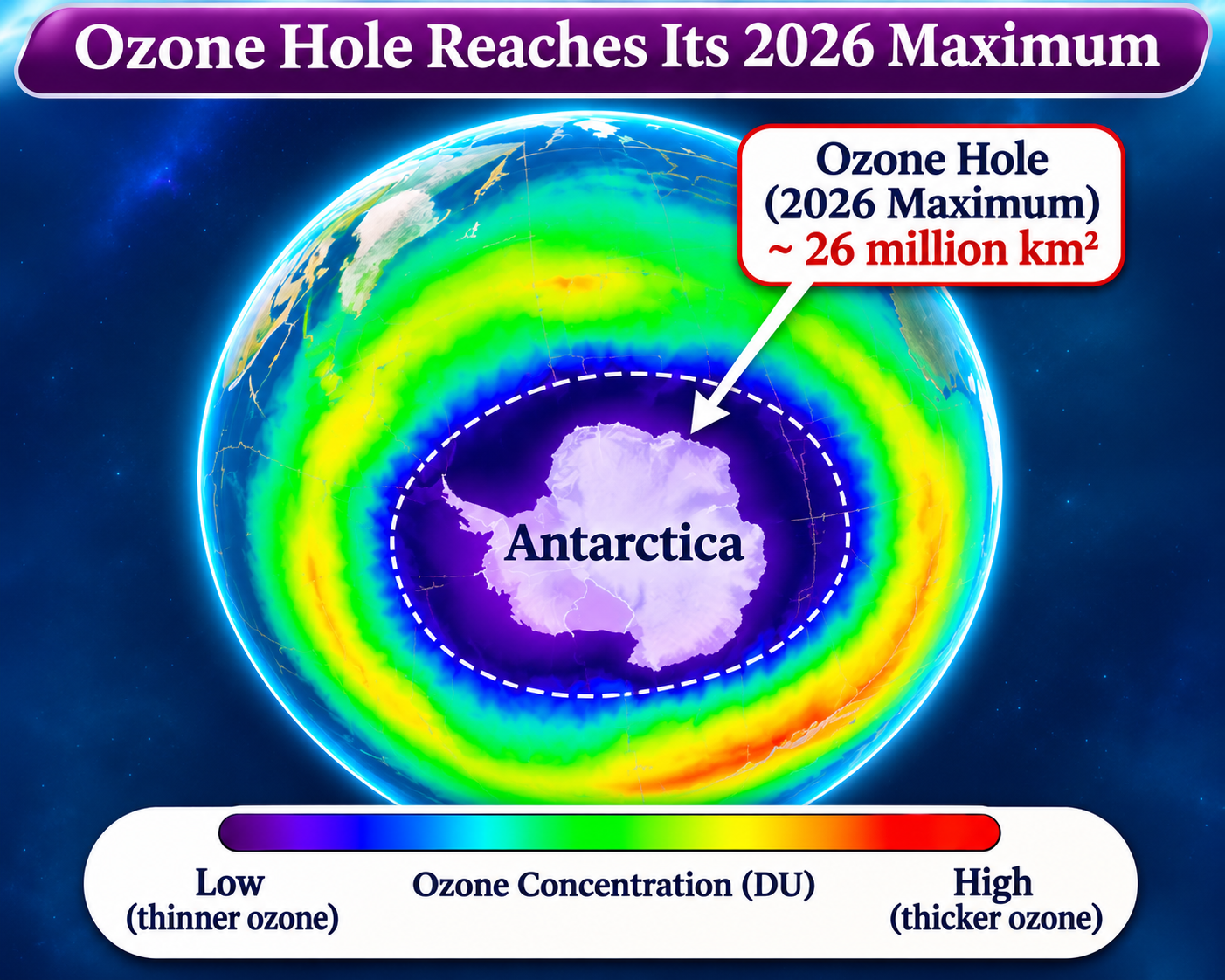
According to reports released by NASA and the National Oceanic and Atmospheric Administration (NOAA), the Antarctic ozone hole reached its 7th-largest size in 48 years of satellite monitoring.
- It is driven largely by meteorological conditions and an unusually powerful polar vortex, the seasonal average area reached approximately 25 million square kilometres.
Key Highlights
- Maximum Extent- At its peak on September 18, 2026, the ozone hole expanded to roughly 27.1 million square kilometres nearly 90% of the largest ozone hole ever recorded in the year 2000.
- Lowest Ozone Concentration - NOAA scientists recorded the lowest ozone value directly overhead at the South Pole on October 17, 2026, dropping to 105 Dobson Units (DU).
- For context, the all-time lowest recorded value was 92 DU in October 2006.
- Key Catalyst - Polar Stratospheric Clouds (PSCs) which form at temperatures below -78°C and activate chlorine/bromine compounds.
- Role of the Polar Vortex- The unusually large extent was fueled by a powerful and stable stratospheric polar vortex.
- Weak planetary-scale weather systems in August and September kept strong vortex winds further from the South Pole, creating a larger area of frigid conditions ideal for ozone destruction.
- Impact of the Montreal Protocol - Despite its large physical size, scientists emphasized that the ozone hole could have been 1 to 2 million square miles larger if ozone-depleting substances (like CFCs) were as prevalent today as they were at their peak in 2000.
- Stratospheric chlorine levels have declined by about a third since their 1980s peak, proving that international regulations continue to drive long-term recovery.
- Projected Recovery - Expected to fully heal and return to pre-1980 levels by the 2070s.
|
Definition of Ozone Hole
|
- Any geographic region over Antarctica where total ozone drops below 220 Dobson Units (DU)
|
|
Dobson Unit (DU)
|
- The standard unit of measurement for ozone concentration.
- One Dobson Unit refers to a layer of ozone that would be 0.01 mm thick if compressed under standard temperature and pressure at sea level (100 DU equals a thickness of 1 mm, roughly the thickness of a dime).
|
|
Montreal Protocol (1987)
|
- A landmark international environmental treaty designed to phase out the production and consumption of ozone-depleting substances (ODS) such as chlorofluorocarbons (CFCs) and halons.
|
Reference
NASA | Ozone Hole Reaches Its 2026 Maximum



