Why in News?
IIIT Bengaluru has been developing a host of projects with the idea of introducing higher efficiency in agricultural processes.
What is Agri Tech?
- Agri Tech – It is the use of technology to improve farming and agriculture across different value chains.
- Need for Agri Tech - Primarily an agrarian economy, India holds large potential for research and technological innovation in agriculture.
- Potential - Innovations in this space is estimated to be around $24 billion.
- Agri Tech areas:
- Precision farming - Accurate application of resources like water, fertilisers, and pesticides to increase efficiency and reduced environmental impact.
- Online Marketplaces - Selling fertilisers, seeds, farm tools, and other inputs at online marketplaces and mobile applications.
- Data-Driven Farming Solutions - Predict the supply-demand of inputs based on AI and data-driven decisions to help farmers anticipate challenges, plan better, and ultimately improve their crop yields.
- Supply Chain Technology - Platforms that connect farmers directly with buyers, cutting out middlemen and ensuring a more equitable distribution of profits.
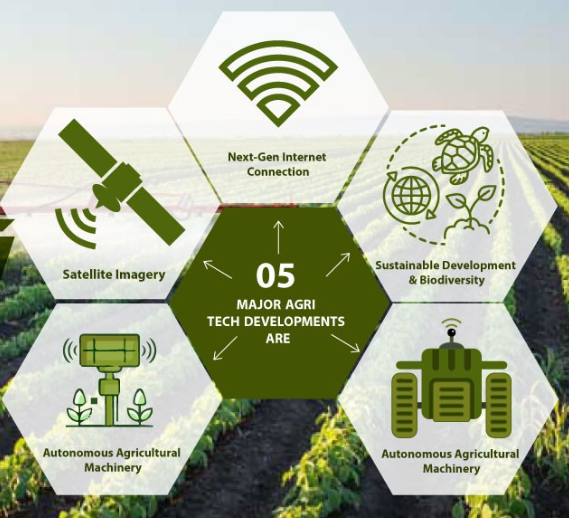
What are the technologies launched by IIITB?
- International Institute of Information Technology Bangalore (IIITB) is a premier research Deemed university in Bangalore, India.
- AutoGrow - an Autonomous greenhouse System for Precision Agriculture for growing food.
- Feature - The system seamlessly integrates biological food production with an IoT/AI-based system
- Automated greenhouse control of climatic conditions, irrigation, and nutrient supply to plants.
- Benefit - Increasing the efficiency of crop production while using optimal resources and thereby reducing costs.
- Vertical open field hydroponic system - It’s a non-linear control system where the inputs are continuously monitored, and the required amount of nutrition is administered.
- It is a control system realized with sensors and AI-ML algorithms.
- Smart Greenhouse Monitoring System - To transform greenhouse farming by leveraging IoT to improve crop health, automate environmental controls, and facilitate remote monitoring.
- Features - Real-time data monitoring utilising a network of sensors
- Automated control based on sensor data
- Remote accessibility for farmers via app
- Data analysis and alerts with the help of machine learning.
- Benefit - It enables farmers to monitor environmental conditions like temperature, humidity, soil moisture, and pH remotely.
- Provides real-time data for precise control over crop conditions.
- AgriSense - IT is an IoT system to address challenges like deteriorating health of soil due to over application of fertilisers and finding the optimum watering level to ensure maximum output.
- Features – It uses Agri-cone a mushroom shaped soil-monitoring device.
- The sensors detect gases such as including CO₂ and ammonia.
- Humidity sensors track air moisture levels around plants, helping to prevent diseases and promote healthy growth.
- Remote Compost Monitoring system – It is an intelligent IoT system that remotely monitors and manages compost which can then be used as fertilizer.
- Features - A sensor hub associated with each bin monitors pH values, temperature, humidity, and CO2 levels of the compost inside them.
Challenges in agri tech innovation?
- Low market adoption – Use of agri technologies by Indian farmers is very low.
- High customer acquisition cost – High initial cost of agri technologies deters farmers from using them.
- Lukewarm investor interest – Inadequate interest by investors to invest developing agri tech businesses.
- Inadequate finances - Lack of funding in agritech poses a challenge to scaling up and deployment.
- Fragmentated userbase - Reaching out to farmers is going to be difficult because the end users are too fragmented.
- Illiteracy – Literal illiteracy and digital illiteracy hinders farmers from using agri technologies.
What needs to changed to boost agri tech?
- Different approach - Agri-tech needs to be approached differently compared to consumer tech or other sectors which attract large funding.
- Interdisciplinary approach – Integrating various technologies to apply on agricultural tech development
- Digital public goods - Agriculture is a use case where solutions should be developed as public digital infrastructure.
- Working with Farmer Producer Organisations (FPO) - Conducting workshops to speak to farmers to get problem statements from them.
References
The Hindu | Different approach to Agri Tech



