Why in News?
The revised Agniveer Scheme 2026 introduces an additional 2-year engagement period for the 75% of Agniveers not selected for regular service after their initial four-year tenure, creating another opportunity for regular enrolment.
What is the Agnipath Scheme?
- Launched in – June 14, 2022.
- Objective – Recruit young personnel into the Armed Forces for a short-term tenure to maintain a younger, technologically adept military workforce.
- Service tenure – 4 years, including training.
- Regular enrolment – Up to 25% of each batch can be retained in the regular cadre after four years.
- Exit provision – The remaining 75% were required to leave military service with a Seva Nidhi financial package and other benefits.
What are the Major Changes in the Agniveer Scheme?
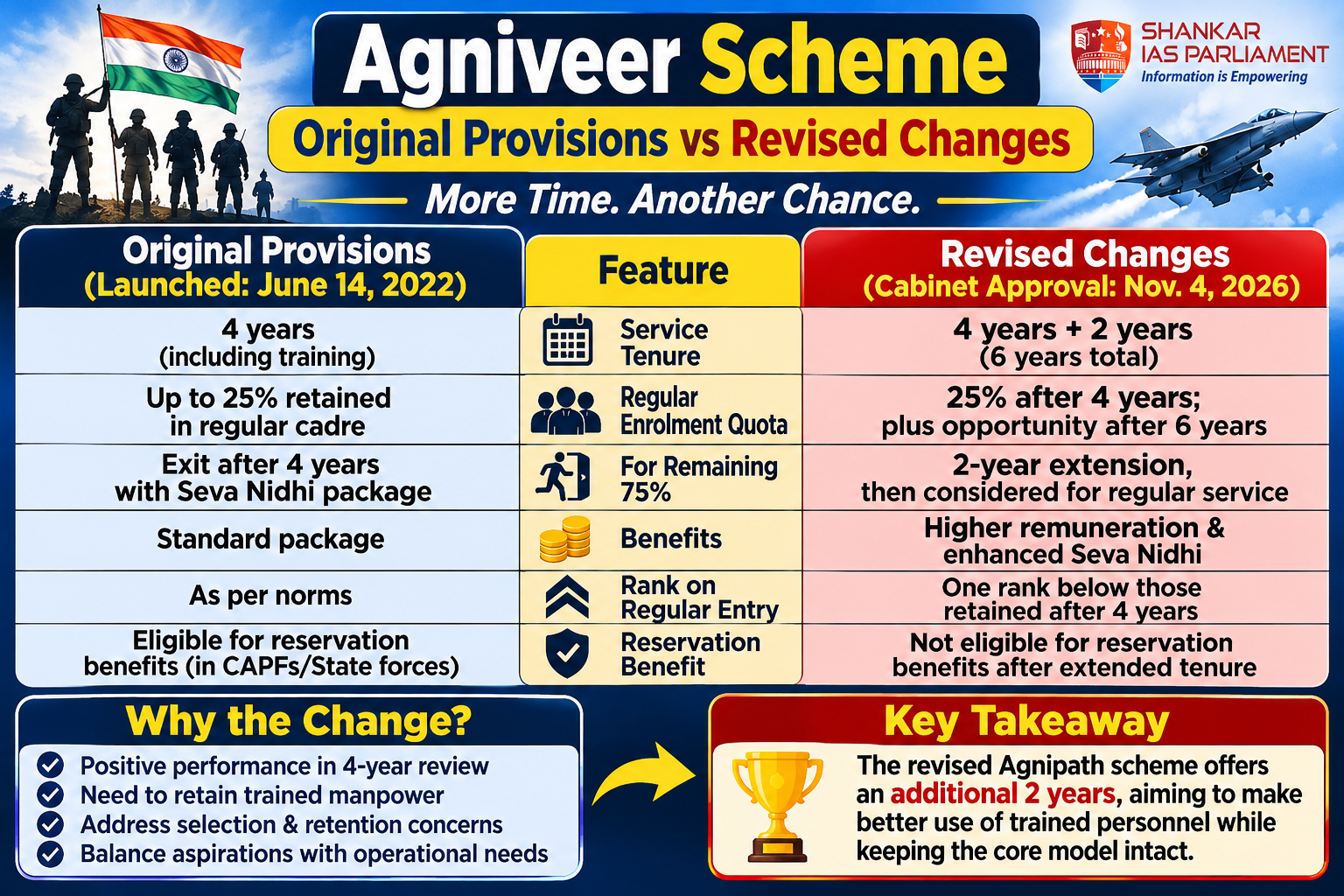
- Second Engagement Period – The remaining 75% of Agniveers, not selected during the initial four-year tenure, will be offered an additional two-year engagement.
- This extends their potential service period from 4 to 6 years.
- Additional Opportunity – At the end of six years, Agniveers will be considered for regular enrolment based on willingness, merit and prescribed objective selection criteria.
- The existing provision of retaining 25% after the initial four years remains unchanged.
- Enhanced Financial Benefits – Higher remuneration and an enhanced Seva Nidhi package will be provided to personnel opting for the second engagement period.
- Rank-Related Provision – Those selected for regular enrolment after the extended six-year period will be placed one rank below personnel directly retained after the initial four-year tenure.
- Changes in Exit Benefits – The revised arrangement creates an alternative to immediate civilian transition after 4 years.
- Agniveers entering regular service through the extended engagement route will no longer be eligible for the reservation benefits provided to exiting Agniveers in State and Central Armed Police Forces (CAPFs).
Why Did the Government Revise the Scheme?
- 4-Year Performance Assessment – The Armed Forces conducted a comprehensive assessment of Agniveers' performance, physical fitness, motivation, skills and operational contribution.
- Centralised databases and annual objective assessments across the three services helped evaluate their suitability for military requirements.
- Retaining Trained Manpower – Agniveers have acquired military training, technical skills and operational experience during their initial service.
- Releasing 75% of trained personnel after 4 years could result in the loss of valuable institutional experience and human resources.
- Addressing Recruitment and Retention Concerns – Selection of only 25% for regular service created limited opportunities for permanent absorption.
- The additional engagement period provides another opportunity for deserving personnel to demonstrate their capabilities.
- Aligning Aspirations – The revision seeks to balance the aspirations of Agniveers for longer military careers with the Armed Forces' requirement for experienced personnel.
- Non-selection in the initial 25% does not necessarily indicate poor performance; it may reflect relative merit and limited vacancies.
What Did the Four-Year Assessment Reveal?
- Wider recruitment base – Recruitment expanded to a larger number of districts across India.
- Transparent recruitment – Greater standardisation and transparency in the selection process.
- Physical fitness – High levels of fitness, morale, motivation and discipline.
- Technological adaptability – Better adaptability to modern military technologies and skill development.
- Educational qualifications – Improved educational and technical capabilities.
- Women in Armed Forces – Opened opportunities for women's participation in various branches.
What is the Significance of the Revised Scheme?
- Operational efficiency – Retaining trained personnel can improve military preparedness and reduce repeated training requirements.
- Experience retention – Longer engagement enables personnel to acquire deeper operational knowledge and institutional experience.
- Human resource management – Provides the Armed Forces with a larger pool of trained personnel for regular enrolment.
- Career opportunities – Offers Agniveers an additional pathway towards a longer military career.
- Military modernisation – Maintains the objective of a younger, technologically skilled and adaptable military workforce while addressing experience requirements.
What are the Challenges and Concerns?
- Uncertainty of permanent absorption – Regular enrolment remains subject to merit and selection criteria, rather than being guaranteed to all willing Agniveers.
- Rank disparity – Personnel retained after six years will enter one rank below those retained after four years.
- Reservation concerns – Agniveers opting for extended engagement and subsequent regular enrolment will lose access to post-service reservation benefits available to exiting personnel.
- Long-term career planning – Differences in service tenure, rank and benefits may create concerns regarding career progression and parity.
What is the Way Forward?
- Ensure transparent, objective and uniform selection criteria across the three services.
- Provide clear information about remuneration, promotions, pensions and other service-related benefits.
- Strengthen skill certification and rehabilitation opportunities for Agniveers who eventually exit military service.
- Conduct periodic evaluations to ensure that the revised arrangement meets both operational requirements and personnel aspirations.
What lies ahead?
- The revision of the Agnipath scheme represents an attempt to balance military modernisation with manpower retention.
- Providing a second engagement period can help preserve trained human resources while offering Agniveers an additional opportunity for regular military service.
- Its success will depend on transparent selection, fair service conditions and effective career transition mechanisms.
Reference
The Hindu| Agniveer Scheme Changes



