0.1294
7667766266
x

Adjournment & Prorogation of Lok Sabha

iasparliament Logo
November 04, 2026

Prelims: Current events of national and international importance | Polity

Why in news?

The Monsoon Session of Parliament this year — the eighth session of the 18th Lok Sabha — has recorded the longest sine die adjournment in history, as it has not been prorogued yet after 83 days.
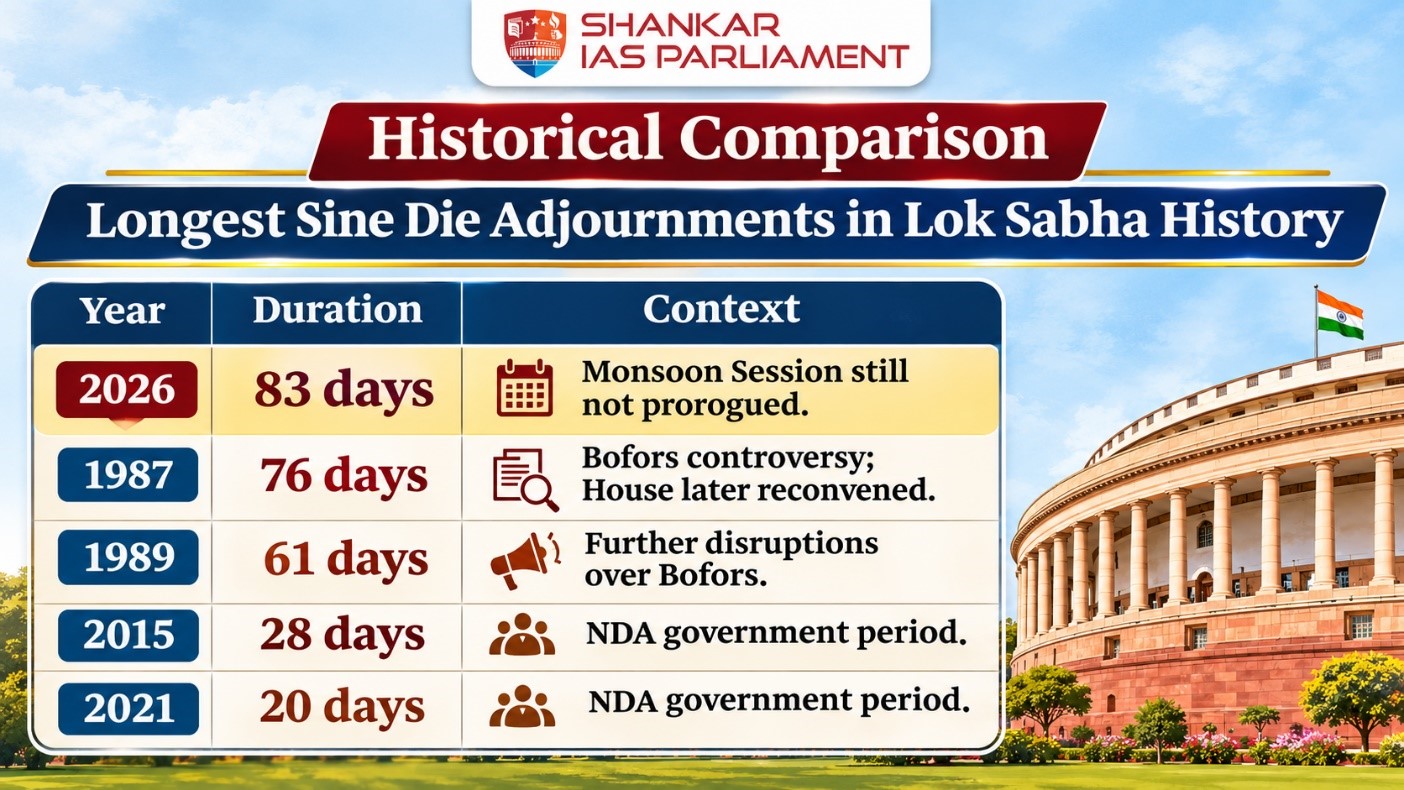
  • Reason for delayed Prorogation – The prolonged gap has triggered speculation that the government may reconvene Parliament to take up delimitation-related legislation and measures linked to the implementation of the Women's Reservation Law.
  • However, these claims remain speculative and are not based on any official parliamentary decision.
  • Possibility of Special Session – It can be convened at shorter notice.
  • If a session has been adjourned sine die but not prorogued, it technically remains alive, and the Lok Sabha can be reconvened at short notice by the Speaker under Rule 15 of the Rules of Procedure.

history-of-adjournment-sine-die.jpg.upsc

Adjournment sine die

  • It means terminating a sitting of Parliament for an indefinite period.
  • In other words, when the House is adjourned without naming a day for reassembly, it is called adjournment sine die. ("Sine die" is a Latin term meaning "without a day".)
  • Issuing Power – Presiding officer of the House.
  • Effect – It ends the current sitting indefinitely, but the session remains alive. The House can be reconvened later by the Speaker.

Adjournment

  • It refers to the suspension of a sitting of a House for a specified period, which could be a few hours, a day, several days, or longer.
  • Issued by – Presiding officer of the House.
  • Effect – It terminates only a sitting of the House; the parliamentary session continues. The House meets again on the date already fixed.

Prorogation

  • It is the formal termination of a session of Parliament.
  • Issued by – The President under Article 85(2) of the Constitution, on the advice of the government.
  • Article 85 – Empowers the President to summon Parliament; the convention is to give around 15 days’ notice for a regular session. However, the rules require that no more than six months elapse between two consecutive sittings of the House.
  • Effect – It ends the entire session; all sittings of that session come to a close. A new session must be summoned to meet again.

Quick Fact

Annual Sessions of Parliament

  • Budget Session (February – May) – The longest and most important session. It begins with the President's address, features the presentation and debate of the Union Budget, and includes a recess for parliamentary committees to review financial proposals.
  • Monsoon Session (July – August) – Typically lasts about three weeks to a month. It focuses on introducing and passing new legislation, debating national issues, and conducting executive oversight.
  • Winter Session (November – December) – The final session of the parliamentary year, lasting around three weeks to address pending bills and national policies.
  • Special Sessions – Convened by the President on the advice of the Cabinet/Government to address urgent matters or specific national issues (such as discussions on special legislative priorities).

Reference

Indian Express | Monsoon Session yet to be prorogued, longest gap on record

There are no reviews yet. Be the first one to review.

ARCHIVES

sidetext

