Mains: GS Paper III | Energy
Why in News?
The Union Cabinet has cleared the Pradhan Mantri Surya Sarovar Yojana (PM-SSY), to build 5,000 MW of floating solar photovoltaic (FSPV) capacity on India’s reservoirs and waterbodies.
What is a Floating Solar Plant?
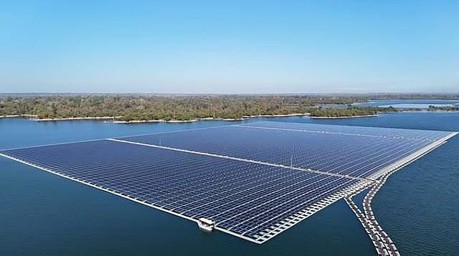
- It is a solar array that floats on a water surface and consists of a reservoir, irrigation tank, industrial pond or hydropower lake instead of on land.
- Its modular blocks of panels are assembled onshore, floated out, and held in place by anchors and mooring lines built to withstand wind, waves and shifting water levels.
- Inverters sit on the floats or on the bank, and cables run over the floats to a substation.
How do the plants work?
- Panels convert sunlight to electricity exactly as on land; the difference is the flotation-and-mooring system beneath them.
- Water cooling can lift energy yield, while shading cuts evaporation and algae growth.
- There are trade-offs, which are mechanical.
- These include continuous motion wears floats, joints and cables.
What does global experience show?
- The report puts cumulative global capacity at roughly 9.6 GW by 2024, with 1–1.2 GW added each year across more than 500 completed projects over 90% of them in Asia.
- China leads, trailed by countries such as India, South Korea and Japan, where land scarcity, supportive policy and abundant reservoirs have driven adoption.
- Europe is a smaller but expanding market.
- Europe’s installations rising from 10 MW in 2017 to nearly 270 MW by 2022, with the Netherlands alone accounting for about 3-quarters of the continent’s capacity.
- Israel, Brazil, Chile, Ghana and Australia are emerging players.
- The World Bank has estimated that using even part of the world’s man-made reservoirs could support several terawatts of solar.
What is Pradhan Mantri Surya Sarovar Yojana (PM-SSY)?
- It is designed to scale up Floating Solar Photovoltaic (FSPV) projects integrated with Energy Storage Systems (ESS) across India's reservoirs, dams, lakes, and industrial ponds.
|
Parameter
|
Details
|
|
Scheme Type
|
Central-sector scheme.
|
|
Nodal Ministry
|
Ministry of New and Renewable Energy (MNRE).
|
|
Implementing Agency
|
Solar Energy Corporation of India (SECI).
|
|
Financial Outlay
|
Rs.5,070 crore.
|
|
Target Capacity
|
5,000 MW of floating solar capacity (FY 2026–27 to FY 2030–31).
|
|
Storage Mandate
|
Co-located ESS with min. 2-hour duration (~10,000 MWh total)
|
|
Technical Potential Basis
|
NISE potential assessment of 102.18 GWp floating solar capacity
|
|
Coverage
|
All States and Union Territories
|
- Every project must be paired with an energy storage system of at least 2 hours, collectively 10,000 MWh in all, so that States can use the stored power to meet peak demand.
India currently has an installed floating solar capacity of about ~0.7 GW against a potential of 102 GW.
- Potential States - Maharashtra (16.28 GWp) and Madhya Pradesh (14.89 GWp) lead, followed by Karnataka, Odisha, Telangana and Gujarat.
- Several are not renewables-rich, so the scheme doubles as a tool for decentralised solar deployment.
What is the Financial Assistance Architecture?
- Post-Commissioning CFA - Developers receive Rs.1 crore per MW as Central Financial Assistance (CFA) upon successful commissioning to bridge the ~25% capital cost premium of floating platforms over ground-mounted solar.
- Project De-Risking Support - Grants of up to Rs.50 lakh per site fund upfront technical feasibility studies.
- It includes bathymetric and hydrographic surveys, solar-yield assessments, and aquatic ecological impact evaluations within a 9-month window.
- Implementation Horizon - Sanctioning window spans FY 2026–27 to FY 2030–31, with financial disbursements continuing through FY 2032–33.
What are the Core Objectives & Strategic Value?
- Eliminating Land Acquisition Friction - Utility-scale ground solar requires ~4–5 acres of land per MW, which often triggers local compensation disputes and land-use conflicts.
- FSPV utilizes existing state-owned water surfaces, requiring land only for power evacuation cabling.
- Mitigating "Duck Curve" & Curtailment- Unbuffered midday solar generation frequently leads to output curtailment.
- Mandatory 2-hour battery storage ensures electricity generated during peak sunlight is stored and dispatched during high-demand evening hours.
- Regional Energy Balance- Non-traditional renewable states with extensive reservoir networks (e.g., Maharashtra, Madhya Pradesh, Karnataka, Odisha, and Telangana) can generate decentralized solar power locally.
- Water & Efficiency Benefits - Water cooling raises PV panel operational efficiency, while panel shading reduces surface evaporation losses and inhibits harmful algal growth.
- Macro-Economic Impact - Expected to abate ~10 million tonnes of CO₂ emissions annually while creating 16,000–17,000 jobs across the manufacturing, installation, and maintenance value chains.
What are the Operational Challenges?
- Higher Initial CapEx - FSPV costs ~Rs.4.9–5.2 crore/MW compared to Rs.3.9–4.2 crore/MW for ground-mounted solar, with battery storage adding another rs.0.9–1.2 crore/MWh.
- Environmental Fatigue - Waves, moisture, and corrosion accelerate wear on floats, joints, and dynamic underwater cabling.
- Water Level Draft Changes - Rapid seasonal drawdown in reservoirs alters mooring line tension, requiring specialised, flexible mooring designs.
How does this feed India’s climate committments?
- The 5,000 MW adds to the non-fossil capacity underpinning India’s climate pledges, its updated Nationally Determined Contribution and the Panchamrit goals of 500 GW non-fossil power by 2030 and net-zero by 2070.
- The government estimates the scheme will abate around 10 million tonnes of CO₂ emissions annually, while generating 16,000–17,000 jobs across the value chain.
What is the Way Forward?
- The Pradhan Mantri Surya Sarovar Yojana marks a transition from simple capacity expansion to grid-integrated, land-neutral renewable energy.
- By coupling the natural cooling benefits of water bodies with battery storage, India can solve its solar curtailment problem while opening a vast new energy footprint across non-traditional solar states.
Reference
The Hindu | Floating solar boost in India’s renewable energy uptake



