What is the issue?
The RBI recently gave license to National Asset Reconstruction Company Limited (NARCL), popularly known as a bad bank but the absence of a clause about the lifespan of NARCL may lead to a moral hazard problem.
What are bad banks?
- Technically, a bad bank is an asset reconstruction company (ARC) or an asset management company that takes over the bad loans of commercial banks, manages them and finally recovers the money over a period of time.
- The bad bank is not involved in lending and taking deposits.
- It just helps commercial banks clean up their balance sheets and resolve bad loans.
- The takeover of bad loans is normally below the book value of the loan and the bad bank tries to recover as much as possible subsequently.
- US-based Mellon Bank created the first bad bank in 1988.
- The role of the bad bank is to establish a liquid market for NPAs to enable the banks to sell their NPAs at a fair value.
What is the status of NPAs in India?
- Currently, the Indian banking system has one of the highest gross non-performing assets (GNPA) to total asset ratio globally.
- Post-covid stress scenarios estimated by the RBI pegs it at an aggregate GNPA ratio in the range of 12.5- 14.7 %
What mechanisms have been initiated to recover NPAs?
- Debt recovery tribunals - under the Recovery of Debts Due to Banks and Financial Institutions (RDDBFI) Act in 1993
- Asset Reconstruction Companies (ARCs) - a part of the Securitisation and Reconstruction of Financial Assets and Enforcement of Security Interest Act (SARFAESI Act) in 2002
- Insolvency and Bankruptcy Code (IBC) in 2016
What is NARCL?
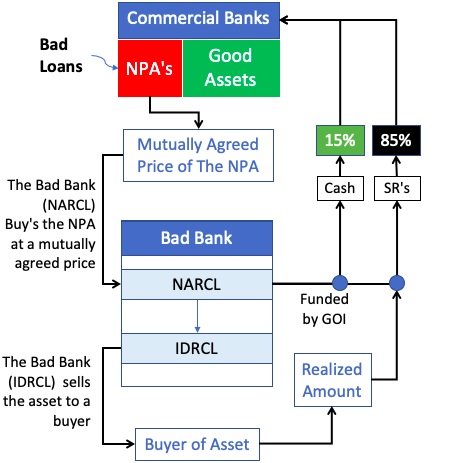
- India’s first-ever bad bank, National Asset Reconstruction Company Limited (NARCL) will acquire stressed assets worth about Rs 2 lakh crore from various commercial banks
- It will pay 15% of the agreed price in cash and the remaining 85% will be in the form of Security Receipts.
- The rest will be paid when the assets are sold by India Debt Resolution Company Ltd (IDRCL).
- Rs 90,000 crore of the asset will be managed in the first phase.
- A government guarantee will back the Security Receipts for a maximum amount of Rs.30,600 crore, and the guarantee will be valid for a resolution period of five years.
- The NARCL is essentially an Asset Reconstruction Company (ARC) with only two distinguishing features
- NARCL is intended for dealing in big sized tickets
- NARCL has a partial government guarantee.
- The effectiveness of ARCs hinges on
- A focused mandate for setting up the ARCs
- Limited lifespan of the ARC
- Market-based resolution of NPAs
What are the issues in NARCL?
- The absence of a clause about the lifespan of NARCL may lead to a moral hazard problem.
- Propagation and evergreening of bad loans - Public sector banks (PSBs) which own 51 % stake in NARCL may continue buying their own stressed assets through NARCL.
- There are question marks over the government guarantee of Rs 30,600 crore in providing liquidity and creating a market for the NPAs.
How can the problems be addressed?
- The government should address the lifespan issue of NARCL in the form of a sunset clause to increase the effectiveness of the NARCL.
- There should be a fair and transparent mechanism while setting the haircut on the stressed assets by the NARCL.
- The net asset value of the Security Receipts must be fairly priced to boost the participation and liquidity in the security receipts market.
- There needs to be a strong political will to recognise bad loans and support legal infrastructure to address wilful defaulters.
Reference
- https://www.thehindubusinessline.com/opinion/why-a-bad-bank-needs-a-sunset-clause/article37424464.ece



