Why in news?
There is a need to implement a collaborative model to meet the challenges faced by creative economy.
What is creative economy?
- Creative economy is an evolving concept is an evolving concept which builds on the interplay between human creativity and ideas and intellectual property, knowledge and technology.
- Also called as Orange economy, it is a knowledge based economic activity.
- Creative industries include film, television, publishing, museums, music, arts, computer programming, crafts, architecture and design.
- They are considered as an important source of commercial and cultural value.
What is the status of creative economy?
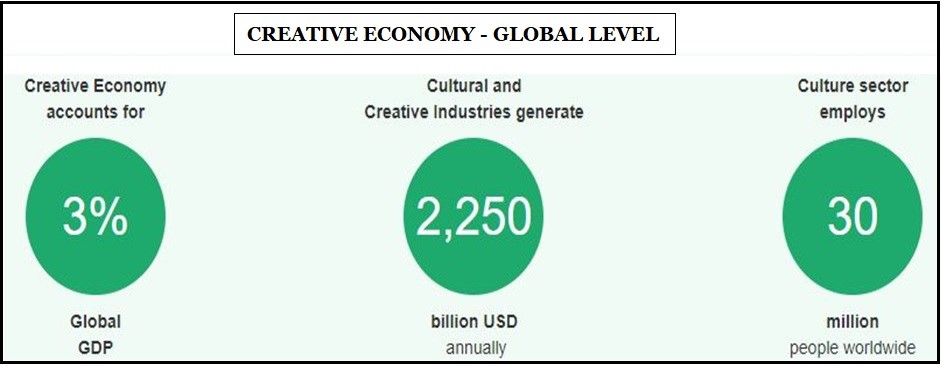
- The creative economy is one of the world’s most rapidly growing sectors, contributing 3% of the global GDP.
- According to EXIM Bank study, Creative economy in India accounts for 121 billion of exports in 2019.
- India ranks 6th globally outside USA with respect to top international box office market by revenue.
What is the significance of creative economy?
- Preservation of art - Artists and artisans play a vital role in preserving traditional art forms and contribute immensely to the cultural economy.
- Creative supply chains - It will make a country or region more attractive destination for investment in film, TV series and further increase growth in supply sectors like music.
- Shared IP -It will create major revenues across multiple creative industries from Pokemon to Harry Potter.
- Creative technology -There is increasing overlap between digital and creative industries, which is further enhanced with Artificial intelligence, VFX.
- Regional development - It will likely play more important role in a greater range of regions over time.
- Policy for Skill Enhancement- There will technical skill policy development to improve the education system to support the creative economy which is increasing in demand.
- Global competitiveness - This is further promoted by increase in incentives and rewards to the countries which performs well in this industry.
- Overall development - It helps in the creation of jobs, economic growth, tourism, exports, and overall societal development.
What are the challenges faced by the artisans in India?
- Appointments – As there is no systematic or rotational mechanism in place for selection of artists, it creates inequality in representation.
- The selection process is often random or based on subjective criteria, which makes the artists unable to gain from sponsored platforms.
- Poor support-There are no serious efforts by private or public institutions to promote contemporary artists as brands.
- Crime in art world- It includes art theft, copyright infringement, forgery, fraud, and illicit trafficking.
- Lack of audit- There is no institutional infrastructure, expertise and technology to verify the original artwork. This gap leads to injustice towards genuine artists.
- Other Challenges- Unaccounted money preserved through artworks, dissemination of disinformation about cultural history, etc.
What efforts were taken in this regard?
- UNESCO
- MONDIACULT 2022- It is a World Conference on Cultural Policies and Sustainable Development.
- Creative Cities Network- It is created in 2004 which covers 7 creative fields
- In India 6 cities has been selected
- Srinagar – Crafts and Folk art category was the last addition (2021).
- UNCTAD -United Nations Conference on Trade and Development
- Creative Economy Program- It is initiative of UNCTAD which generates economic information through a trade lens, to understand past trends and project into the future.
- Creative Economy Outlook 2022 - It is published by UNCTAD which provides latest data and trends on fast growing creative economy sector.
- Bridgetown Covenant- It is the outcome of the Creative Industries and Trade Digitalization Forum and calls UNCTAD to place greater emphasis on societal and developmental benefits.
- United Nations General Assembly (UNGA)
- UNGA recognises 2021 as International Year of Creative Economy for Sustainable Development.
How to address the challenges faced by the creative economy?
- Robust security architecture- It is possible by deploying advanced technology for authentication and tracking which would foster healthy creative economy.
- Regular audits- There must be regular audits of acquired artworks to enhance trust and preserve the collection’s integrity.
- An institutional record of incoming and outgoing artworks with a verified identification mark is required.
- Enhancing India’s soft power - It can be done through a capacity-building centre which would create an ecosystem of innovative technology-based start-ups in the arts and crafts sector.
- Fulfilling the artists’ needs – Artists’ needs must be bridged by training, professional development, market access, and participation in larger communities and networks.
- Use of ICT - Data analytics should be used to foster creative ecosystems that contribute to a sustainable world.
- Public-Private Partnership- PPP is required to empower artists, bridge industry gaps, and contribute to the overall development of the creative economy.
What lies ahead for India?
- To develop the creative economy to realize its full potential, Indian policy makers would like to
- Increase the recognition of Indian culture globally
- Facilitate human capital development among its youth
- Address the bottlenecks in the intellectual property framework
- Improve access to finance
- Streamline the process of policy making by establishing one intermediary organization
- India must also leverage its G20 Presidency to put creative economy concretely on the global agenda.
References
- The Hindu| A new Palette for Creative Economy
- UNESCO| Creative Economy 2021
- ANI| Talentverse



