Mains: GS Paper II | Bilateral Relations | India and its Neighbourhood Relations.
Why in News?
Both India and China are facing extreme weather events that threaten economic growth, food security, and public well-being in the two most populous countries.
What are the drivers of shared climate vulnerability?
- The Third Pole Crisis - The Hindu Kush Himalaya (HKH) region contains the largest ice mass outside the polar regions.
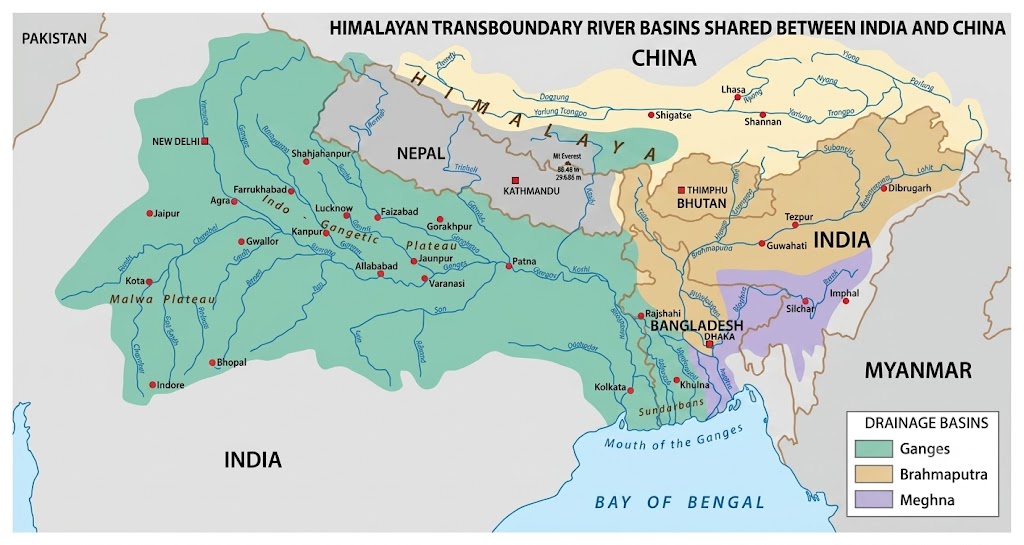
- It feeds 10 major Asian river systems (including the Brahmaputra/Yarlung Tsangpo, Indus, and Mekong/Lancang).
- Glacial retreat in the Himalayas is accelerating at unprecedented rates, increasing the incidence of
- Glacial Lake Outburst Floods (GLOFs),
- Landslips, and
- Erratic seasonal runoff.
- It disrupts downstream agriculture and hydropower infrastructure in both countries.
- Monsoonal Disruptions - Shifts in sea surface temperatures and regional warming patterns have rendered monsoon dynamics unpredictable.
- Extreme Hydrological Events - Both nations face a dual threat-compressed, ultra-intense rain events causing urban flooding, followed by extended dry spells threatening food and water security.
- Rapid Urban Adaptation Demands - Megacities in both nations face severe infrastructure deficits against extreme weather.
- Managing urban runoff, heat island effects, and coastal/riverine flood protection are common administrative priorities.
What are the main areas for India-China climate collaboration?
Transboundary River Governance
- Hydrological Data-sharing - Expand hydrological data-sharing agreements on the Brahmaputra (Yarlung Tsangpo) and Sutlej (Langqen Zangbo) beyond flood seasons to round-the-year data, improving baseline flow models.
- Joint GLOF Monitoring - Establish joint scientific task forces to map high-risk glacial lakes across Tibet and the Indian Himalayan region, deploying real-time automated telemetry.
- Disaster Risk Reduction (DRR) - Bilateral institutional mechanisms for joint disaster response, early warning integration, and hazard mapping under the framework of the Sendai Framework for Disaster Risk Reduction (2015–2030).
Clean Energy Transition
- Supply Chain Synergies - China is the global leader in solar PV component manufacturing, battery cell production, and EV supply chains.
- India possesses massive scaling capacity and demand under its National Green Hydrogen Mission and renewable energy targets.
- Global South Leadership - As key members of BASIC (Brazil, South Africa, India, and China) and BRICS, joint bargaining strengthens the Global South's position on climate finance (NCQG) and Loss & Damage mechanisms at UNFCCC COPs.
- Urban Adaptation - Cross-learning between China’s Sponge Cities Initiative (permeable infrastructure, urban wetland restoration) and India’s AMRUT / Smart Cities Mission to counter urban flash flooding.
What are the strategic challenges?
- Geopolitical & Border Friction - Strategic distrust along the Line of Actual Control (LAC) frequently leaks into functional cooperation, causing environmental data to be securitised rather than shared openly.
- Asymmetry in Water Data Transparency- China’s upstream position creates anxieties in lower riparian India regarding dam construction (e.g., proposed super-dam at Medog on the Brahmaputra bend) and selective data transparency.
- Trade Barriers - Rising tariff/non-tariff barriers on Chinese clean-tech imports in India due to economic de-risking goals complicate technology transfer.
- Competing Global South Ambitions - Rivalry for regional influence in South Asia and Africa often overshadows opportunities for joint climate leadership.
What is the way forward?
- To build climate resilience, India and China must insulate scientific and ecological collaboration in the Hindu Kush Himalayas from border disputes using a Track 1.5 technocratic approach.
- Reviving bilateral joint working groups on environment and water is essential to institutionalise automated, protocol-driven data sharing.
- Utilise forums like the SCO, BRICS, and ICIMOD to secure broader regional consensus and backing for Himalayan ecological protection.
- Jointly define standards for green technologies, adaptation frameworks, and carbon credit mechanisms to strengthen collective leadership for developing economies.
Reference
The Hindu | Climate resilience pathway between India and China



