Prelims: Current events of national and international importance | Environment
Why in News?
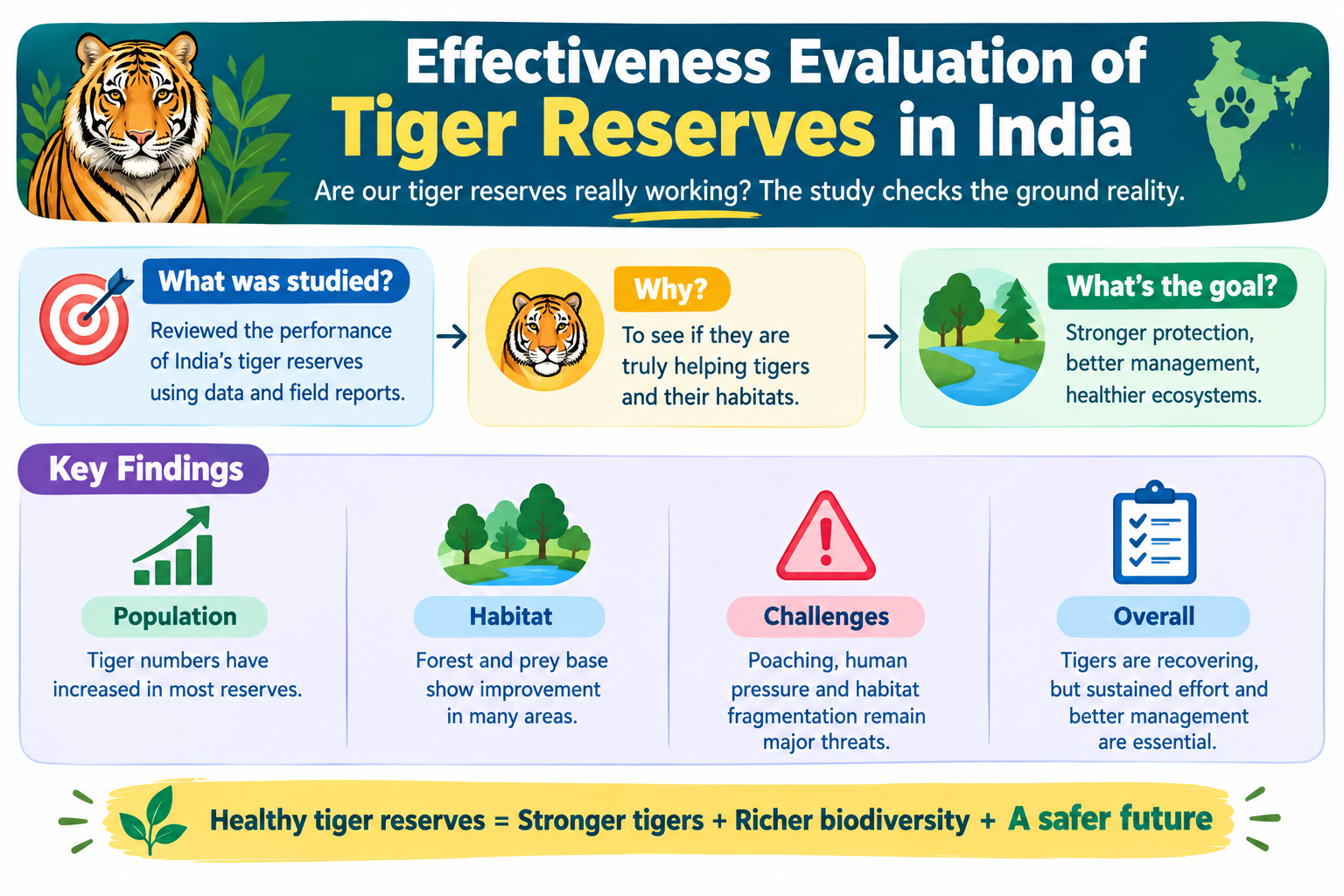
Recently, the Union Minister for Environment, Forest and Climate Change launched the Inception Workshop for the 6th Cycle of Management Effectiveness Evaluation of Tiger Reserves (MEE-TR 2026) in New Delhi.
- Organised by - The National Tiger Conservation Authority (NTCA) in collaboration with the Wildlife Institute of India (WII).
- The session marked the official release of the Technical Manual for MEE-TR 2026.
- This 6th cycle expands evaluation to cover all 58 notified Tiger Reserves across India.
Management Effectiveness Evaluation (MEE-TR)
- Definition – It is a systematic, evidence-based assessment framework.
- It is designed to evaluate how effectively protected areas are managed, auditing administrative capacity, input resources, planning, and long-term conservation outcomes beyond mere species headcounts.
- Global Framework Adaptation - Adapted directly from the IUCN World Commission on Protected Areas (WCPA) Framework for Assessing Management Effectiveness.
- 6 Core Evaluation Elements-
- Context - Value, threats, and policy environment.
- Planning - Design, layout, and management plans.
- Inputs - Financial, human, and material resources.
- Processes - Management practices, field patrolling, and conflict protocols.
- Outputs - Implementation of targets, anti-poaching infrastructure, and expenditure.
- Outcomes - Prey-predator dynamics, habitat integrity, and community co-management.
- Evolution of MEE Cycles in India - Initiated in 2006, India is the only nation globally to conduct MEE for its big cat reserves quadrennially across five past cycles
- 2006: 28 reserves | 2010: 39 reserves | 2014: 43 reserves | 2018: 50 reserves | 2022 (5th Cycle): 51 reserves (Periyar Tiger Reserve ranked No.1 with 94.38%).
Key Innovations in the 6th Cycle (MEE-TR 2026)
- Dedicated Solid Waste Management (SWM) Criterion - Introduces an independent, mandatory evaluation metric focusing on containment, segregation, and disposal of solid waste across three internal streams
- Anti-poaching forest camps (chowkis).
- Eco-tourism zones and safari corridors.
- Biomedical and organic waste generated at wildlife rescue centres.
- Integration of Evidence - Emphasizes satellite remote sensing, geo-tagged field patrolling logs, real-time spatial monitoring platforms, and data integration over subjective feedback.
- Inclusion of Local Community - Incorporates local community representatives, local youth, and independent sociological experts into multidisciplinary evaluation teams alongside retired forest officers and scientists.
- Measurable Community Interfaces - Enhanced scrutiny of voluntary village relocation schemes from core/critical tiger habitats.
- Under Section 38V of the Wildlife (Protection) Act, 1972, alongside the functional efficacy of Eco-Development Committees (EDCs).
Scoring Framework
|
Performance Band
|
Percentage Score Range
|
|
Excellent
|
90% and above
|
|
Very Good
|
75%" to " 89%
|
|
Good
|
60%" to " 74%
|
|
Fair
|
50%" to " 59%
|
Reference
PIB | Effectiveness Evaluation of Tiger Reserves in India



