0.0958
7667766266
x

2026 Nobel Prize in Economic Sciences

iasparliament Logo
October 13, 2026

Prelims: Current events of national and international importance | Awards

Why in News?

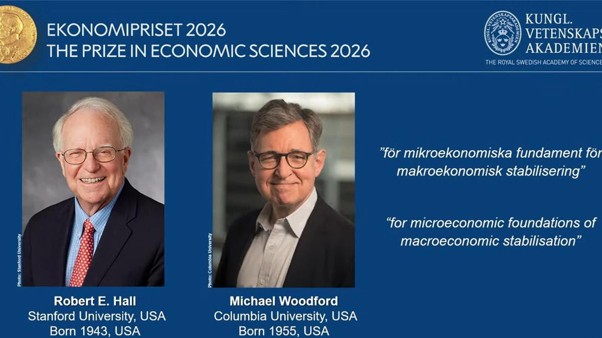
Recently, the Royal Swedish Academy of Sciences awarded the Sveriges Riksbank Prize in Economic Sciences jointly to Robert E. Hall (Stanford University) and Michael Woodford (Columbia University).

  • The 2026 Sveriges Riksbank Prize in Economic Sciences in Memory of Alfred Nobel is the official name of the economics prize commonly called the Nobel Prize in Economics.
  • This year the award recognises Robert E. Hall (Stanford University) and Michael Woodford (Columbia University)’s work on “microeconomic foundations of macroeconomic stabilisation.”
  • Their research helped develop New Keynesian models used by central banks and governments to manage economic fluctuations.
  • Robert E. Hall (Consumption Smoothing & Labor Market Frictions)
    • Random Walk Hypothesis of Consumption (1978) - Showed that if consumers optimize their life-cycle spending under rational expectations, changes in consumption should follow a random walk, meaning future consumption is predicted only by current consumption, not by current income alone.
    • Labor Frictions & Macro Dynamics - Analyzed how search frictions, sticky wages, and unemployment fluctuations impact real economic cycles and policy effectiveness.
  • Michael Woodford (Inflation Targeting & Interest Rate Rules)
    • New Keynesian Framework (Interest and Prices) - Reconstructed macroeconomic policy models to show how monetary policy operates primarily by steering market expectations of future interest rates rather than merely adjusting the money supply.
    • Forward Guidance & Zero Lower Bound - Established the theoretical foundation for modern central bank communication strategies (like forward guidance), explaining how central banks can maintain monetary policy traction even when short-term interest rates hit zero.

Comparison of Economic Modeling Paradigms

Structural Aspect

Traditional Macro-Models (Pre-1970s)

Hall-Woodford Reconstructed Framework

Foundational Basis

Purely aggregate statistical correlations (e.g., static Phillips Curve).

Microfoundations based on individual utility & profit maximization.

Handling Expectations

Backward-looking or adaptive expectations.

Forward-looking rational expectations incorporating future policy shifts.

Central Bank Transmission

Direct control over monetary aggregates (M1,M2).

Managing interest rate paths, forward guidance, and inflation targets.

Resilience to Shocks

Vulnerable to structural policy regime changes (Lucas Critique).

Robust to policy shifts because parameters reflect deep economic preferences.

2026 Nobel Prize in Economic Sciences

Reference

The Hindu | Economics Nobel 2026

There are no reviews yet. Be the first one to review.

ARCHIVES

sidetext