Why in news?
The World Population 2019 report of the United Nations Population Fund (UNFPA) was released recently.
What are the highlights?
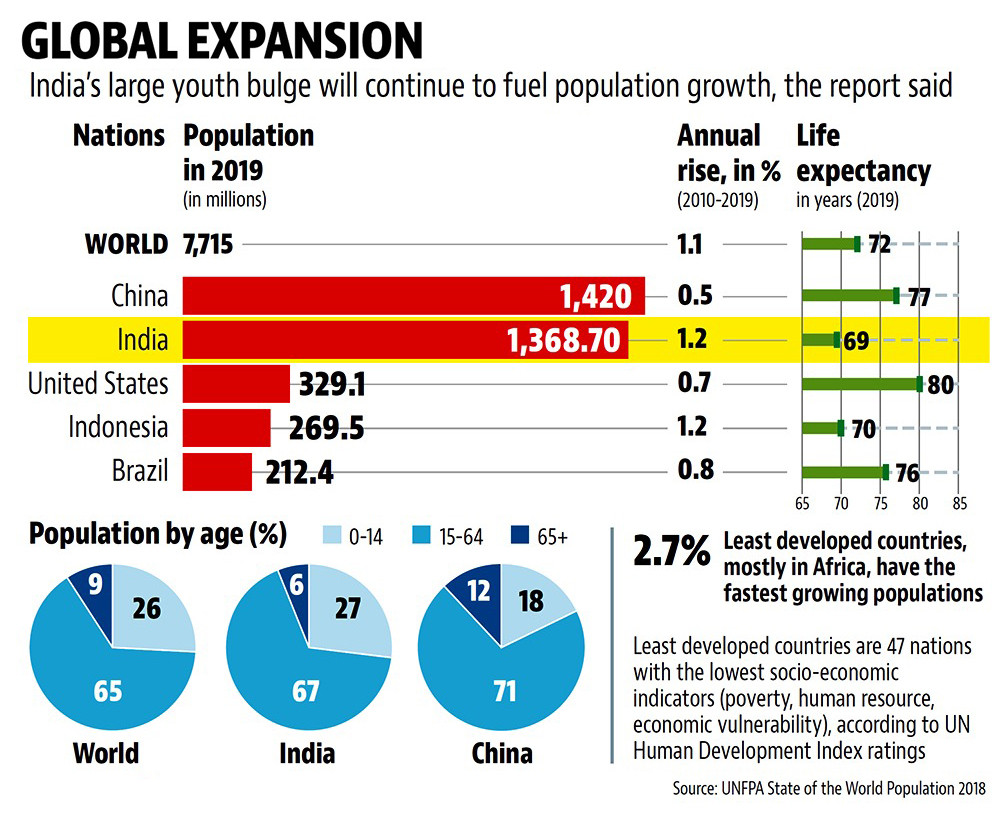
- Population - India’s population in 2019 stands at 1.36 billion, growing from 541.5 million in 1969 and 942.2 million in 1994.
- It accounts for over one-sixth of the world’s population in 2019 (7.71 billion).
- Growth rate - India has seen a growth rate of 1.2% per year between 2010 and 2019.
- This is just over the world growth rate of 1.2%.
- China, the world’s most populous country at 1.42 billion, has a population growth rate of 0.5% per year between 2010 and 2019.
- Age composition - 27% of India's population is in the age bracket of 0-14 years and 10-24 years each.
- 67% of the country’s population is in the 15-64 age bracket.
- 6% of the country’s population is of the age 65 and above.
- Life expectancy at birth in India is lower than the world’s (69 years to 72).
- Healthcare - India scores higher than the global average in terms of access to healthcare during childbirth.
- Between 2006 and 2017, 86% of births in India were attended by skilled health personnel (79% across the world).
- MMR - India’s maternal mortality ratio (MMR) in 2015 was 174 deaths per lakh live births (down from 448 in 1994).
- On the other hand, the global MMR in 2015 was 216.
- Two-thirds of all maternal deaths today are said to occur in sub-Saharan Africa.
- Adolescent birth rate in India is much lower than the global rate.
- 28 in every 1,000 Indian adolescent women (age 15-19) gave birth between 2006 and 2017.
- In contrast, the global adolescent birth rate was at 44 per 1,000.
- Fertility rate in India in 2019 is 2.3 births per woman, compared to 2.5 worldwide.
- In India, the total fertility rate per woman has been reduced from 5.6 in 1969 and 3.7 in 1994 to 2.3 today.
- Globally, the average number of births per woman has been reduced form from 4.8 in 1969 and 2.9 in 1994 to 2.5 today.
What are the concerns highlighted?
- Early marriage continues to present a major cultural obstacle to female empowerment and better reproductive rights.
- A girl who marries when she is 10 will probably leave school and consequently, loses the negotiating skills and job opportunities.
- The report includes, for the first time, data on women’s ability to make decisions over three key areas.
- These are sexual intercourse with their partner, contraception use and health care.
- It notes that absence of reproductive and sexual rights has major and negative repercussions on women’s education, income and safety.
- Ultimately, they are not in a position to shape their own futures.
What lies ahead?
- Despite the concerns, millions have enjoyed healthier and more productive lives in the 50 years since the UNFPA was founded.
- Unintended pregnancies and maternal deaths have dramatically been reduced with efforts from civil society and governments.
- Going ahead, the threat to women’s and girls’ reproductive rights posed by emergencies caused by conflict or climate disasters should be addressed.
- [Every day, more than 500 women and girls including in countries with emergency settings, die during pregnancy and childbirth.]
- About 35 million women, girls and young people will need life-saving sexual and reproductive health services in the coming year.
- Services to address gender-based violence, in humanitarian settings, are also a need of the hour.
Source: The Indian Express, The Hindu
Quick Fact
UNFPA
- UNFPA is the United Nations sexual and reproductive health agency.
- Its mission is to deliver a world where every pregnancy is wanted, every childbirth is safe and every young person's potential is fulfilled.
- UNFPA calls for the realization of reproductive rights for all.
- It thus supports access to a wide range of sexual and reproductive health services including voluntary family planning, maternal health care and comprehensive sexuality education.


