Why in news?
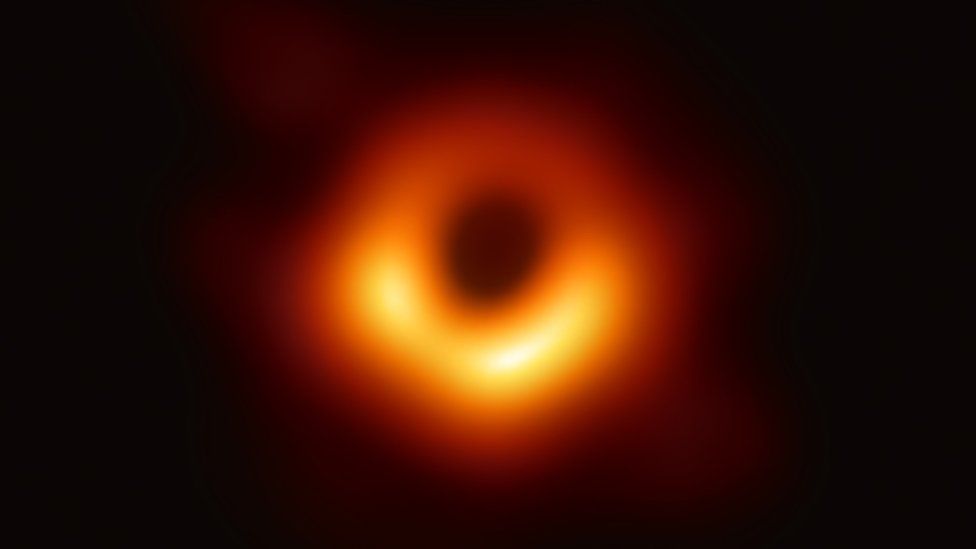
- The Event Horizon Telescope (EHT) collaboration recently showed the world the very first image of a black hole.
- The first-ever black hole to be photographed has been named "Powehi", meaning embellished dark source of unending creation.
What is a black hole?
- A Black Hole is a region of space which is of immense gravity that nothing, not even light, can escape from it.
- Black holes form at the end of some stars’ lives, stars that are many times the mass of our sun.
- The energy that held the star together disappears and it collapses in on itself producing a magnificent explosion.
- All the material left over from the explosion falls into an infinitely small point.
- Large black holes can have tens to millions of times the mass of our sun trapped in a point smaller than the tip of a pin.
What was EHT based on?
- If immersed in a bright region, like a disc of glowing gas, the Black Hole could be seen as a dark region similar to a shadow.
- This was something predicted by Einstein’s general theory of relativity.
- It predicts that the heated material will illuminate the extremely warped space-time, making a dark shadow visible.
- This is what was attempted through the Event Horizon Telescope.
What was it composed of?
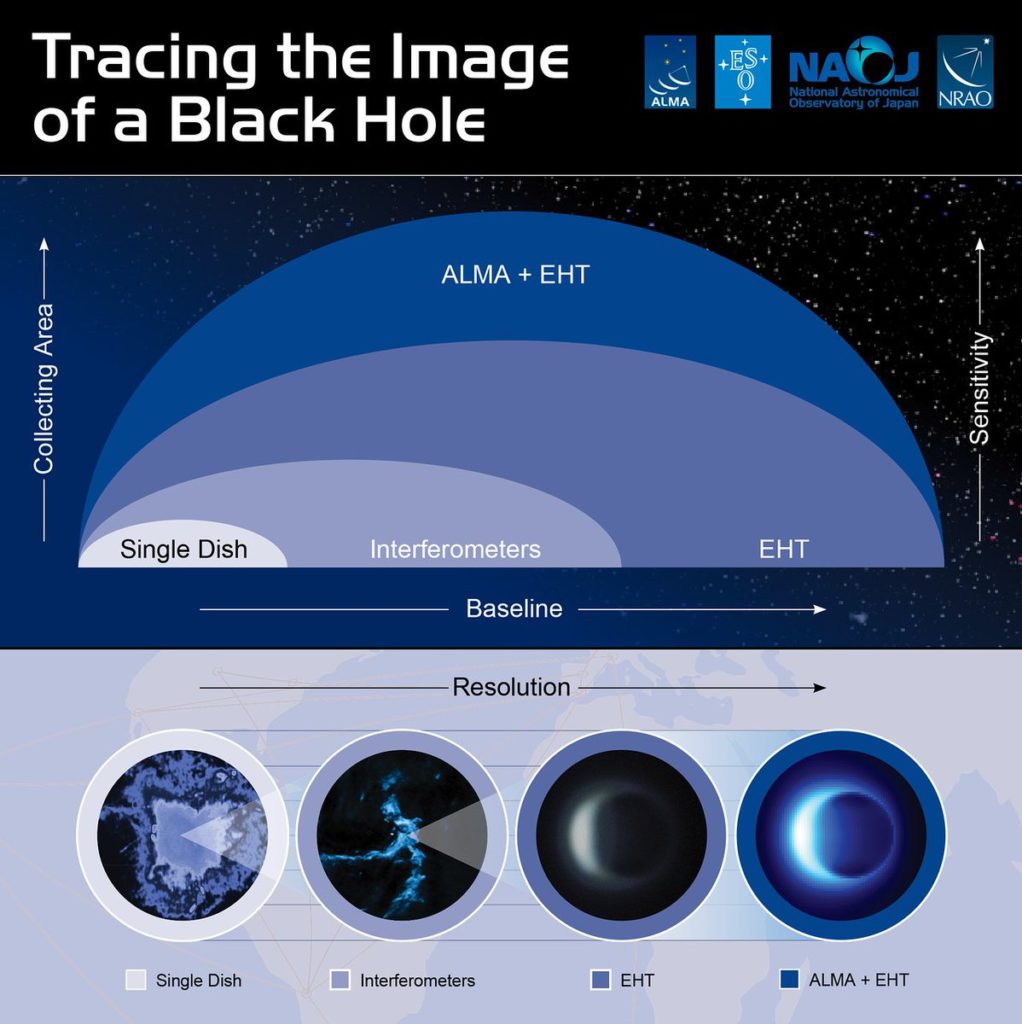
- EHT - The Event Horizon Telescope (EHT) operates a planet-scale array of eight ground-based radio telescopes that are linked together.
- Over time, the EHT recruited new radio observatories.
- By 2017, there were eight observing stations in North America, Hawaii, Europe, South America and the South Pole.
- Among the newcomers was the Atacama Large Millimeter/submillimeter Array, or ALMA, located on a high plateau in northern Chile.
- With a combined dish area larger than an American football field, ALMA collects far more radio waves than other observatories.
- VLBI - The EHT observations use a technique called very-long-baseline interferometry (VLBI).
- The VLBI technique linked the radio dishes of telescopes across the world to produce a virtual telescope the size of the earth.
- This was needed to obtain the high resolution required for the measurement.
- In this way, VLBI allows the EHT to achieve an angular resolution of 20 micro-arcseconds.
How was it executed?
- The EHT set out to image two candidate supermassive black holes:
- Sagittarius A* which is 26,000 light years from the earth, at the centre of the Milky Way
- another black hole which is 55 million light years away at the centre of the Messier 87 galaxy in the Virgo galaxy cluster
- But the first image released was of the more distant one.
- The black hole itself cannot be seen, because light cannot escape its intense gravitational attraction.
- The so-called event horizon that envelops the black hole is the point of no return and any object transgressing this boundary is lost.
- Just outside of it is a region where a photon (light quantum) can orbit the black hole without falling in.
- This is called the ‘last photon ring’, and this is what the EHT imaged, seeing in effect the silhouette of a black hole.
- The challenges included making each of the eight telescopes observe the same broad range of wavelengths around 1.3 mm.
- Another challenge was having precise atomic clocks at each location, so the data could be combined.
How has black hole understanding evolved?
- About a hundred years ago, the black hole made its way into physics through Albert Einstein’s general theory of relativity.
- Few years back from now, the LIGO collaboration first directly observed the gravitational waves made by the merging of two black holes.
- The Higgs boson was detected 50 years after it had been postulated.
- Now, the visual proof of the existence of black holes marks an important milestone.
- It helps understanding the fundamental processes that determine the formation and evolution of galaxies.
Source: Indian Express, The Hindu


