Why in news?
Seven Maoists were killed recently in an encounter with the Chhattisgarh Police in the Bagnadi area of Rajnandgaon district bordering.
What are the recent happenings?
- A week previously (on July 27, 2019), another 7 had been killed in Machkot in Bastar, Chhattisgarh.
- With these operations, over a week, 16 Maoists have been killed.
- The security forces have made continuous inroads into the disturbed areas.
- On the other hand, the CPI (Maoist) has repeatedly admitted that their base area has shrunk, fresh recruitment almost dried up, and desertions increased.
What contributed to police’s success?
- The anti-Maoist operations do get restricted by various seasonal factors.
- However, operations continue to be launched if there is actionable intelligence of Maoist movement.
- Further, security forces have learnt to overcome many impediments.
- Use of satellite technology helps in keeping track of jawans’ movement from any location, and the target can be identified with more clarity.
- Staff trained in ‘battlefield nursing’ courses (conducted by the Army) can treat wounded jawans on the field itself.
- Night helicopter landing facilities keep the jawans motivated even at odd hours.
- Therefore, despite peak monsoon, the police were able to launch operational teams and emerge successful.
- In both instances, security forces were successful to a great extent in recovering weapons and the bodies of the deceased Maoists.
- Of late, local police in the form of DRG (District Reserve Guard) have been more and more successful in countering Left Wing Extremism (LWE).
What are the other supporting factors?
- Chhattisgarh’s state police, with the support of specialised training institutes, have built up capacity and raised specialised forces.
- The institutes include the Counter Terrorism and Jungle Warfare (CTJW) College, Kanker and four CIAT (Counter Insurgency & Anti Terrorism) Schools.
- The Centre, besides helping the state strengthen training capacity and capabilities, is also providing financial support.
- This helps strengthening the specialised wings of STF (Special Task Force) and SIB (State Intelligence Bureau).
- DRGs have been constituted in many districts consisting of local policemen of affected areas.
- They have the best knowledge of the terrain as well as are well-versed in the local dialect.
- Their natural instincts have been supplemented with professional ethos from the Counter-Insurgency and Jungle Warfare School of Vairengte, Mizoram.
What was the Maoists’ plan?
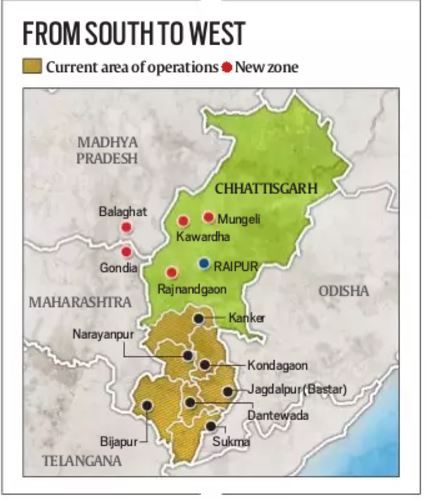
- The CPI (Maoist), following a decision taken in the 2014 Central Regional Bureau (CRB) meeting, is trying to develop the new MMC Zone.
- The recent encounter was in the Maoist-proposed ‘MMC Zone’ (Maharashtra, Madhya Pradesh and Chhattisgarh Confluence zone.).
- Maoists intend to create an entity like the Dandakaranya (DK) Special Zonal Committee in Bastar.
- It broadly incorporates the districts of Gondia in Maharashtra, Balaghat in Madhya Pradesh, and parts of Rajnandgaon, Kabirdham, and Mungeli in Chhattisgarh.
- This area is predominately tribal, forested and hilly, and suitable for guerrilla warfare.
- It is also contiguous to the North Gadchiroli Maoist Division of the DK.
- Except for a few, most of the cadres in the MMC Zone were transferred there from Bastar.
What are the governments’ measures?
- The governments of the states involved took proactive steps by deploying additional resources, and are trying their best to check Maoists’ expansion.
- In Chhattisgarh, many new police stations and security camps have been established.
- A number of awareness campaigns were organised in remote areas which are most vulnerable to Maoist influence.
- Arrangements for villagers’ training were made and government employment for hundreds was facilitated.
- The administration has also taken steps to expedite developmental work.
- Madhya Pradesh and Maharashtra too have intensified anti-Maoist operations in these areas.
- Though the Maoists are yet to find their roots here, the efforts need to be continued.
- The Darrekasa Area Committee of the Gadchiroli-Rajnandgaon-Balaghat (GRB) Division of MMC was almost wiped out in the recent attack.
What is the way forward?
- Further attacks - The overall strength of the CPI (Maoist) has thinned and the capacity of the security forces has improved.
- However, Maoists can still manage to strike security forces and cause casualties.
- So, the security forces need to be extra vigilant in the coming future.
- IEDs - One way to avoid destruction and casualties caused by IEDs (improvised explosive device) is to ensure that these are successfully detected and defused in time.
- Visual surveillance or technical gadgets could be employed here.
- Law-enforcement agencies can crack down on miscreants who supply explosive substances to the Maoists.
- Explosive substances and most importantly detonators can be made identifiable at the production stage.
- Better technologies, including Ground Penetration Radar, are required to detect and defuse IEDs.
- Security forces also need to learn from previous tactical errors and adhere to time-proven Standard Operating Procedures (SOPs).
- Development - The information network should improve with better road and telecom connectivity in far-flung areas.
- Surrender and rehabilitation policies must be implemented in letter and spirit.
- The administrative and political vacuum in remote areas must be filled.
- ‘The Forest Rights Act’ should be interpreted in favour of forest dwellers.
- The root cause of the problem that is exploited by the Maoists i.e. the socio-economic deficits must be bridged.
- The human rights of the local populace must be protected by the administration and security forces if the credibility of efforts taken so far is to be established.
Source: Indian Express


