Why in news?
- The monetary policy committee of Reserve Bank of India has unanimously decided to cut lending rate by 35 bps.
- The central bank also lowered its GDP growth projection from 7% in June policy to 6.9% now.
What is the repo rate?
- Repo rate is the rate at which RBI lends to commercial banks.
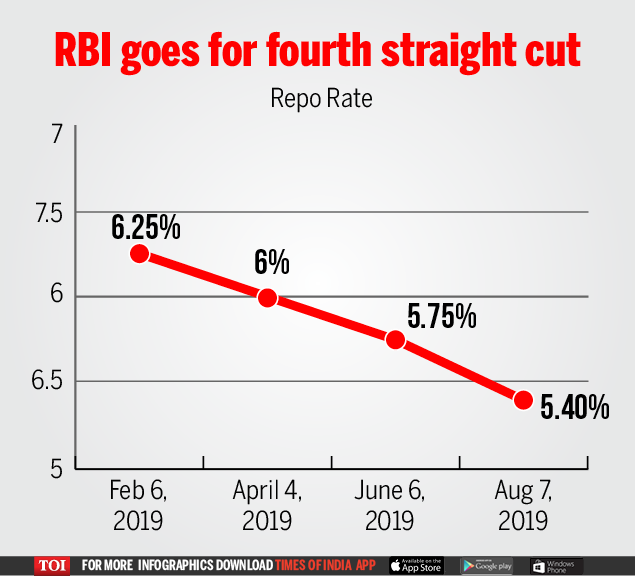
- With a 35 basis point cut (highest this year), the repo rate stands at a 9-year low of 5.4% since July 2010 when it was 5.25%.
- The current rate cut is the fourth this year. The previous three cuts this year were 25 basis points each.
What is the rationale?
- The rate cut comes as a move to boost economic activity amidst slowing consumption demand.
- Inflation is a key consideration for a rate cut and it was a key factor for the RBI to go for a rate cut now.
- The monetary policy statement mentioned that inflation was currently projected to remain within the target over a 12-month ahead horizon.
- But besides this, the decision was also taken to boost aggregate demand especially private investment.
What were the RBI’s observations?
- The RBI statement further said that domestic economic activity continues to be weak.
- This is because of the global slowdown and escalating trade tensions posing downside risks.
- It noted that private consumption, the mainstay of aggregate demand, and investment activity remain sluggish.
- However, the favourable inflation outlook provides enough space for policy action to close the negative output gap.
- Addressing growth concerns by boosting aggregate demand, especially private investment, assumes the highest priority at this juncture.
Why is the GDP growth revision now?
- This is the second consecutive policy statement where the RBI has lowered its GDP growth projection for 2019-20.
- In June 2019 statement, it revised it projection downward from 7.2% (stated in April 2019) to 7%.
- This time it further revised the growth projection further down to 6.9%.
- The downward revision is primarily because various high frequency indicators suggest weakening of both domestic and external demand conditions.
- Business expectations Index of the Reserve Bank’s industrial outlook survey shows muted expansion in demand conditions in Q2.
- Nevertheless, a decline in input costs augurs well for growth.
- The RBI said that the monetary policy easing since February 2019 is expected to support economic activity, going forward.
How does the future look?
- Despite three consecutive rate cuts aggregating to a total of 110 basis points, the transmission by banks to lenders has not been even a third of this.
- The central bank says that banks have passed on just 29 basis points which is poor indeed.
- One factor inhibiting transmission was the tight liquidity conditions until June 2019.
- Since June, the RBI has eased the liquidity norms; the last two months the central bank has in fact had to absorb excess liquidity floating around.
- There is, therefore, reason to hope that transmission from hereon would be quicker.
What is the way forward?
- A rate cut alone will not suffice as the cost of capital is just one aspect that determines investment.
- The government has to play its part too in boosting growth and roll out measures at this front.
- Arguably, the space for fiscal concessions is limited given the overall revenue scenario.
- The slowdown now is part cyclical which can be addressed by a rate cut and part structural, for which reforms are an absolute necessity.
- The government can certainly push for further reforms to incentivise investment without affecting its fiscal arithmetic.
Source: Indian Express, The Hindu


