Why in news?
Switzerland and the European Union (EU) are about to face a battle in the share trading, owing to a row over a stalled partnership treaty.
What do the new rules mean?
- The EU’s decision will effectively prevent EU-based banks and brokers from trading on Swiss exchanges.
- In the new Swiss regime, foreign exchanges are required to get Swiss permission to host trading in Swiss stocks.
- But, trading venues outside the EU can carry on as before.
Who would be affected by Swiss ban?
- Pan-European stock trading platforms will not be able to host trading in Swiss equities.
- Foreign trading venues, including stock exchanges and so-called multilateral trading facilities will be affected.
- Switzerland will let them host trading in Swiss-registered companies (only if the foreign venues’ regulations do not curb trading of Swiss stocks in Switzerland).
- Markets outside the EU will not be affected.
- Once Brexit takes effect, British share trading platforms could be certified provided their regulation does not interfere with trading on Swiss markets.
What could happen to violators?
- Wilful and negligent violations of the Swiss rules could result in criminal charges.
- Sanctions – Target foreign trading venues, their management or board of directors.
- Intentional violations – Imprisonment of up to 3 years or a fine.
- Negligence – Punished with a fine.
Why is the EU-Swiss treaty so controversial?
- The Swiss/EU deal would have Switzerland routinely adopt changes to single market rules.
- It would also create a more effective platform to resolve trade disputes and open a path to new trade deals such as an electricity union.
- The pact would be an over-arching accord above a patchwork of separate deals that already govern bilateral Swiss/EU ties.
- This pact emerged after Swiss voters in 1992 rejected plans to join the European Economic Area.
- These individual agreements were crafted when Switzerland still aimed to join the EU, a goal it has since dropped.
- But the trade deal has become tangled up in domestic politicsin Switzerland.
How long might the standoff last?
- In theory – Indefinitely, but both sides have said they are open to talks to break the logjam.
- In effect –Thenext deadline for Switzerland to sign the treaty and start the ratification process is the end of October.
- But Swiss officials say there is no point signing a deal that is doomed to fail in parliament or get shot down by voters under the Swiss system of direct democracy.
Source: The Indian Express
Quick Fact
European Union (EU)
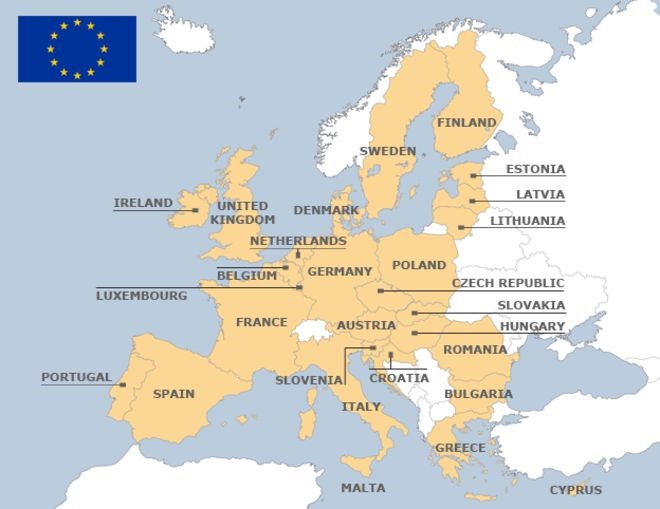
- The European Union (EU) consists of a group of countries that acts as one economic unit in the world economy.
- Its official currency is the euroand 19 of its 28 members have adopted the currency.
- The EU began as the European Coal and Steel Community in 1950 and had just six members: Belgium, France, Germany, Italy, Luxembourg, and the Netherlands.
- It became the European Economic Community (EEC) in 1957 under the Treaty of Rome.
- Upon the formation of the European Union in 1993, the EEC was incorporated and renamed as the European Community (EC).
- In a 2016 referendum, the U.K. voted to leave the EU. Brexit has been challenged repeatedly.