What is the issue?
- There is a shift of focus from other regional initiatives such as SAARC to BIMSTEC.
- This shift can be attributed to the inability of SAARC to foster regional cooperation and make progress.
Why is there a shift?
- Regional cooperation under SAARC saw no progress, as indicated by the fact that the group has not met since 2014.
- Further, the summit cancelled in 2016 because of India’s boycott owing to Pakistan-sponsoredterror attacks in India.
What fact should be considered while dealing with BIMSTEC?
- India will have to take into account the fact that in Asia,economics and politics have historically been deeply integrated.
- It should not fall into the acquiescence trap.
Why BIMSTEC isa viable option?
- Regional initiatives in Asia have been defined along the tangents of strategy and security.
- These groupings are less inclined towards theeconomic, cultural and social lines,it may be fruitful to look towards BIMSTEC for these lines.
- Pakistan’s presence inSAARC has been an impediment to India for its SAARC’s success.
- China’s absence in BIMSTEC means that there may be fewer obstacles hindering the achievement of the organisation’s mandate.
- As the renegotiation of SAARC remains unattainable, BIMSTEC might be a viable option for India to maintain its foreign policy discourse.
Source: The Hindu
Quick Facts
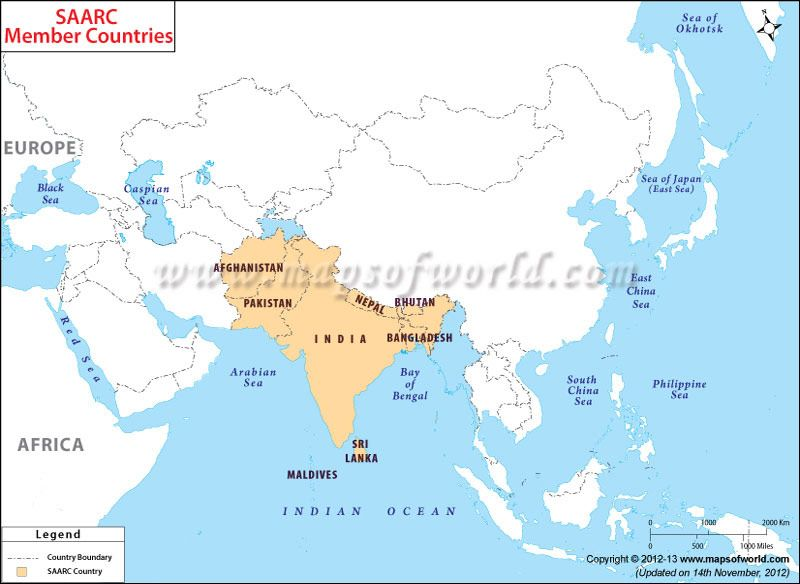
Bay of Bengal Initiative for Multi-Sectoral Technical and Economic Cooperation (BIMSTEC)
- BIMSTEC is a sector-driven cooperative sub-regionalorganization.
- It came into being in 1997 through the Bangkok Declaration.
- Its member States lie in the littoral and adjacent areas of the Bay of Bengal.
- 7 Member States: Bangladesh, Bhutan, India, Nepal, Sri Lanka, Myanmar and Thailand.
- Initially, it was an economic bloc with four Member States called BIST-EC (Bangladesh, India, Sri Lanka and Thailand Economic Cooperation).
- Then it became BIMST-EC (Bangladesh, India, Myanmar, Sri Lanka and Thailand Economic Cooperation) following the inclusion of Myanmar.
- With the admission of Nepal and Bhutan, it became BIMSTEC.
South Asian Association for Regional Cooperation (SAARC)
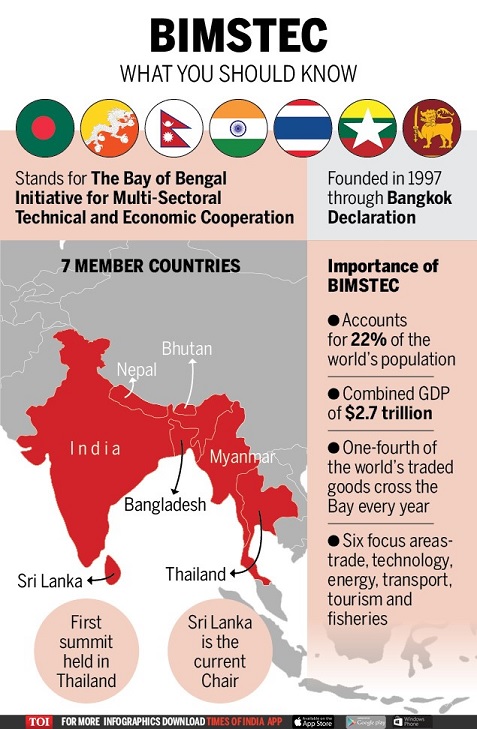
- It was established with the signing of the SAARC Charter in Dhakain the year of 1985.
- 8 Member States: Afghanistan, Bangladesh, Bhutan, India, Maldives, Nepal, Pakistan and Sri Lanka.
- SAARC Secretariat was set up in Kathmanduin 1987.
- Objectives of SAARC –
- To provide a platform for the peoples of South Asia to work together in a spirit of friendship, trust and understanding.
- It aims to promote the welfare of the peoples of South Asia and to improve their quality of life through accelerated economic growth, social progress and cultural development in the region.