Why in news?
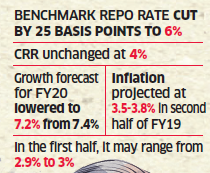
The Reserve Bank of India recently cut the repo rate by 25 basis points to 6%, in its recent bi-monthly meeting.
What are the highlights?
- The monetary policy committee of the RBI has decided to maintain the 'neutral' monetary policy stance.
- Besides, the RBI has also revised its GDP projection downwards for Financial Year 2020 (FY’20).
- In the February policy, it had projected a GDP growth of 7.4% for FY’20 - in the range of 7.2-7.4% in H1, and 7.5% in Q3.
- But in the latest monetary policy statement this has been revised downwards to 7.2% - in the range of 6.8-7.1% in H1 and 7.3-7.4% in H2.
What are the likely implications?
- Repo rate is the key interest rate at which the RBI lends short-term funds to commercial banks.
- RBI’s reduction in benchmark rates is largely an acknowledgement of a slowdown in growth and is thus likely to boost the economy.
- It also signals a shift in policy since Shaktikanta Das assumed office as Governor of the RBI.
- The Monetary Policy Committee (MPC) now seems to be not solely focussed on inflation but also takes into account growth trends with equal seriousness.
- The MPC’s neutral policy stance is laudable given the uncertainties ahead.
- It would give RBI the flexibility to rework on the policy in tune with the emerging data sets.
- But banks may be able to pass on the RBI’s present rate cut to borrowers only to a limited extent.
- Banks had only reduced their lending rates by under 10 basis points (bps) after the RBI’s last 25 bps cut in February.
- Deposit growth has come down sharply and banks are competing with one another to attract depositors.
- The rate cut may further impact this as it translates into a lower interest rate earned by depositors and thus mean less deposit mobilisation.
Why is the downward revision of GDP growth?
- The central bank noted that there have been some signs of weakening in the domestic investment activity.
- This is reflected in the recent slowdown in production and imports of capital goods.
- Further, a moderation of growth in the global economy might impact India’s exports.
- These are the risks that have led the central bank to lower its projection.
- However, it pointed that higher financial flows to the commercial sector augur well for economic activity.
- Also, private consumption which has been dull is expected to get a fillip.
- Public spending in rural areas and an increase in disposable incomes of households due to tax benefits could help in this regard.
What is the inflation outlook?
- Inflation, despite the mild spike in February, is well under control at 2.6%.
- It is projected to average at 3.2% to 3.4% in the first half of 2019-20, well below the 4% target set for the MPC.
- The domestic and global demand-supply balance of key food items is also expected to remain favourable.
- So the short-term outlook for food inflation certainly remains favourable.
- However, early forecasts indicate a strong possibility of a below-normal monsoon due to El Nino.
- Such an event would have an impact on the agricultural output, and consequently on the food prices.
- There is also the risk of an abrupt reversal in vegetable prices, especially during the summer months.
- Besides, the RBI also noted that crude oil prices have risen around 10% since the February policy.
- All these factors are found to reflect the uncertainties in the inflation trend and outlook.
Source: Indian Express, The Hindu
Author: Shankar Civil Service Coaching Center Bangaluru
Visit for Daily Current Affairs on Indian Economy


