Why in news?
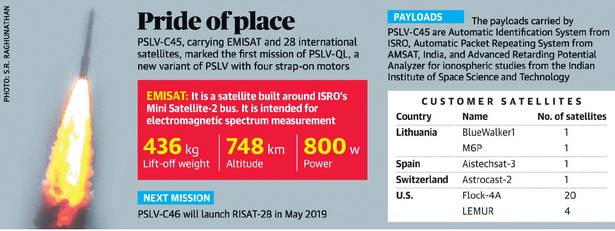
The Indian Space Research Organisation (ISRO) recently launched the PSLV-C45 rocket carrying one Indian (EMISAT) and 28 international satellites.
What is the mission for?
- ISRO launched the country’s first electronic surveillance satellite, EMISAT, from Sriharikota in coastal Andhra Pradesh.
- EMISAT was built by the Defence Research Development Organisation (DRDO).
- It will gather information on enemy radar positions from a sun-synchronous orbit at an altitude of about 750km.
- EMISAT will achieve this through electromagnetic spectrum measurement.
- So the spacecraft carries a payload of DRDO's prestigious Kautilya system for electromagnetic intelligence (ELINT) gathering.
- Space-based electronic intelligence (ELINT) will add to the situational awareness of the Armed Forces.
- This will provide location and information of hostile radars placed at the borders.
- This will be another dimension to the current land or aircraft-based ELINT.
- Besides this, as many as 28 small satellites of international customers were also put in space as secondary riders.
- These include 24 satellites from the US, two from Lithuania, and one each from Switzerland and Spain.
What are the unique features of PSLV-C45?
- Orbits - ISRO holds the world record for carrying a number of satellites on a single launch vehicle.
- It carried 104 satellites on PSLV C-37 in 2017.
- However, so far, these satellites have been ejected in two different orbits at the most.
- PSLV-C45 is the first time that ISRO has launched a rocket that injected satellites in three different orbits.
- Satellites - The fourth and last stage of the rocket will function as a satellite itself for some time.
- The fourth stage is what remains of the rocket after most of it is discarded in the three stages after ejecting the payloads.
- Strap-on motors - This flight marked the first mission of PSLV-QL, a new variant of PSLV with four strap-on motors.
- [Strap-ons are booster rockets attached externally to the main rocket.
- They provide additional thrust, or energy, by firing themselves midway during the flight.]
- In earlier flights, ISRO has used two or six strap-on motors.
- The four extra-large strap-ons used this time reduced the overall weight while still delivering the power equivalent to six motors.
What was the earlier procedure?
- On most previous occasions, the primary satellite of the rocket was taken to its orbit.
- Meanwhile, the others were ejected, or sprayed in quick succession either before or after that into different trajectories.
- There used to be only a marginal difference in the vertical distances between the satellites.
- Also, the entire operation used to be over in a few minutes.
How is PSLV C-45 different from this?
- EMISAT is the primary satellite in PSLV C-45, which is a piece of surveillance equipment to be used by the DRDO.
- PSLV C-45 placed this primary satellite to the 748 km sun-synchronous polar orbit.
- It then made one complete revolution around Earth, over the poles, while lowering its orbit to 504 km height.
- After this, it deposited the 28 international customer satellites.
- It then made a further round of Earth while attaining an even lower orbit of 485 km.
- At this level, the fourth stage of the rocket will continue for some time.
- The entire operation took a little over three hours.
- For enabling each of the two revolutions around Earth, the fourth-stage engines were reignited, which is a unique feature of PSLV C45.
- Earlier missions used to be “single-shot” operations in which the engines used to fire just once.
What is the significance?
- Orbit - Reaching three different orbits gives ISRO a new technological edge.
- The mission will help ISRO pack its future rockets with multiple satellites even if they have to be placed in diverse but precise orbits.
- Earlier, this could be done only in multiple missions.
- It also showed that the guidance and navigation systems aboard the rocket could be used for much longer times than in earlier missions
- Fourth stage as satellite - The rocket, or the launch vehicle, is only a carrier.
- Once it places its passenger, or satellite, to its designated orbit in space, it becomes practically useless, adding to the space debris.
- But for the last few years, ISRO had been planning to give some life to the rocket.
- It was planning this at least to the uppermost part, or the last stage, which remains with the satellite till the ejection.
- So significantly, in PSLV-C45, ISRO demonstrated its capability to reuse the fourth-stage engines multiple times.
What purpose will the fourth stage serve?
- The fourth stage is carrying three kinds of equipment to carry out some measurements and experiments; each of them to be used -
- to capture messages transmitted from ships
- by amateur radio operators' use for tracking and monitoring position data
- to study the structure and composition of the ionosphere
- It also carries a solar panel to provide power to these equipment and enable communication with ground stations.
- The fourth stage will not have the usual life of a satellite as it can remain alive only for a few weeks or a few months.
- As, it is not equipped with a lot of other things that enable a satellite to exist for longer duration in outer space, like a radiation shield.
- However, this is still good enough time to carry out shorter duration experiments and data collection.
- In future, such an “orbital platform”, as it is being described, can also be used to inject smaller satellites into orbits.
Source: The Hindu, Indian Express


