What is the issue?
With 20th Livestock Census currently going on in India, here is a look on its significance and the challenges involved.
Why is livestock census crucial for India?
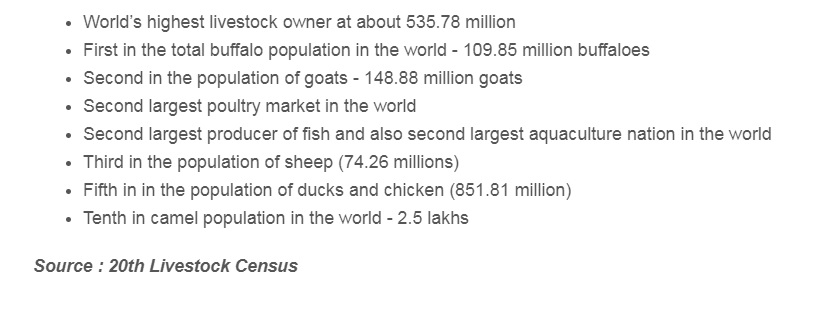
- India leads the world in livestock population at 125.5 crore.
- Livestock is not only an integral part of the agriculture economy supporting the rural livelihood.
- It is also a fundamental element of India's socio-cultural setting.
- India's cultural heritage endows great importance to owning and rearing livestock as an inseparable part of an inclusive universe.
- Accurate, reliable data therefore become inevitable for planning and development of the sector.
- Livestock Census is thus immensely useful for policymakers, planners and academics.
- The importance of a livestock census was first recognised in 1919, 47 years after human counting was started in 1872.
What are the challenges involved?
- Enormity - Enumerating animals in every village and ward is more voluminous than enumerating the human population.
- Capturing such wide and varied information across numerous species is extremely difficult and cumbersome.
- Human resource - Livestock Census continues to be an elaborate, complex and daunting exercise with just about 50,000 enumerators and 10,000 supervisors.
- This is a low number compared to the nearly 25 lakh involved in the human Census.
- Details - Data to support policy and planning should be robust and meaningful.
- Merely counting and compiling the absolute numbers would be a sub-optimal use of such a laborious exercise.
- So, what is also being captured is the breed of each animal along with sex, age, productivity, use, etc.
- Institutional - Feeder livestock is counted by no permanent administrative institution.
- As a result of this, livestock census lacks bare resources and the quinquennial (every five years) Livestock Census becomes a burden.
- It goes unnoticed as general awareness about it stays low, especially in urban areas.
- With general elections around, the current animal count exercise across the country has been pushed further.
What are the key features of the current census?
- Data - The current round is counting a larger number of species besides the regular cattle.
- These include mithun, yak, sheep, goats, pigs, horses, mules, donkeys, camels, dogs, rabbits, elephants and poultry birds.
- 82 breeds of cattle and 26 breeds of buffaloes are being captured with further data on sex, age.
- Similarly, 52 breeds of goats and 84 breeds of sheep are being recorded along with other parameters.
- The census is counting stray and abandoned animals as well.
- It also categorises animals on the basis of purposes such as that for breeding, draught, milk, calving, etc.
- Other supporting and supplementary data on the owners of livestock are also being collected and compiled.
- These include information on occupation, income, landholding, education, etc. to support holistic planning.
- Tools - The ongoing Census is increasingly harnessing the technological innovations of the digital age.
- The aim is to streamline the process and eliminate error, and to create a high-quality database.
- There is complete elimination of paper, which has been replaced with tablet computers with which enumerators capture data.
- They then upload it to the server after online validation by the supervisor, resulting in real-time compilation and updating.
- The National Informatics Centre has developed the Android-based mobile application with various features of data entry module.
- The software enables simultaneous monitoring of the operations.
- It also facilitates developing various analytical reports useful for a dynamic planning process for an equally dynamic livestock sector.
Source: Indian Express


