FAME India scheme phase II
- Recently government has sanctioned 5,595 electric buses under Fame India Phase-II.
- 'Faster Adoption and Manufacturing of Electric Vehicles in India’(FAME) was launched to promote manufacturing of electric and hybrid vehicle and to ensure sustainable growth.
- It was lauched by ‘Ministry of Heavy Industries & Public Enterprises’.
- The main objective is to encourage,
- Faster adoption of Electric and hybrid vehicle,
- Offering upfront Incentive on purchase of Electric vehicles,
- Establishing a necessary charging Infrastructure,
- To address environmental pollution and fuel security.
- It will offer incentives to manufacturers investing in developing electric vehicles, lithium-ion batteries, electric motors.
- The centre has asked states to frame their EV policy and provide additional fiscal and non-fiscal incentives to manufacturers and buyers.
- Only buses priced up to Rs 2 crore, plug-in hybrids under Rs 15 lakh, 3-wheelers under Rs 5 lakh and 2-wheelers under Rs 1.5 lakh will be eligible for incentives.
- It will also encourage interlinking of renewable energy sources with charging infrastructure.
National Crisis Management Committee (NCMC)
- Recently Cabinet Secretary chairs NCMC meeting to review flood situation in Maharashtra, Karnataka, Kerala and Gujarat.
- It is a temporary committee set up by the Government in the wake of a natural calamity.
- It is for effective coordination and implementation of relief measures and operations.
- It oversee the command, control and coordination of the disaster response.
- Composition-
- Cabinet Secretary - Chairperson
- Other members - Secretary to Prime Minister Member, Secretaries of Ministries/Departments with specific Disaster management responsibilities.
- It gives direction to the ‘Crisis Management Group’ (CMG) as deemed necessary.
CMG
- This group deals with matters relating to relief in the wake of major natural calamities.
- It consists of Relief Commissioner (Chairman) and other nodal officers from various concerned Ministries.
- Its functions are to review:
- The contingency plans formulated by various Ministries, Departments and Organizations in their respective sectors.
- Measures required for dealing with a natural disaster.
- Coordinate the activities of the Central Ministries and the State Governments in relation to disaster preparedness and relief.
Sex Ratio at Birth (SRB)
- Recently a state-wise data of SRB was tabled by the Ministry of Health and Family Welfare in Parliament.
- The SRB in the country, defined as the number of female births per 1,000 male births.
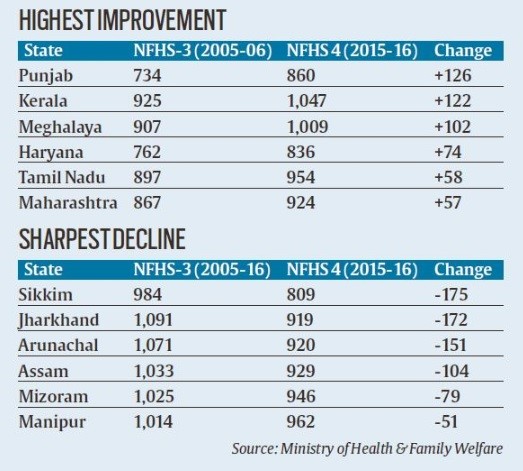
- It has improved from 914 to 919 between 2005-06 and 2015-16, National Family Health Surveys (NFHS).
- The highest improvement was in Punjab at 126 points, but its SRB remained lowest among the states at 860 in NFHS-4.
- The sharpest decline was in Sikkim, where the SRB dropped to 809, the lowest among all states in 2015-16.
- The 2nd highest improvement in SRB was in Kerala, by 122 points from 925 in 2005-06.
- Its 1,047 in 2015-16 was the highest SRB among all states.
- SRB has been falling in states like Uttar Pradesh, Uttarakhand and Madhya Pradesh.
- In North Eastern states such as Sikkim, Assam the sex ratio at birth has fallen dramatically over 10 years.
Source: PIB, The Indian Express


