Why in News?
A new report by the Intergovernmental Panel on Climate Change (IPCC) was released recently.
What the report is about?
- It presents the most recent evidence on how the different uses of land like forests, agriculture, and urbanization are affecting and getting affected by climate change.
- The Geneva-based IPCC is the United Nations body for assessing the science related to climate change.
- It provides policymakers with regular scientific assessments on climate change, its implications and potential future risks, as well as to put forward adaptation and mitigation options.
What is the land-climate link?
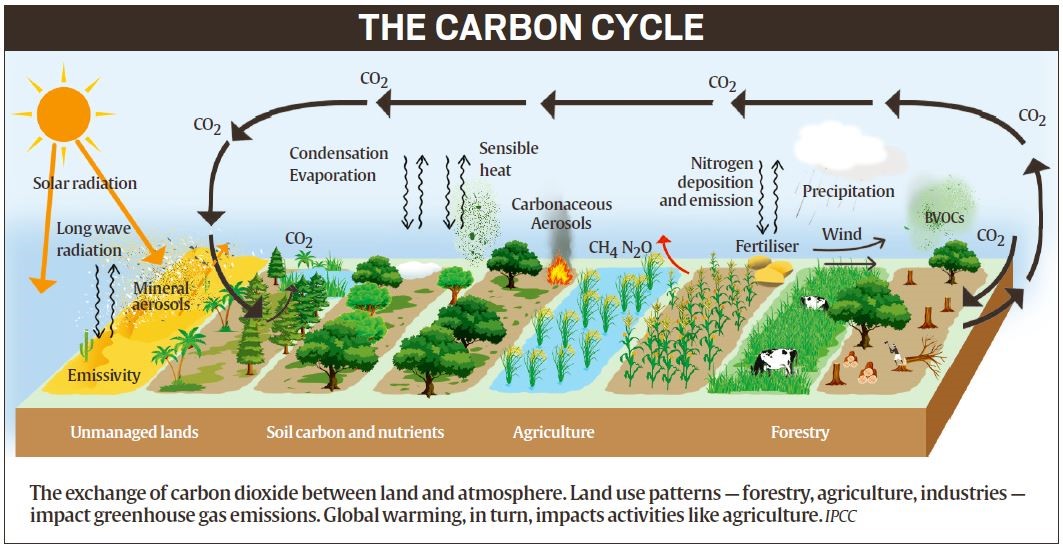
- Land use, and changes in land use, has always been an integral part of the conversation on climate change.
- That is because land acts as both the source as well as a sink of carbon.
- Activities like agriculture, cattle rearing, etc are a major source of methane and nitrous oxide, which are more dangerous than CO2.
- Soil, trees, plantations and forests absorb CO2 for photosynthesis, thus reducing the overall CO2 content in the atmosphere.
- This is the reason why large-scale land use changes like deforestation, urbanisation or change in cropping pattern, have a direct impact on the overall emissions of greenhouse gases.
What does the report say?
- It talks about the contribution of land-related activities to global warming.
- It also talks about the manner in which even existential activities like food production contributes to global warming and is also affected by it.
- If pre-production and post-production activities are taken into account, food production could contribute as much as 37% of all greenhouse gas emissions (GHG) every year.
- It points out that nearly 25% of all food produced is either lost or wasted. And even the decomposition of the waste releases emissions.
What are the other facts in the report?
- Land and ocean together absorb nearly 50% of GHGs emitted every year through natural processes in the carbon cycle.
- The importance of land or ocean, as a carbon sink cannot be overstated in the global fight against climate change.
- That is why afforestation and reduction in deforestation are vital approaches in a global strategy to combat climate change.
- India’s action plan on climate change too, has a very important component on forests.
- India has promised that it would create an additional carbon sink of about 2.5 to 3 billion tonnes by the year 2032 by increasing its forest cover, and planting more trees.
Source: The Indian Express
Quick Facts
Intergovernmental Panel on Climate Change (IPCC)
- IPCC was established by the United Nations Environment Programme (UNEP) and the World Meteorological Organization (WMO) in 1988.
- It is the United Nations body for the assessment of climate change.
- It provides a clear scientific view on the current state of knowledge in climate change and its potential environmental and socio-economic impacts.


