What is the issue?
- America’s retreat strategy in Afghanistan now reflects much its Vietnam war campaign in the late 1960s.
- Here is a comparison of these two notable processes in history.
What was the U.S.’s role in Vietnam?
- The U.S.’s involvement in Vietnam goes back to the last years of French colonial rule.
- The U.S. first backed France against the Viet Minh guerrillas.
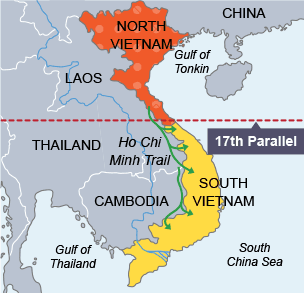
- After France exited Vietnam in 1954, the U.S. backed South Vietnam against the communist-led North.
- Initially, the U.S. involvement was limited to advisory roles.
- But in August 1964, the U.S. destroyer, USS Maddox, was attacked by North Vietnamese torpedo boats in the Gulf of Tonkin, off the Vietnamese coast.
- So, the Lyndon Johnson administration steadily escalated the U.S.’s role thereafter; the American troop deployment in Vietnam was increased.
How did U.S’s withdrawal happen?
- Public opinion - In Vietnam, the U.S. was negotiating from a position of weakness.
- By the late 1960s, American public opinion had largely turned against the war.
- America’s search and destroy operations in communist-dominated villages in the south and its air campaign in the north only fuelled Vietnamese hostility.
- Besides, the South Vietnamese regime that the U.S. had supported was unpopular, oppressive and weak at the same time.
- Exit Strategy - Given these, Richard Nixon (elected the US President in 1968) first started “Vietnamising” the war, by reducing the U.S. troop presence in Vietnam.
- He also shifted the focus from direct participation in land war to training and advisory roles, while continuing with air strikes.
- Talks - Nixon assigned Henry Kissinger, the National Security Adviser, to hold talks with the communist North Vietnam, seeking “peace with honour”.
- Mr. Kissinger started talks with Le Duc Tho, a North Vietnamese revolutionary and diplomat.
- When talks were deadlocked, the U.S. offered to pull out of the South as a compromise.
- Exit - The war became a long, divisive conflict between the communist government of North Vietnam, and South Vietnam and its principal ally, the U.S.
- By the late 1960s, it became evident to American leaders that they could not win the Vietnam war.
- The Americans were actually prolonging a war they had already lost.
- The goal was not to defeat North Vietnam but to stop them from taking over the South, the American ally.
- In 1973, the U.S., North Vietnam and representatives of South Vietnam and Viet Cong, the communist guerillas from the South, signed the Paris Peace Accords.
- The North and the South agreed to a ceasefire and continue holding peace talks, while the U.S. agreed to pull troops out of Vietnam.
What is the present state in Afghanistan?
- The U.S. went into Afghanistan after the September 11, 2001 terrorist attacks on U.S.
- At the peak of the war here, there were over 1,00,000 troops.
- Despite the massive deployment of troops and superior air power, the U.S. got stuck in the war and failed to stabilize the country.
- Consequently, America is fighting in Afghanistan for nearly 18 years, which is longer than America’s direct military involvement in Vietnam.
How is it similar with Vietnam?
- Much like in Vietnam war, the U.S. has now realised that it cannot win the Afghan war.
- Similarly, the American goal is no longer defeating the Taliban but to stop them, at least for now, from taking over Kabul.
- Just as Nixon wanted to get out of Vietnam, President Donald Trump too wants to get out of Afghanistan.
- In the case of Afghanistan as well, the U.S. is negotiating from a position of weakness.
- The war entered a stalemate long ago. America’s allies in Afghanistan stand divided.
- The government in Kabul, which the U.S. backs, is known for infighting and chronic corruption.
- The security forces are struggling to ensure basic security to the public, even in the capital city.
- Like Nixon’s “Vietnamisation”, U.S. President Barack Obama had started “Afghanising” the war.
- He has pulled out most troops and moved the remainder to training and advisory roles.
- The Afghan war is also unpopular in America, much as how Vietnam war was among Vietnamese.
What is the ongoing peace process?
- Given the present conditions, the U.S. cannot unilaterally pull out, especially when the Taliban is on the offensive.
- That would cause a lasting stain on America’s already weakened reputation as the world’s pre-eminent military power.
- So, the situations demand a deal, and finding one is Ambassador Khalilzad’s mission (Khalilzad is an Afghan-American diplomat).
- Mr. Khalilzad has already held multiple rounds of talks with the Taliban’s representatives in Doha, Qatar.
- Reportedly, the U.S. and the Taliban have agreed to a road map for peace.
- The U.S. has agreed for a withdrawal in return for the Taliban’s assurance that Afghanistan would not be used by terrorists.
- The U.S. has already made two big compromises by agreeing to the Taliban demand that the Afghan government should be kept away from the peace process.
- Second, the U.S. continued to hold talks even in the absence of a ceasefire.
- As a result, the Taliban continued its terror campaign even when the peace process was under way. Click here to know more.
How does the future look?
- When the U.S. was forced to pull out of Vietnam, the Southern and Northern governments had not reached any settlement but for the ceasefire.
- In the 2 years after the U.S. pulled out, the communists captured Saigon in South and the government crumbled.
- Likewise, what would happen to the Afghan government once America had withdrawn is uncertain.
- However, in Vietnam’s case, the Communists unified Vietnam, and after early years of struggle, modernised the economy and rebuilt the country into an Asian powerhouse.
- Unlike the Viet Cong, the Taliban is an anti-modern, anti-woman, anti-minority fundamentalist structure.
- Given these, the peace process in Afghanistan is much more challenging.
Source: The Hindu


