What is the issue?
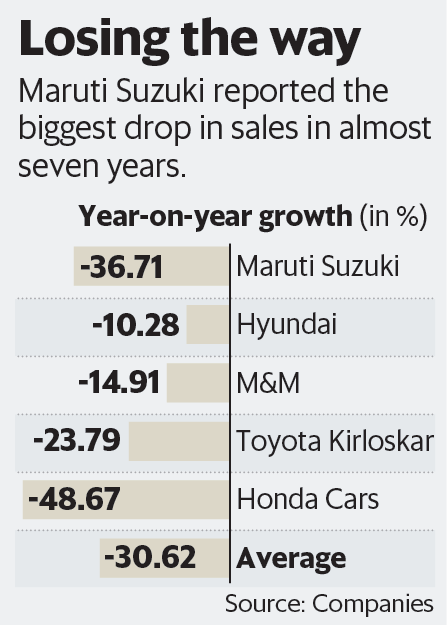
- Leading automobile manufacturers announced a sharp decline of up to 50% in their domestic sales in July 2019.
- The trend is potential of having widespread implications for the economy as a whole.
What is the recent happening?
- Market leader Maruti Suzuki reported a 36.2% drop in sales during July 2019.
- Manufacturers are now going for cuts in production.
- Moreover, being one of the biggest job creators in the country, the auto sector is staring at a deep-rooted slowdown and job losses across its value chain.
- Segments - The drop in sales is happening across all segments.
- The passenger vehicle sales witnessed a fall of 18.4% in the quarter ended June 2019.
- The commercial vehicle segment witnessed a 16.6% decline.
- The two-wheeler segment too, saw a drop in sales by 11.7% during the quarter.
- This is notably the more affordable form of motorised mobility and an indicator of consumption demand in the hinterland.
- In contrast to the trend, the tractor industry had posted a third consecutive year of double-digit growth up until March 2019.
- However, even tractor sales have consistently fallen since March, recording the biggest monthly fall in production in June 2019.
What are the causes?
- NBFCs - The pressure on non-banking financial companies (NBFCs) and the liquidity squeeze in the market is a big factor for the decline in auto sales.
- E.g. a third of the retail sales of Maruti Suzuki (the country’s largest carmaker) were funded by NBFCs
- A liquidity crisis for the NBFC sector has led to a drop in sales for lack of funding for customers.
- Customer sentiment - The deteriorating customer confidence is another factor leading to a continuous slide in sales of passenger cars.
- Customers are also postponing their purchase decisions due to various considerations.
- These include an expected fall in GST rates, and the hope that the transition from BS-IV to BS-VI may lead to big discounts between January and March 2020.
- Customers are also expecting discounts in the coming festive season.
- [However, company officials say that they do not expect the trend to be reversed in the near future.]
- Given these factors, July became the twelfth out of the last 13 months in which the auto sector has seen a decline in domestic sales.
- Other factors - Apart from the NBFC liquidity stress, the tractor sales was hurt by weak farm sentiment, the slowdown in the rural economy, and fears of a worse than average monsoon in 2019.
- Truck sales have been hurt by changes made by the government in the axle load norms.
What does this indicate?
- The sharp decline in sales of the leading manufacturer shows the decline in consumer sentiment and indicates an overall slowdown in the economy.
- The drop in sales over the last one year has led major manufacturers to cut production.
- This has put pressure on the overall automotive sector, including the automobile ancillaries.
- There have already been job losses across the value chain of the automobile sector, including in the dealerships and ancillaries.
- The continuing decline in sales is now expected to put pressure on manufacturers to cut down on their costs, and so reduce workers.
- The outlook for the rest of the year will depend on multiple factors.
- These include the progress of the monsoon and the festive season offtake, as well as improvement in the liquidity situation.
Source: Indian Express
Related News: Economic Slowdown


