Prelims - General Science | Physical, Social, Economic Geography of India and the World
Why in News?
According to research firm Rystad Energy, by the end of 2023, 40 companies, including start-ups, were searching for deposits of natural hydrogen around the world, up from just 10 in 2020.
- Hydrogen – It is a gas of diatomic molecules with the formula H2, officially called "dihydrogen", but also called molecular hydrogen.
- It is a colorless, odorless, flammable gas.
- Natural Hydrogen – It refers to hydrogen gas that is found in its natural form beneath Earth’s surface.
Natural Hydrogen is sometimes known as white Hydrogen or gold Hydrogen or geologic Hydrogen.
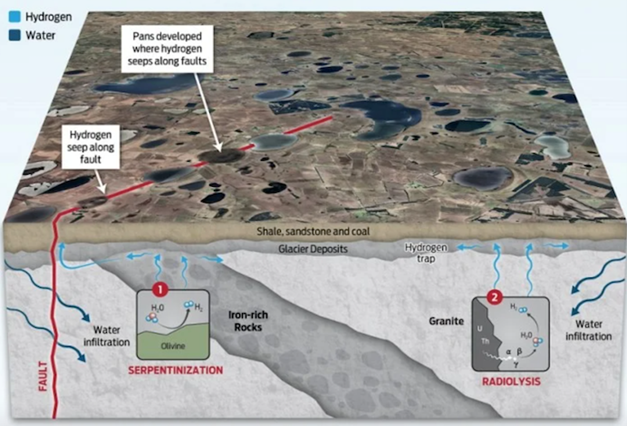
- Generation – It occurs as a free gas in geology, produced by
- Serpentinisation, the interaction of water and iron-containing rocks.
- Radiolysis of water by radioactive rocks, and from organic matter at depth.
- Helium co-exists with hydrogen in a few reserves points that radiolysis plays a role in its generation.
- Discovery – It was 1st discovered by accident in Mali, contains no carbon and produces only water when burned.
- Areas for geological hydrogen generation – Gas seeps, volcanic outgassing, mines and in also in active mountain ranges with tectonic activity
- Examples: The Pyrenees, Alps, and Himalayas
- Current reserves – Hundreds of hydrogen seeps have been in various countries, including Spain, France, Albania, Colombia, South Korea, Canada and
- Australia - Eyre Peninsula and Kangaroo Island
- United States - Kansas, Nebraska
|
Favourable Geological Structures for Natural Hydrogen in India
|
- Hard rock formations of diverse ultramafic/mafic and basaltic assemblages
- Andaman and Himalayan ophiolite complexes
- Greenstone volcanic-sedimentary sequences in cratons (Dharwar, Singhbhum)
- Sedimentary basis (for example, in Vindhyan, Cuddapah, Gondwana and Chhattisgarh)
- Basement rocks with fractures
- Areas where active hydrothermal systems as represented by hot springs exist
|
- Current production – It is manufactured mostly from natural gas through an energy-intensive and polluting process.
Production of Green Hydrogen involves a process that involves splitting water into hydrogen and oxygen using renewable electricity.
- Significance – If harvested in a sustainable manner, it may provide a clean and potentially low-cost fuel.
Quick Facts
- Serpentinization – It is a geological process where ultramafic rocks, rich in minerals like olivine and pyroxene, are altered by water and converted into serpentine minerals which releases hydrogen gas during the process.
- Radiolysis – It is the process in which subatomic particles naturally emitted by radioactive rocks such as granite cause certain molecules to break apart, releasing hydrogen.
Reference
The Hindu| Potential of Natural Hydrogen Fuel


