10. “BRICS acts as a powerful counterweight in global governance, actively amplifying the voice and influence of the Global South.” Explain the role of BRICS in projecting itself as an alternative to other groupings. (150 words, 10 marks)
Directions: Intro----role of BRICS------Conclusion.
Introduction:
Brief about BRICS.
Main Body
Role of BRICS
- Alternative to Western-dominated economic institutions – like the IMF, World Bank, WTO and UN.
- Political security – Alternative voice on global political issues like multilateralism, international security, reform of global institutions, etc.
- Alternative financial architecture - New Development Bank (NDB), de-dollarisation, promotes use of national currencies.
- Strategic resources like critical minerals,
- Reduces the global North-South divide
- Promoting South-South cooperation.
Conclusion:
Give a balanced and positive conclusion.
11. Discuss the position of the Governor in the federal polity of India. What is the nature of his power while giving assent to a bill passed by the State Legislature? Is he bound by the aid and advice of his Council of Ministers in all his functions? (15 marks, 250 words)
Direction: Intro---- position of the Governor + Power to assent to bills + Is bound by aid and advice--------Conclusion.
Introduction:
Briefly describe the office of the Governor.
Main Body
Position of the Governor in the federal polity of India
- Constitutional head of the State – Articles 153, 154 - the Governor is the nominal executive head of the State.
- Act as a link between Union and State – Holds office during the President's pleasure and is an important institutional link between the Union and the State.
- Parliamentary, not presidential, authority – Article 163 provides for a Council of Ministers headed by the Chief Minister to aid and advise the Governor, except where the Constitution requires him to exercise discretion.
- Constitutional safeguard – The Governor has certain functions intended to protect constitutional governance; thus, the Governor is neither merely an agent of the Union nor an entirely independent constitutional authority.
Governor's power regarding assent to bills
- Article 200 – When a Bill passed by the State Legislature is presented to the Governor, the Governor has three substantive constitutional choices
- Give assent to the Bill.
- Withhold assent.
- Return the bill: In the case of a non-Money Bill, the Governor may also return it to the Legislature for reconsideration.
- Reserve the Bill for consideration of the President.
Is the Governor bound by aid and advice in all functions?
- No, the Governor is not bound by the aid and advice of the Council of Ministers in all functions.
- While Article 163(1) states that there shall be a Council of Ministers with the Chief Minister at the head to aid and advise the Governor, it explicitly adds a caveat: "except in so far as he is by or under this Constitution required to exercise his functions or any of them in his discretion."
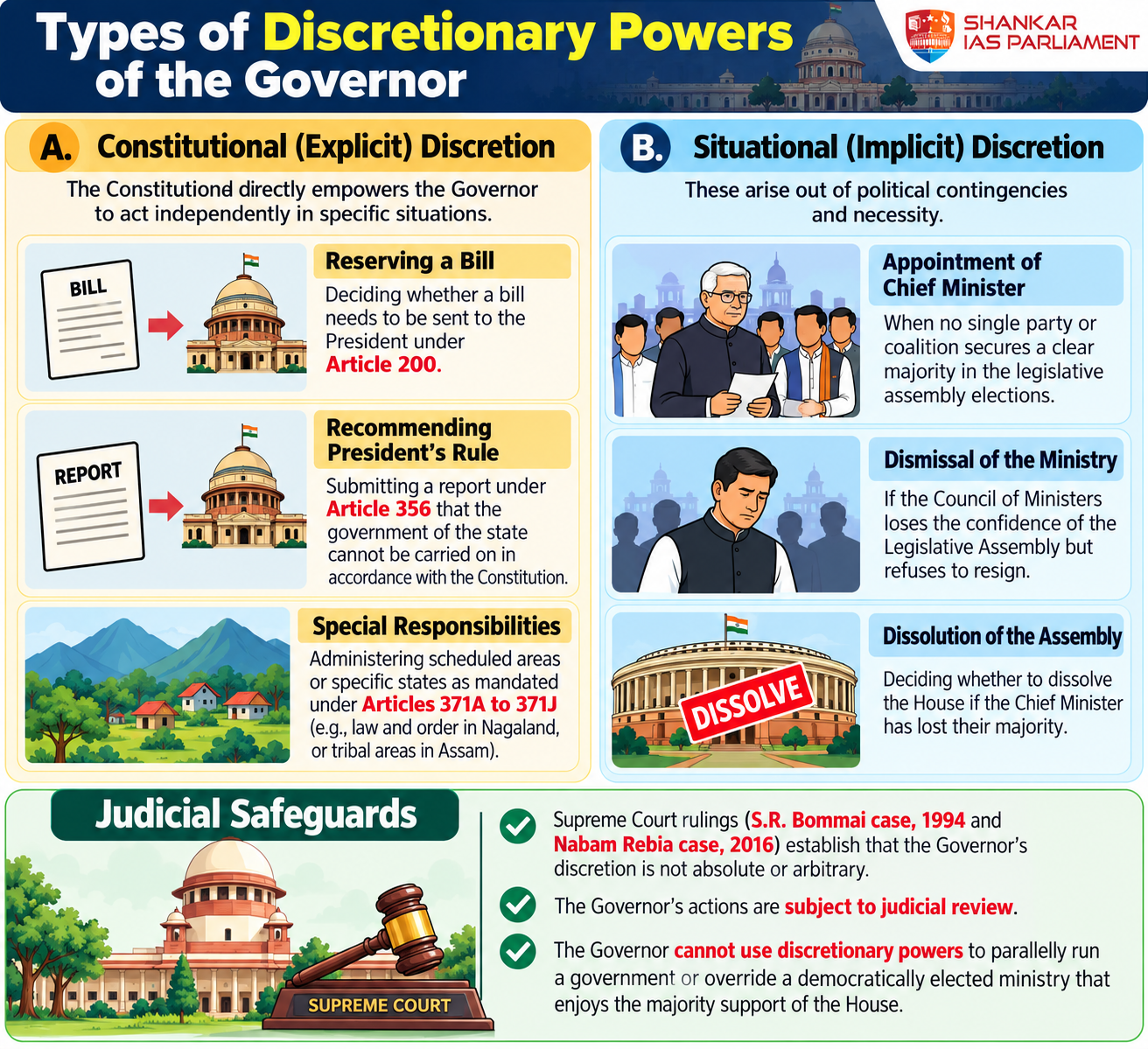
Conclusion:
Give a balanced conclusion.
12. What is meant by judicial legislation? In this context, discuss the verdicts of the apex court allowing "passive euthanasia" and a "living will". (15 marks, 250 words)
Direction: Intro----Verdicts of the apex court------Conclusion.
Introduction:
Describe Judicial legislation and give some examples.
Judicial legislation refers to a situation where courts lay down rules, guidelines or procedures in an area where legislation is absent or inadequate. It does not mean that courts formally assume the legislative power of Parliament.
Rather, the judiciary fills a legal vacuum to protect constitutional rights, subject to constitutional limits.
Examples: Vishaka v. State of Rajasthan (1997),
Main Body
Verdicts of the apex court: passive euthanasia and living will
- Passive euthanasia – Withholding or withdrawing life-sustaining medical treatment, allowing the underlying illness to take its natural course.
- Living Will – Legally referred to as an Advance Medical Directive (AMD), is a document through which a competent person specifies in advance what medical treatment they would or would not want if, in the future, they become incapable of making or communicating such a decision.
Key verdicts
- Aruna Shanbaug v. Union of India (2011) – Recognised passive euthanasia and established interim, High Court-supervised procedures for withdrawing life support in the absence of legislation.
- Common Cause v. Union of India (2018) – Ruled that the right to die with dignity falls under Article 21, officially sanctioning passive euthanasia and living wills (advance medical directives) while laying down a detailed administrative execution mechanism.
- Whereas, Active euthanasia, such as deliberately administering a lethal substance to cause death, remains unlawful.
- Harish Rana v. Union of India (2026) – Providing a substantive application of the framework, the Court permitted the withdrawal of Clinically Assisted Nutrition and Hydration for a long-term vegetative state patient under the "best interests" standard.
- The Court stressed that withdrawal of treatment does not mean abandonment. The patient must continue to receive appropriate palliative and end-of-life care.
Conclusion:
Give a positive conclusion.
The Supreme Court has transformed the right to die with dignity from a purely philosophical claim into a constitutionally protected end-of-life right under Article 21.


