1. The right to privacy relating to self-identity is very dear to every human being and well protected under Article 21 of the Constitution. In this context, examine the effect of the amendment in 2026 to the Transgender Persons (Protection of Rights) Act, 2019. (150 words, 10 marks)
Directions: Intro-------Amendments & effects------Conclusion.
Introduction:
Describe Transgender Persons (Protection of Rights) Amendment Act, 2026.
Mention NALSA v. Union of India (2014) & K.S. Puttaswamy case (2017).
Main Body
Key amendments
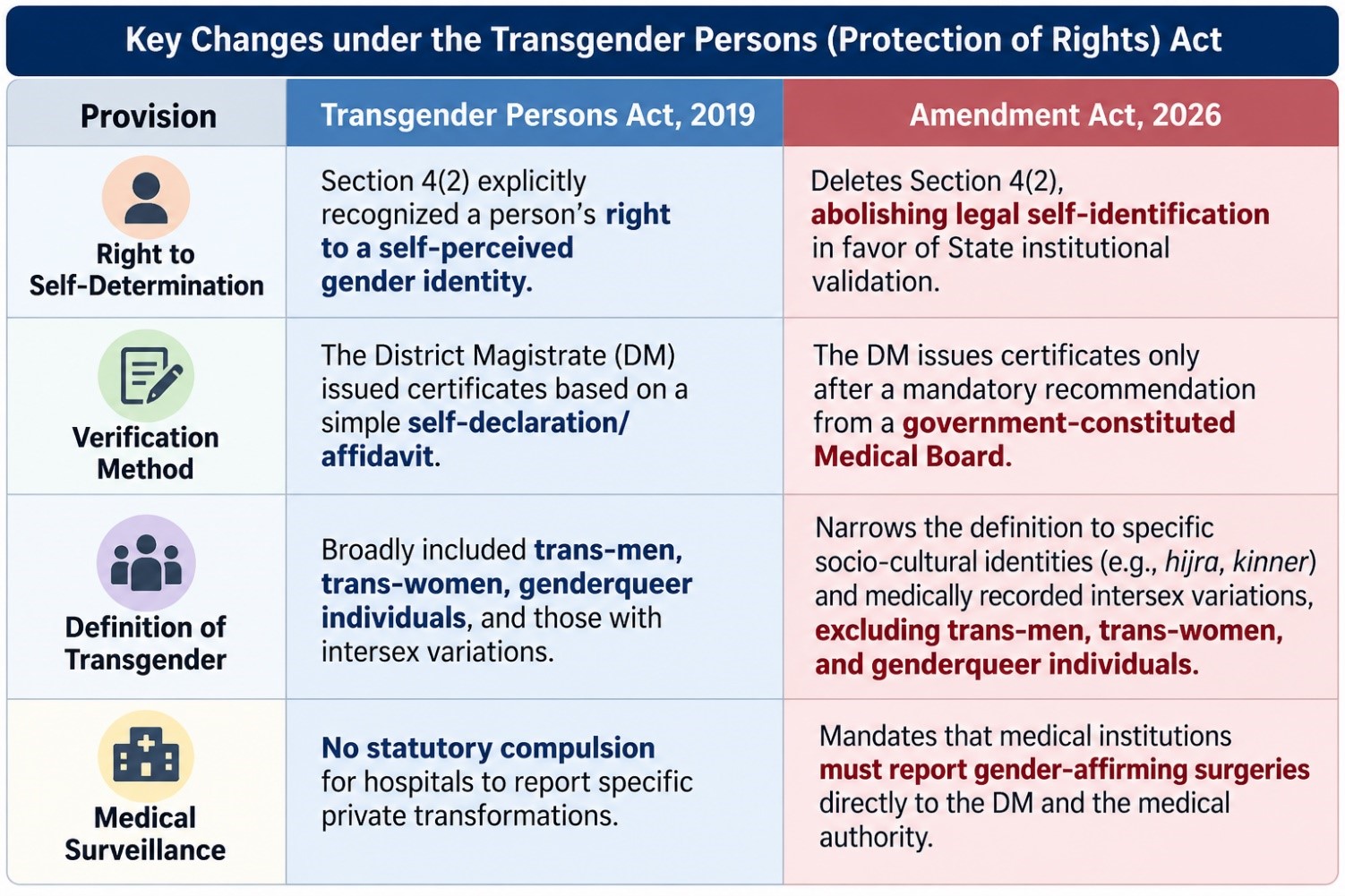
- Removes the explicit right to self-perceived gender identity
- Removes trans-man, trans-woman and genderqueer from the specified categories
- Medical Board recommendation required before the District Magistrate issues a transgender identity certificate
- Gender-change certification is linked to gender-affirming surgery, with hospitals required to furnish information to authorities
- No specific statutory appeal mechanism for denial of identity certification
- Adds stringent penalties for forced castration, mutilation, kidnapping and forced assumption of transgender identity
Effects on Article 21
- From self-identification to medical/institutional verification – Creates a potential tension with NALSA, where the Supreme Court placed self-determination at the heart of personal autonomy.
- Privacy & bodily autonomy – Mandatory medical verification may expose sensitive health information to state scrutiny, raising concerns over privacy, bodily autonomy and self-determined gender identity.
- Dignity & identity – Institutional verification may create a gap between self-perceived identity and legally recognised identity, affecting dignity and personal autonomy.
- Equality & non-discrimination – A narrower definition may exclude groups previously covered, raising Article 14 concerns about reasonable classification and equal protection.
- Positive Effect – Protection from Coercion – Stronger penalties for kidnapping, grievous injury, forced castration and forced assumption of transgender identity, especially involving children, enhance protection against exploitation.
Conclusion:
Give a balanced conclusion.
The 2026 amendment shifts from an autonomy-centred model towards a verification-centred model of transgender legal recognition.
But the increased medical scrutiny raises important questions concerning the constitutional guarantees of privacy, dignity, autonomy and personal identity under Articles 14, 19 and 21.
2. “Women as a class neither belong to a minority group nor are they regarded as forming a backward class.” In the light of this statement, discuss the evolution of women's reservation from local bodies to Parliament. (150 words, 10 marks)
Directions: Intro-------Evolution-----Conclusion.
Introduction:
Start with Women's reservation (or) Population of women (or) women's empowerment.
Main Body
Evolution of women's reservation:
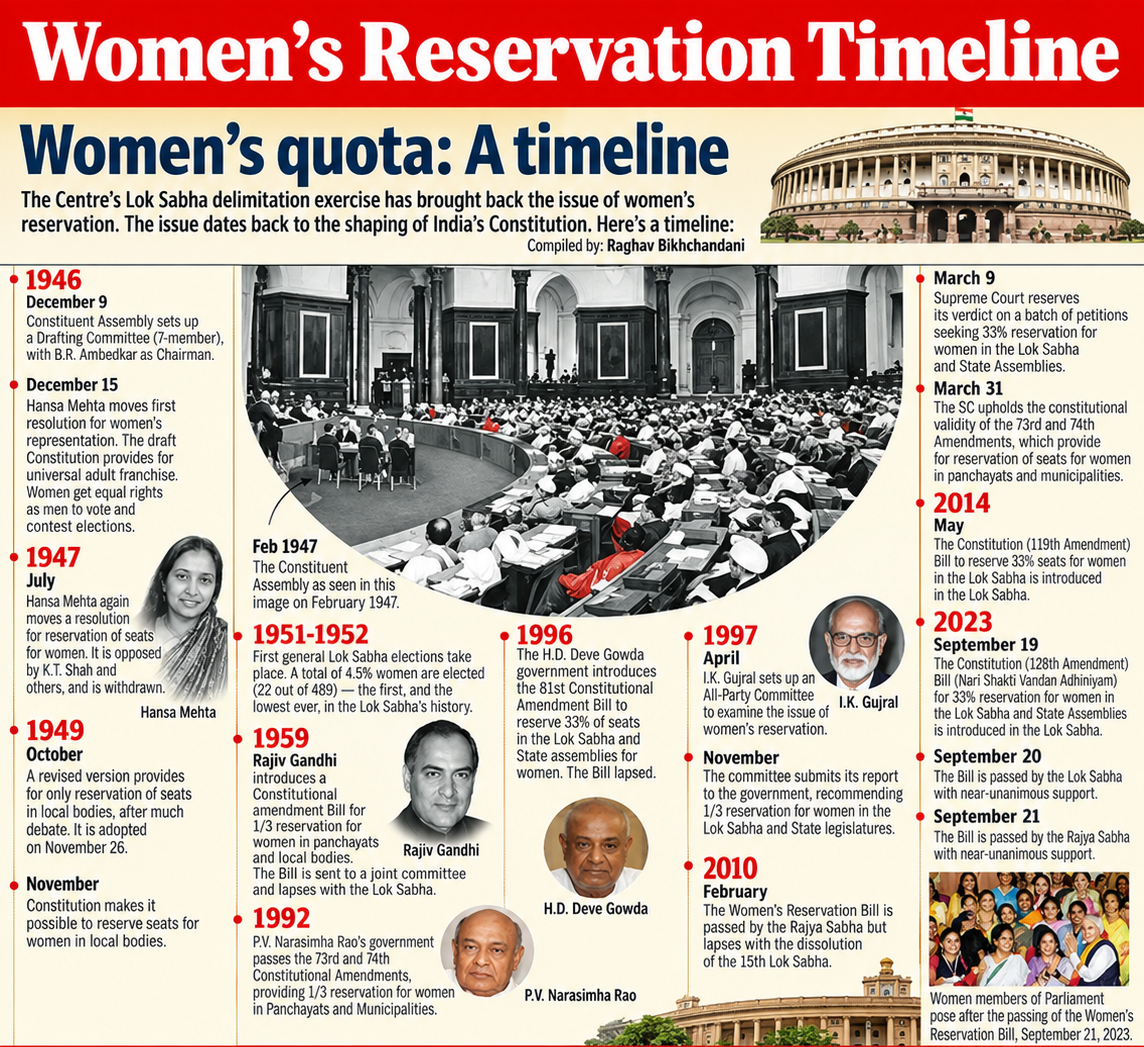
- Grassroots Beginnings (1980s–1990s)
- 1983 – Karnataka pioneered reservation for women in local governance; other states followed.
- 73rd & 74th Amendments (1992–93) – Mandated 1/3 reservation for women in Panchayats and Municipalities.
- Several States later increased it to 50%, creating a strong base of women political representatives.
- Parliamentary Journey (1996–2010)
- 1996 – First Bill proposed 33% reservation in Parliament and State Assemblies; faced demands for an OBC sub-quota.
- 1998–2003 – Reintroduced repeatedly but lapsed amid lack of consensus.
- 2010 – Bill passed by Rajya Sabha, but did not clear Lok Sabha.
- Constitutional Breakthrough (2023)
- Nari Shakti Vandan Adhiniyam / 106th Amendment Act, 2023 – Provides 1/3 reservation in Lok Sabha and State Assemblies, including within SC/ST reserved seats.
- Implementation – Linked to the Census and subsequent delimitation.
Conclusion:
Give a balanced positive conclusion.
The journey of women's reservation shows that while women do not fit the orthodox definitions of a "minority" or a "backward class,".
India has shifted its approach from viewing women merely as beneficiaries of local welfare to recognising them as equal stakeholders in national lawmaking.
3. Examine whether the constitutional office of the Lok Sabha Speaker has become vulnerable to partisan politics under the current anti-defection regime. What institutional changes are required to ensure the neutrality of the Lok Sabha Speaker in managing a polarised House? (150 words, 10 marks)
Directions: Intro------- vulnerable to partisan politics + institutional changes-------Conclusion.
Introduction:
About the Speaker.
Main Body
Office of the Lok Sabha Speaker - vulnerable to partisan politics
- Yes – Because the combination of political affiliation, adjudicatory power and the absence of a rigid timeline can create a perception and possibility of partisan influence.
- No – Because the Speaker works under the limits mentioned in constitution, judicial review, procedural fairness and parliamentary conventions provide important safeguards.
Institutional changes required:
- Independent adjudicatory mechanism – Transfer Tenth Schedule cases to an independent tribunal/authority.
- Fixed time limit for disposal of defection petitions
- Strengthen Speaker's institutional independence – Resignation from party positions and greater cross-party consultation.
- Stricter parliamentary rules – Reduce arbitrary discretion through objective rules on motions, voting and legislative scrutiny.
- Effective judicial oversight
Conclusion:
Give a balanced conclusion.


