10. Do you think digital technology promotes social empowerment? Explain with examples. (150 words, 10 marks)
Directions: Intro------ digital technology promotes social empowerment------Conclusion.
Introduction:
Start with answer this question with yes (or) no (Do you think digital technology promotes social empowerment?) & briefly link digital technology with social empowerment.
If Yes & If No
Main Body
Yes, digital technology helps to promote social empowerment –
- Financial Access – UPI, BHIM, digital banking, DBT transfers, JAM trinity, etc.
- Safety & Security – For women, some location tracking apps, CCTV networks, etc.
- Farmers – eNAM, ONDC, PM-KISAN mobile app, Agristack, etc.
- Access to information & education – Free online learning platforms, digital libraries, PM eVIDHYA, DIKSHA platform, etc.
- Access to Government services – Digital public infrastructure such as Aadhaar, DigiLocker and e-governance platforms.
- Empower marginalised groups – Assistive technologies, digital accessibility tools, online services for disabilities.
No, digital technology does not help promote social empowerment –
- Lack of digital infrastructure
- Digital divide
- Lack of technology in rural areas
- Poor internet connectivity
- Digital illiteracy
- Privacy and surveillance concerns
- Misinformation and manipulation
Conclusion:
Give a balanced conclusion based on your stand – Yes (or) No.
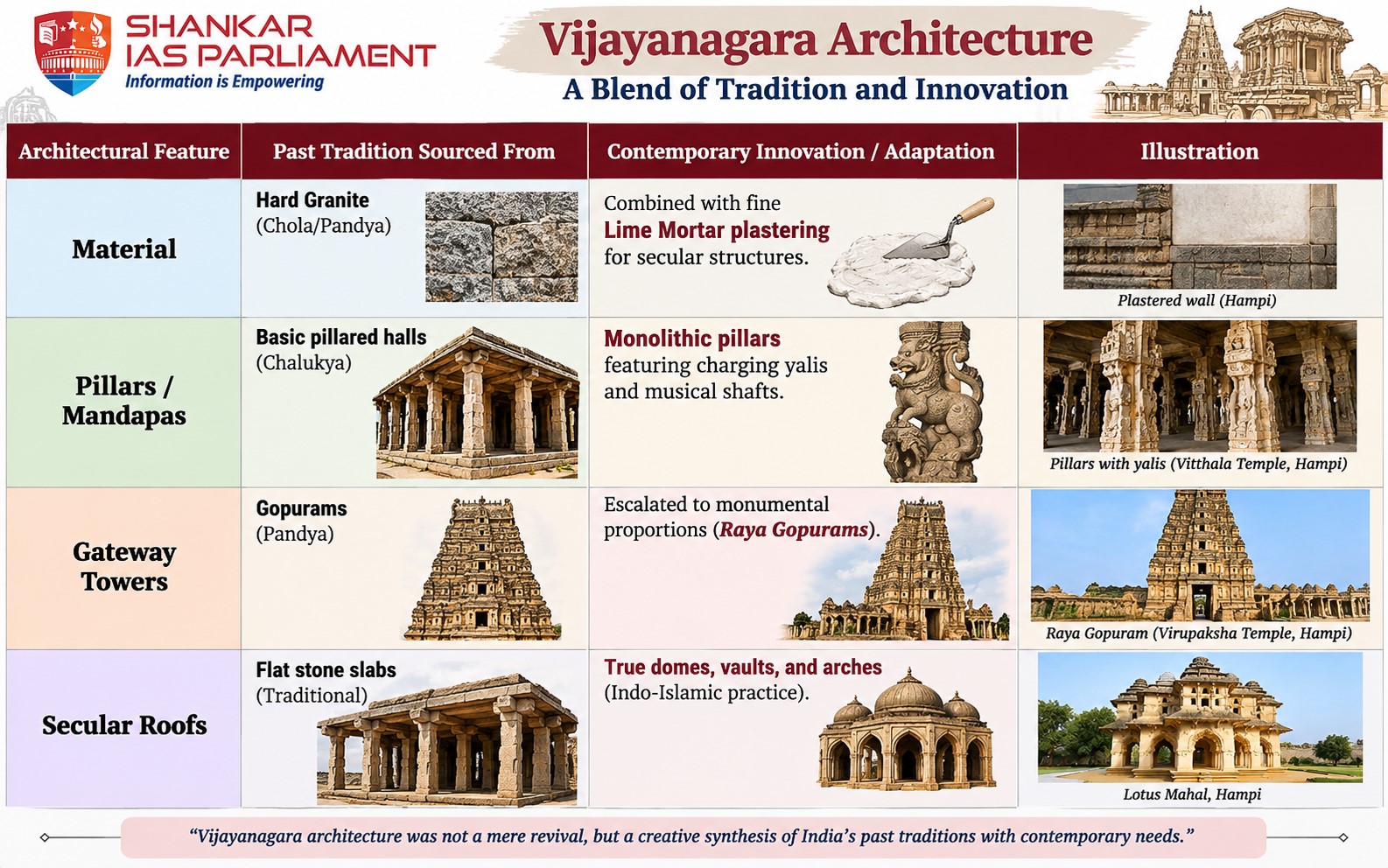
11. Vijayanagara architecture exemplifies the amalgamation of past traditions with contemporary practices. Elucidate with examples. (250 words, 15 marks)
Direction: Intro---- Amalgamation of tradition and contemporary practices------Conclusion.
Introduction:
Describe Vijayanagar empire (14th–16th century).
Vijayanagara architecture - unique "Synthesis of Styles" includes Cholas, Chalukyas, Hoysalas, Indo-Islamic and so on.
Main Body
Past tradition
- Dravidian temple style – Tall gopurams, mandapas and vimanas - traditions of the Chola and Pandya periods. Eg: Raya Gopuram of Virupaksha Temple, Hampi, Kalyana Mandapa of the Vithala Temple, Hampi.
- Hoysala influence – Large temple complexes with elaborate sculptures & introduced the yali. Eg: Hazara Rama Temple - extensive narrative reliefs depicting the Ramayana,
- Chalukya influence – Intricate sculptural detailing, star-shaped elements and experimentation with temple spaces – large water structures. Eg: The Achyutaraya Temple.
Contemporary Practice & adoptions
- Open, elaborate mandapas & pillared halls – Rituals, festivals, music and public gatherings. Eg: The 100-pillared & 56-pillared structures at Hampi.
- Musical pillars – Vitthala Temple's musical pillars - innovative combination of architecture, craftsmanship and performing arts.
- Integration of secular architecture – Like palaces, bazaars, water-management structures and military buildings. Eg: King’s Audience Hall, Elephant Stables in Hampi.
- Arches, Domes, and Vaults – Adopted the arcuated system utilised by contemporary Muslim kingdoms. Eg: Lotus Mahal, recessed Islamic-style arches layered with plaster decoration, series of distinct pyramidal domes.
- Urban planning – Temple complexes along with markets, roads, tanks and residential areas. Eg: The Vitthala Temple–bazaar complex at Hampi.
Conclusion:
Give a balanced conclusion.
Vijayanagara architecture managed to remain deeply rooted in sacred Hindu aesthetics while mirroring the cosmopolitan, secure, and grand realities of its era.
12. Linguistic reorganisation of Indian States was driven by popular pressure from below. Comment. (250 words, 15 marks)
Direction: Intro-----Yes (or) NO------Conclusion.
Introduction:
Describe the linguistic reorganisation of Indian States.
Start with answer this question with Yes (or) No – for “Comment”.
Main Body
Yes, Linguistic reorganization of Indian States was driven by popular pressure from below –
- Andhra Movement - Potti Sriramulu's fast unto death (1952)
- Samyukta Maharashtra Movement (1956–60)
- Punjabi Suba movement (1950s & 60s)
- Mahagujarat Movement (1960)
- Eikikarana movement, Karnataka (around 1956)
Outcomes
- Dhar Commission (1948)
- JVP Committee (1949)
- States Reorganisation Commission (1953)
- States Reorganisation Act (1956)
- Bifurcation of Bombay (1960)
- Shah Commission (1966)
- Official Languages Act (1963)
No, Linguistic reorganization of Indian States was driven by popular pressure from below –
- Role of national leadership – Leaders like Jawaharlal Nehru and Vallabhbhai Patel initially resisted immediate linguistic reorganisation.
- Dhar Commission (1948) – Reorganised primarily on the basis of administrative convenience rather than language.
- JVP Committee (1949) – Advised against immediate linguistic reorganisation; popular demand was not automatically accepted.
- States Reorganisation Commission (1953) – Fazl Ali Commission systematically examined linguistic identity along with administrative efficiency, economic viability and national interests.
- States Reorganisation Act, 1956
- Language was not the only criterion – Economic viability, administrative convenience, geographical contiguity, security and national integration.
- Centre mediated competing claims – Disputes over territories and capitals required negotiations and decisions by the Union government.
- Some later states were created on non-linguistic grounds – Jharkhand, Chhattisgarh and Uttarakhand (2000).
Conclusion:
Give a balanced conclusion based on your stand – Yes (or) No.


