0.0691
7667766266
x

Mains PYQs - GS-II (2025) (Q. 10 - 12)

iasparliament Logo
July 29, 2026

10. “With the waning of globalisation, the post-Cold War world is becoming a site of sovereign nationalism." Elucidate. (150 words, 10 marks) (2025)

Direction: Intro-----Waning of globalisation + Rise of sovereign nationalism ------ Conclusion.

Introduction:

Describe globalisation and link it to the post-Cold War era.

Main Body

Waning of globalization

  • Economic problems – Job loss, trade wars, increase in tariffs, etc.
  • Disruption of supply chain – COVID pandemic, Russia – Ukraine war, etc.
  • Paralysed/disruption in world institutions – Ineffective functioning of UN, WTO, etc. USA’s withdrawal from major institutions, etc.
  • Regionalism replacing globalisation.

Rise of sovereign nationalism

  • Strategic autonomy
  • Political sovereignty – Eg., Brexit (2016)
  • Economic nationalism & self-reliance – Eg. US’s America First policy
  • Border security
  • Cultural identity
  • Resource security – Crude oil, rare earth elements, etc.

Conclusion:

Conclude with the balanced view – in Post cold war, the sovereign nationals has reemerged as a dominant force….which helps in transforming the international system.


11. “Constitutional morality is the fulcrum which acts as an essential check upon the high functionaries and citizens alike…”

In view of the above observation of the Supreme Court, explain the concept of constitutional morality and its application to ensure balance between judicial independence and judicial accountability in India. (250 words, 15 marks) (2025)

Direction: Intro-----Concept + Application-------Conclusion.

Introduction:

Define constitutional morality with examples – Liberty, equality, fraternity, judicial review, etc.

Main Body

Concept of constitutional morality

  • Coined by George Grote and elaborated by Dr B.R. Ambedkar, it requires constitutional authorities to exercise power with restraint, integrity, and accountability.
  • Upholding the supremacy of the Constitution
  • Respecting the rule of law and constitutional limitations.
  • Protecting Fundamental Rights, dignity, equality, and liberty.
  • Ensuring accountability, transparency, and institutional integrity.
  • Promoting democratic values, separation of powers, etc.

Application to ensure balance between judicial independence & judicial accountability
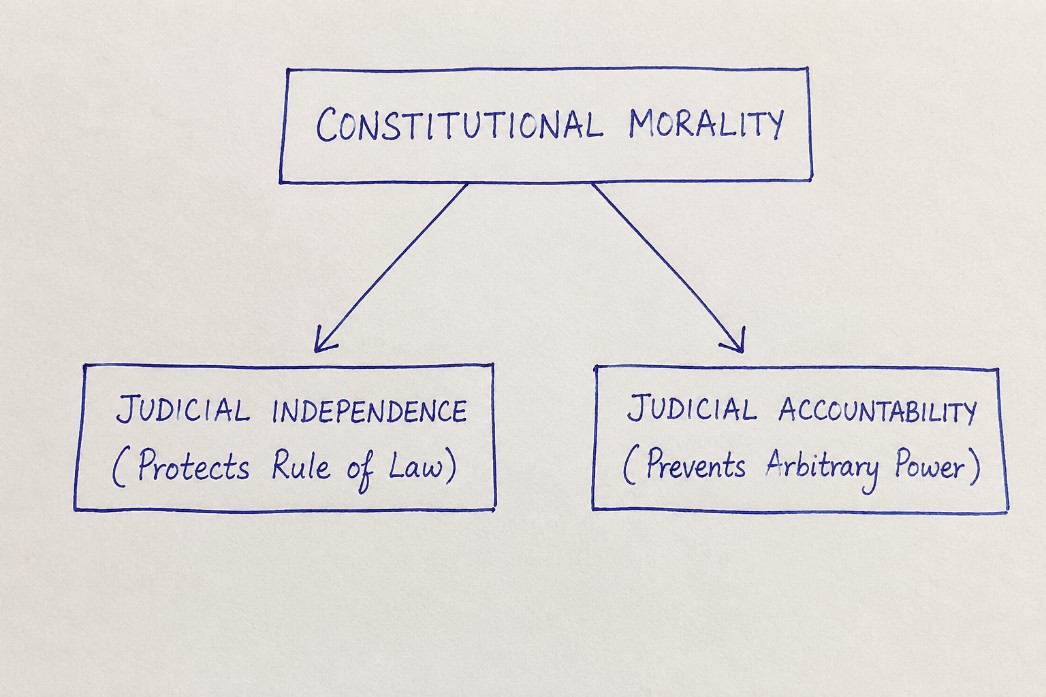
Constitutional Morality.UPSC

  • Checking the Collegium System – Retains control over appointments; Constitutional morality demands that this process not be opaque or nepotistic.
  • Regulating the "Master of Roster" Power – The Chief Justice of India (CJI) has sole authority to allocate cases; Constitutional morality demands that case assignment follow fair, predictable guidelines.
  • Defining Judicial Activism vs Judicial Overreach – Constitutional morality draws a strict line at the Separation of Powers and demands judicial self-restraint.
  • Managing Contempt of Court Powers – Constitutional morality ensures the contempt of Court power is used to protect the institution, not the egos of individual judges.
  • Recusal – Judges must follow constitutional morality by recusing in cases of bias to uphold public confidence.

Conclusion:

Conclude in a positive manner – conclude with constitutional morality (or) all the three organs of the government must adhere with constitution, etc.


12. Indian Constitution has conferred the amending power on the ordinary legislative institutions with a few procedural hurdles. In view of this statement, examine the procedural and substantive limitations on the amending power of the Parliament to change the Constitution. (Answer in 250 words, 15 marks) (2025)

Direction: Intro----- Procedural & substantive limitations-----Conclusion.

Introduction:

Describe the amendment provision of the Constitution.

Main Body

Procedural & substantive limitations on the amending power
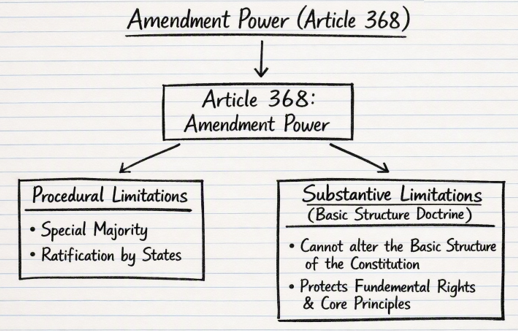
Amendment Power.UPSC

Procedural Limitations

  • Special Majority.
  • No Joint Sitting.
  • Federal Consent – Ratification of half of the states.
  • No veto power for president.
  • Subject to judicial review.

Substantive Limitations

  • Basic Structure Doctrine.
  • Judicial review.
  • Limited constituent power for Parliament.
  • Preservation of Constitutional Identity.

Conclusion:

Conclude by giving a balanced conclusion – India is a constitutional sovereignty, not parliamentary sovereignty (or) mention BR Ambedkar’s words about constitutional amendments, etc.


Login or Register to Post Comments
There are no reviews yet. Be the first one to review.
