0.0689
7667766266
x

Mains PYQs - GS-1 (2025) (Q. 10 - 12)

iasparliament Logo
July 18, 2026

10. Do you think that globalisation results in only an aggressive consumer culture? Justify your answer. (150 words, 10 marks) (2025)

Direction: Intro------Arguments in favour + Arguments against-------Conclusion.

Introduction:

Define Globalisation – impacts economic, culture and society. Link with growth of aggressive consumer behaviour and reaches beyond consumerism.

Main Body

Yes, it encourages aggressive consumer culture

  • Global Brands
  • Mass marketing
  • Social media influence
  • Fast fashion
  • Digital platforms - e-commerce portals.
  • Debt-driven lifestyle – Credit cards, EMI, etc.
  • Cultural Homogenization.

No, not only encourages, but it goes beyond it

  • Economic growth
  • Employment generation
  • Cultural exchange
  • Knowledge & technology transfer
  • Social Inclusion & awareness
  • Development of startup ecosystem.

Conclusion:

Give a neutral conclusion – as it leads to economic growth & integration, aligns with Atmanirbhar Bharat, consumerism is good, but aggressive consumerism is not, etc.


11. Mahatma Jotirao Phule’s writings and efforts of social reforms touched issues of almost all subaltern classes. Discuss. (250 words, 15 marks) (2025).

Direction: Intro--------Contributions to the subaltern classes------Conclusion.

Introduction:

Write briefly about Jotirao Phule (1827-1890) & mention who all the subaltern classes are (women, depressed classes, children, peasants, etc.).

Main Body

Contribution to subaltern classes

  • Women & Children – Widow remarriage, opened 1st girls' schools in Pune (1848), opened Balhatya Pratibandhak Griha (Home for the Prevention of Infanticide), opposed child marriage, etc.
  • Depressed classes/Dalits – Worked for upliftment of these classes, Gulamgiri, 1873 (caste-based slavery work), Sarvajanik Sathya Dharma Pustak.
  • 1st to mention the word Dalit for Depressed class.
  • Sathya Sodhak Samaj & promoted education for all marginalised.
  • Peasants – Book ‘Shetkarayacha Asud’ (The Whipcord of the Cultivator, 1883) - upper-caste moneylenders (shets), corrupt revenue officials; advocated for practical agricultural reforms.
  • Working Class – Vocational training centres, demanded fair wages, etc.

Conclusion:

Mention Phule’s influence in the development of modern India’s social development (or) His efforts addressed the multiple issues and influenced many leaders, etc. (or) Mention any quotes.


12. Trace India’s consolidation process during early phase of independence in terms of polity, economy, education and international relations. (250 words, 15 marks) (2025).

Direction: Intro---- India’s consolidation process-----Conclusion.

Introduction:

Mention that India is the youngest democracy, in its earliest phase of independence (1947-1964) – mix of immense challenges and opportunities.

Main Body

Give the Gist in the form of a flowchart/diagram, etc and then explain each point.
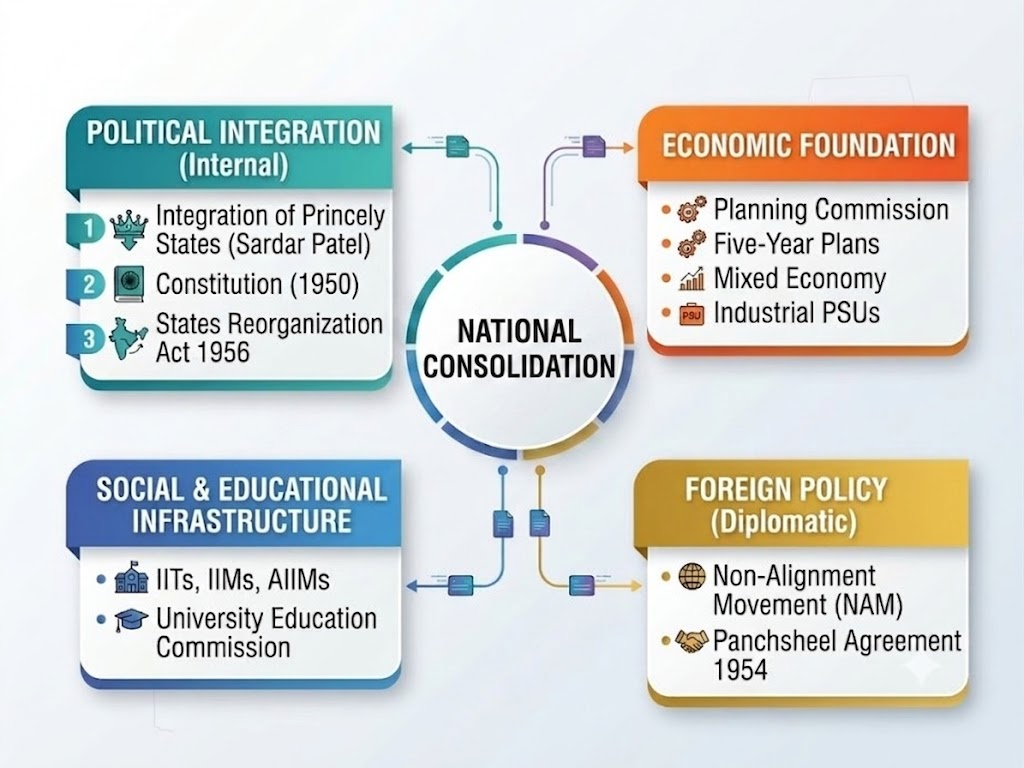
India's consolidation

  • Polity
    • Making, Implementation & adoption of constitution – Jan 26, 1950, etc.
    • Integration of Princely states
    • Reorganisation of States
    • 1st constitutional amendment, 1951.
  • Economy
    • 5 Year planning
    • Planning Commission
    • Adopted mixed economy with tilt towards socialist model
    • Land reform, abolition of zamindaris, etc.
  • Education
    • Radhakrishnan Commission (1948–1949)
    • Establishment of UGC in 1956.
    • Established premier institutions like IITs, AIIMS (1956), etc.
    • Expansion of primary education, adult literacy, etc.
  • International relations
    • Non-alignment Movement
    • Panch Sheel principle, 1954
    • Active participation in UN
    • Nuclear disarmament
    • Membership to Common wealth.

Conclusion:

Link the early phase and the present times – As the early phase works as a strong foundation for modern developments, active role in international level, active voice for global south, etc.


Login or Register to Post Comments
There are no reviews yet. Be the first one to review.
