Why in News?
Recently, The Swachhata Hi Seva (SHS) 2026 campaign was launched.
The Big Picture – India’s Sanitation Journey
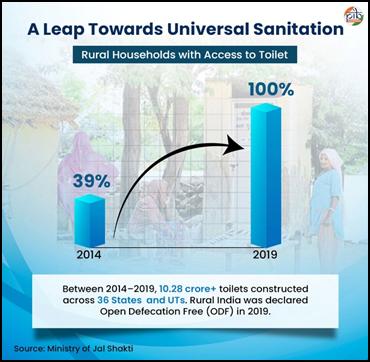
- 2014 Baseline – Rural sanitation coverage stood at just 39%.
- 2019 Achievement – Rural India declared 100% Open Defecation Free (ODF).
- Over 10.28 crore toilets constructed across 36 States/UTs between 2014 and 2019.
- The Shift (SBM-G Phase II) – Moved focus from basic toilet access to sustainability and Solid and Liquid Waste Management (SLWM).
Key Milestones and Progress (As of September 2026)
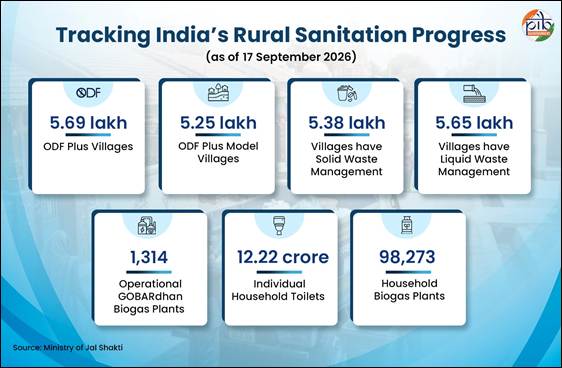
- ODF Plus Villages – 5.69 lakh total ODF Plus villages nationwide.
- 5.25 lakh have achieved top-tier ODF Plus Model status.
- Waste Management Systems –
- 5.38 lakh villages with Solid Waste Management (SWM).
- 5.65 lakh villages with Liquid Waste Management (LWM).
- GOBARdhan Biogas – 1,314 operational biogas plants across 582 districts.
- Household-Level Infrastructure – 12.22 crore individual toilets and 98,273 household biogas plants built.
ODF Plus Village Classifications
- An ODF Plus Village sustains ODF status, manages waste, and stays visually clean through 3 stages –
- Aspiring – Manages either solid or liquid waste.
- Rising – Manages both solid and liquid waste.
- Model – Manages both waste streams, maintains visual cleanliness, and displays ODF Plus messaging.
Behaviour Change – Building Habits, Not Just Toilets
- Core Philosophy – True transformation relies on everyday habits using, maintaining, and sustaining toilets.
- Key Focus Areas –
- Safe toilet usage and maintenance.
- Managing wet waste via compost pits or biogas.
- Everyday hygiene – handwashing, safe water storage, and zero public littering/spitting.
Women as the Primary Agents of Change
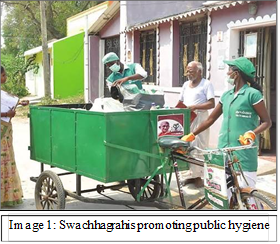
- Swachhagrahis and SHGs – Special preference given to women for door-to-door outreach, awareness, and cleanliness verification.
- Real-World Impact –
- Howrah (West Bengal) – SHGs collected 9.32 tonnes of plastic waste across 18 Ganga-adjacent Gram Panchayats in 18 days.
- Gorakhpur (Uttar Pradesh) – SHG women operate a Resource Recovery Centre—converting wet waste into vermicompost and selling dry waste for income.
- Bhopal (Madhya Pradesh) – A Cluster Level Federation runs a Material Recovery Facility in partnership with SBM-G to trade plastic waste.
Schools and Youth – Building Cleanliness as a Sanskaar
- School-to-Home Cycle – Children learn waste segregation and hygiene at school, then bring these habits into their households.
- Local Initiatives –
- Chandil (Jharkhand) – A school banned single-use plastic and built soak pits for greywater.
- Child Cabinets (Jharkhand) – Students manage Menstrual Hygiene Management (MHM) stock; Kasturba Gandhi Balika Vidyalaya established a dedicated MHM lab.
- Swachhata Hi Seva 2026 Focus – Youth-led initiatives including Swachhata Gyan Yatras, School Samvads, and learning SWM Rules, 2026.
Local Governance – Gram Panchayats and VWSCs
- Gram Panchayats (GPs) – Responsible for planning, implementation, Information/Education/Communication (IEC), and community mobilization.
- Village Water and Sanitation Committees (VWSCs) – Support village-level supervision and execution.
- Success Story (Gadli GP, Haryana) –
- Achieved ODF Plus Model status led by Sarpanch Kanta Kanwar.
- Built community toilets, a village drainage network, and a 5-pond greywater treatment system.
- Integrated GOBARdhan plants to generate agricultural manure and biogas.
Jan Bhagidari and The "Swachhata Hi Seva" Campaign
- Institutional Support – Funding pooled from Government allocations, Finance Commission grants, and Viksit Bharat-Gramin programs.
- Swachh Sanivara (Karnataka) – Community cleanliness drive held on the first Saturday of every month for schools, temples, and public spaces.
Swachhata Hi Seva (SHS) Annual Campaign –
- 2025 Participation – Over 18.06 crore citizens participated.
- SHS 2026 Theme – "Swachhata Mein Sahbhag; Swachh Bharat, Viksit Bharat" (Starts Sept 17).
- Key Events – Ek Din, Ek Ghanta, Ek Saath collective shramdaan (Oct 1) and Special Gram Sabhas (Oct 2).
The Sanitation Economy and Livelihood Opportunities
- Waste Collection (Betul, Madhya Pradesh) – Babita Dhurve became the district’s first female e-rickshaw waste collector, inspiring ~100 GPs in Betul to deploy collection vehicles.
- Masons and Skilling (Nadia, West Bengal) – Two masonry training institutes were created, training 2,400 men and women in specialized toilet construction.
- Resource Recovery (Vedancha, Gujarat) –
- System treats 200 KL of greywater daily for irrigation and groundwater recharge.
- GP earns Rs.2.5 lakh annually through compost and treated water sales while reducing waterborne diseases.
Reference
PIB



