Prelims: Current events of national and international importance | Science & Technology
Why in News?
Recently, an academia-industry collaboration decoded the multi-target molecular mechanism through which common preservatives eliminate bacteria.
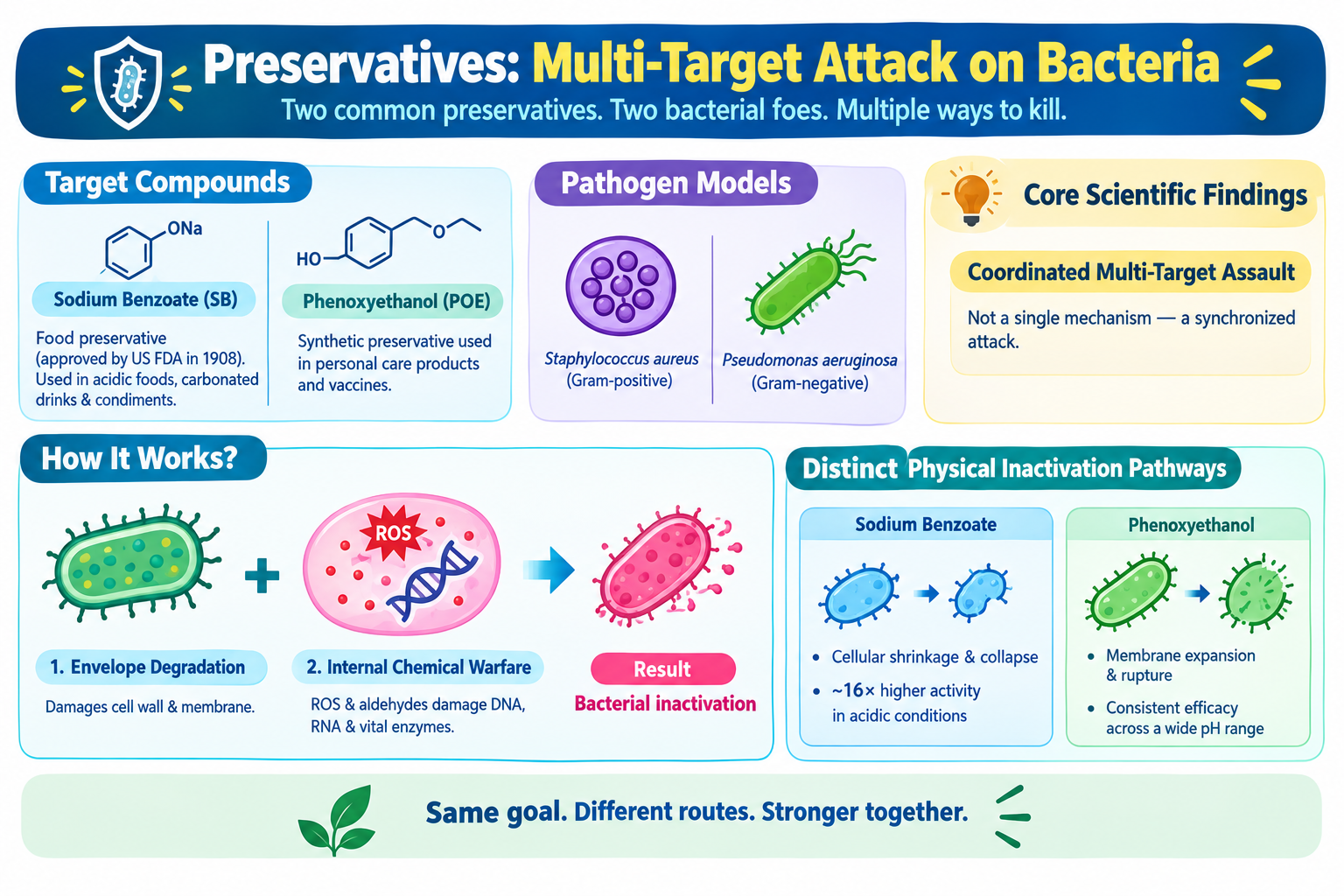
Target Compounds
- Preservative Models
- Sodium Benzoate (SB) - The first food preservative approved by the US FDA (1908); widely used in acidic foods, carbonated drinks, and condiments.
- Phenoxyethanol (POE) - A modern synthetic preservative used extensively in personal care products (shampoos, moisturisers, sunscreens) and vaccines.
- Pathogen Models - Evaluated against both Gram-positive (Staphylococcus aureus) and Gram-negative (Pseudomonas aeruginosa) bacterial strains.
Core Scientific Findings
- Coordinated Multi-Target Assault - Preservatives do not rely on a single killing mechanism.
- Instead, they execute a synchronised attack combining physical envelope damage with intracellular oxidative stress.
- Outer Envelope vs. Intracellular Disruption
- Envelope Degradation - Preservatives compromise the structural integrity of the bacterial cell wall and plasma membrane.
- Internal Chemical Warfare - Triggers the rapid intracellular accumulation of reactive oxygen species (ROS) and reactive aldehydes, damaging DNA, RNA, and vital metabolic enzymes.
- Distinct Physical Inactivation Pathways
- Sodium Benzoate- Induces rapid cellular shrinkage and collapse.
- Its potency is highly dependent on pH, demonstrating a ~16-fold increase in antimicrobial activity in acidic environments (pH<4.5).
- Phenoxyethanol- Triggers membrane expansion and cell rupture.
- It maintains consistent antimicrobial efficacy across a wide pH spectrum.
Industrial Applications
- Provides a mechanistic basis to select optimal preservatives tailored to specific product pH levels and matrix conditions, avoiding over-preservative loading.
- Understanding multi-target pathways helps design synergistic preservative combinations that prevent bacteria from evolving single-target resistance mechanisms.
- Optimizes preservative concentrations in cosmetics, pharmaceuticals, and packaged foods, extending shelf-life while lowering chemical discharge into environmental wastewater.
Reference
PIB | Preservatives and Bacteria



